Use AI to Maintain and Improve the Enterprise Capability Model - Designing, Building, and Maintaining Comprehensive and Usable Enterprise Capability Models
Use AI to Maintain and Improve the Enterprise Capability Model
(Chapter 27 of Designing, Building, and Maintaining Comprehensive and Usable Enterprise Capability Models)
Executive Summary: Chapter Overview
IF4ITThe Bottom Line
Core Concepts
| Concept | Definition & Strategic Role |
|---|---|
| AI-Assisted Quality Monitoring | AI can identify anomalies, gaps, contradictions, duplicate concepts, and stale or weak content. |
| AI-Assisted Enrichment | AI can suggest aliases, descriptions, relationships, tags, classifications, summaries, and publication improvements. |
| Governed Automation | Confidence, evidence, approval, access control, audit trails, and human review constrain what automation may change. |
Quick Q&A
Question: How should AI-generated maintenance suggestions be governed?
Read More Below
Best Practice: Use AI for Gap, Duplicate, and Quality Detection
Description
AI can be used to detect model quality issues that are difficult to find manually at scale. Useful AI-assisted checks include identifying missing capability areas, weak descriptions, vague names, duplicate records, overlapping definitions, inconsistent aliases, incomplete attributes, stale records, contradictory assessment values, and unclear relationship patterns.
AI can also compare the enterprise model against public knowledge, industry patterns, internal documents, application portfolios, process libraries, value-chain descriptions, regulatory obligations, and service catalogs to identify likely gaps or mismatches. These outputs should be treated as recommendations for review, not automatic changes to the governed model.
Benefit(s)
AI-assisted quality detection improves model quality and reduces manual maintenance effort. It helps stewards find issues earlier and across a larger body of model content than a manual review process can usually cover.
This practice also increases the value of review sessions. Instead of asking reviewers to find every problem from scratch, AI can prepare candidate issues for humans to validate, reject, or refine.
Best Practice: Use AI for Relationship Inference
Description
AI can suggest candidate relationships between capabilities and other Enterprise Model Noun Types. For example, AI can propose which Applications may enable a capability, which Value Chain Stages may depend on it, which Processes may realize it, which Data or Information Types may be consumed or produced, which Organizations may own or perform it, and which Risks, Controls, Initiatives, Vendors, Technologies, or Regulatory Obligations may be relevant.
Relationship inference should include confidence indicators and source evidence where practical. Suggested relationships should remain in a proposed or candidate state until reviewed and approved by accountable owners or stewards.
AI can also help suggest semantic predicates, relationship descriptions, relationship attributes, and capability-based metadata for intranet pages, wiki pages, EDMS documents, search indexes, and RAG retrieval stores. These suggestions should remain candidates until validated by humans because relationship meaning directly affects navigation, search, and AI interpretation.
Benefit(s)
AI-assisted relationship inference accelerates Enterprise Model enrichment. It can help populate the relationship graph faster than manual mapping alone and can reveal connections that stakeholders may not initially identify.
This practice also improves impact analysis, knowledge navigation, and AI runtime value because the model becomes more connected and therefore more useful for traversal, summarization, and decision support.
Best Practice: Use AI to Support Assessments and Reviews
Description
AI can support capability assessments and reviews by summarizing evidence, preparing review packets, comparing capability records, identifying weak support patterns, highlighting stale or conflicting attributes, and suggesting assessment questions. AI can also help explain why a capability may appear under-supported, over-supported, strategically important, risky, or misaligned with a target state.
AI should not be the final assessor for governed values such as maturity, health, risk, or strategic disposition. It should support the review process by organizing evidence and surfacing candidate findings for human judgment.
Benefit(s)
Using AI to support assessments and reviews improves review efficiency and assessment quality. Reviewers can spend less time gathering and organizing information and more time making informed judgments.
This practice also improves consistency because AI can apply common prompts, checklists, scoring rubrics, and evidence summaries across many capabilities while still leaving final accountability with humans.
Best Practice: Use Human-in-the-Loop Governance for AI Suggestions
Description
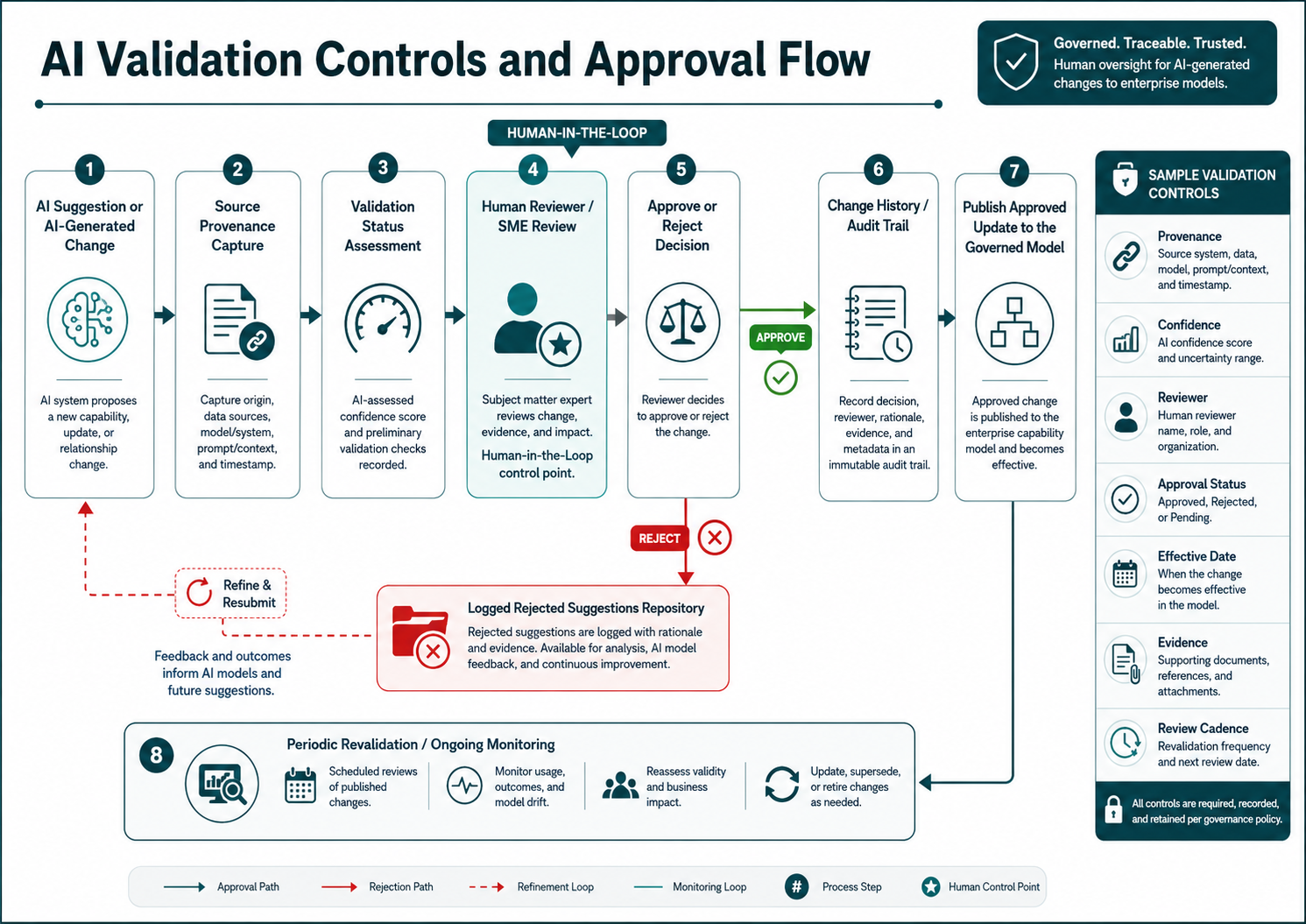
AI suggestions should follow a human-in-the-loop governance process. Suggested capabilities, attribute changes, relationship changes, assessment values, page content, aliases, definitions, and improvement actions should be reviewed, corrected, approved, rejected, routed, or converted into backlog items before becoming authoritative.
The governance process should distinguish between AI-generated, AI-assisted, human-reviewed, approved, rejected, and retired content. Where the enterprise depends on traceability, each accepted AI-assisted change should retain provenance showing how it was generated and who approved it.
Benefit(s)
Human-in-the-loop governance preserves trust, accountability, and safe AI-assisted model maintenance. It allows the enterprise to benefit from AI speed and scale without surrendering authority over enterprise definitions, relationships, assessments, or published knowledge.
This practice also reduces the risk of embedding inaccurate, biased, outdated, or unsupported AI output into the governed Enterprise Model.
Best Practice: Apply AI Validation Controls Before Promoting Model Changes
Description
An Enterprise Capability Model (ECM) may benefit from AI-generated suggestions for new capabilities, renamed capabilities, improved descriptions, duplicate detection, missing relationships, stale attributes, and knowledge-page enrichment. However, those suggestions should not be promoted into the governed model until they pass explicit validation controls. AI output should be traceable, reviewable, correctable, rejectable, and auditable.
| AI Validation Control | Purpose |
|---|---|
| Source Provenance | Identifies the prompts, reference documents, inventories, public sources, or enterprise sources that influenced the AI output. |
| Validation Status | Indicates whether AI-generated content is draft, pending review, approved, rejected, retired, or scheduled for revalidation. |
| Human Reviewer | Identifies the person or role that reviewed, corrected, approved, or rejected the AI suggestion. |
| Confidence / Evidence Flag | Indicates whether the suggestion is well supported, weakly supported, inferred, speculative, or contradicted by trusted evidence. |
| Change History | Records what changed, when it changed, who approved it, and why the change was made. |
| Rejected Suggestion Log | Preserves rejected AI recommendations so they are not repeatedly reintroduced without new evidence. |
| Approved Suggestion Record | Captures accepted AI suggestions as governed changes with traceable rationale. |
| Periodic Revalidation | Ensures AI-generated or AI-assisted model content remains current, accurate, and aligned to enterprise reality. |
Benefit(s)
AI validation controls reduce the risk of hallucinated content, weakly supported relationships, incorrect ownership, outdated descriptions, and unapproved structural changes. They also make the ECM more trustworthy for executives, architects, Knowledge Management professionals, EDMS owners, AI users, and operational teams.
How to cite this page
When referencing this page in academic work, internal standards, or external publications, include the page title, IF4IT as author and publisher (The International Foundation for Information Technology (IF4IT), LLC), the URL, and your access date.
Example (informal web citation):
The International Foundation for Information Technology (IF4IT), LLC. Use AI to Maintain and Improve the Enterprise Capability Model | Designing, Building, and Maintaining Comprehensive and Usable Enterprise Capability Models. https://if4it.org/best-practices/designing-building-and-maintaining-comprehensive-and-usable-enterprise-capability-models/use-ai-to-maintain-and-improve-the-enterprise-capability-model/ (accessed 2026-10-05).
See About Us for content governance and site-wide citation guidance.
Copyright for The International Foundation for Information Technology (IF4IT), LLC: 2008 - Present
Legal Disclaimers