Designing, Building, and Maintaining Comprehensive and Usable Enterprise Capability Models - Use Enterprise Capability Models as Enterprise Knowledge Management Taxonomies
Designing, Building, and Maintaining Comprehensive and Usable Enterprise Capability Models
Chapter 21. Use Enterprise Capability Models as Enterprise Knowledge Management Taxonomies
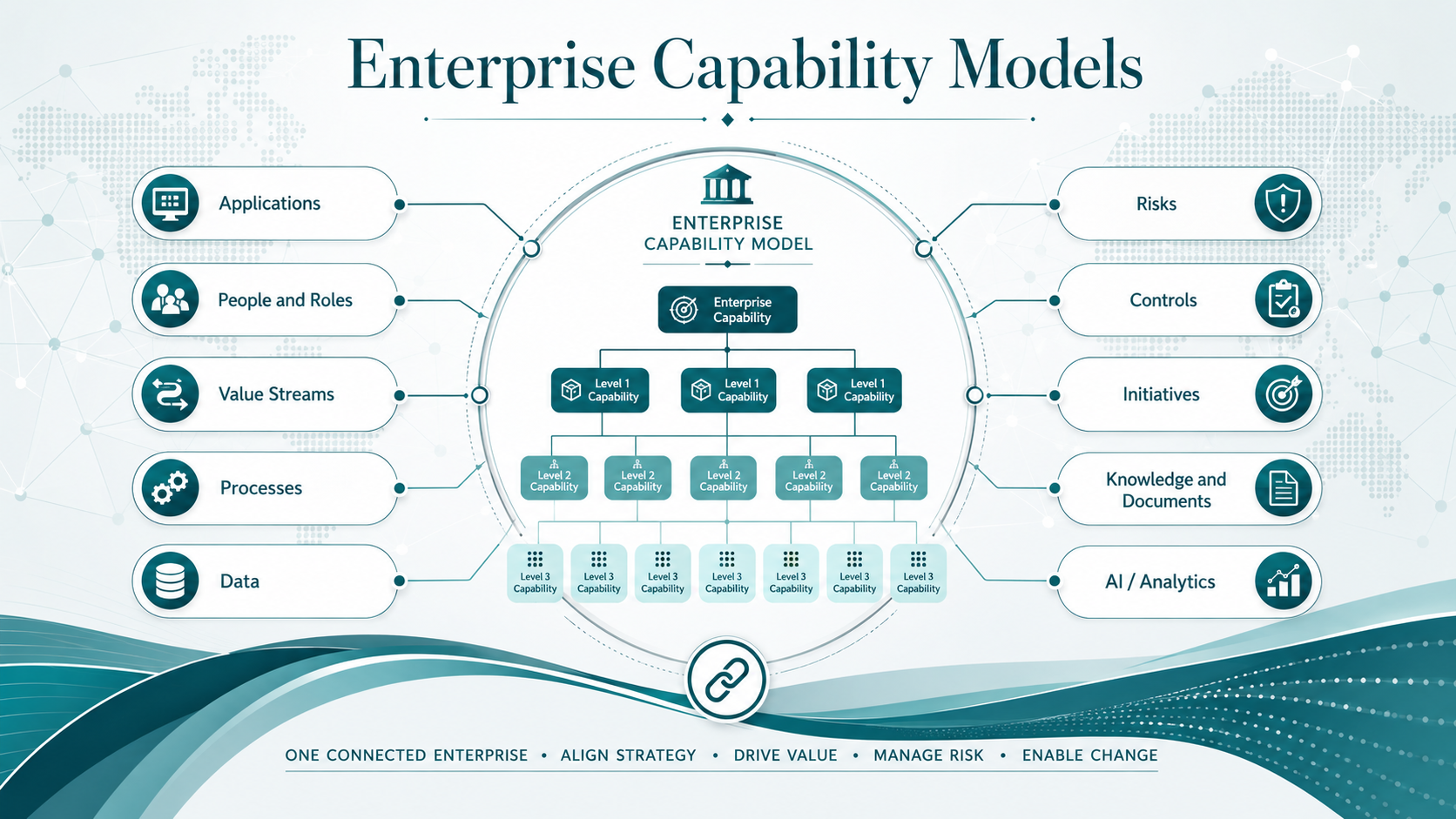
Executive Summary: Chapter Overview
IF4ITThe Bottom Line
Core Concepts
| Concept | Definition & Strategic Role |
|---|---|
| Capability Taxonomy | The hierarchy provides a stable structure for classifying knowledge by the enterprise abilities it supports or describes. |
| Managed Metadata | Capability identifiers and terms can become governed tags, facets, virtual folders, and navigation values. |
| Knowledge Discovery | Users can traverse from a capability to related documents, experts, applications, risks, controls, processes, and initiatives. |
Quick Q&A
Question: Why is an Enterprise Capability Model useful as a knowledge taxonomy?
Read More Below
Best Practice: Use Capabilities as a Stable Knowledge Organizing Spine
Description
Capabilities should be used as a stable organizing spine for enterprise knowledge because they describe what the enterprise does rather than how it is currently organized, which projects are active, which applications are installed, or which processes are documented. Organization structures, applications, technologies, projects, and process designs change frequently. Capabilities are usually more durable.
Benefit(s)
Using capabilities as the organizing spine makes enterprise knowledge easier to browse, search, explain, and maintain. It gives users a stable way to understand the enterprise even as organizational structures and technology portfolios change.
This practice also improves AI-assisted knowledge retrieval. AI agents can use the capability structure to scope questions, traverse relationships, summarize related knowledge, and explain enterprise context.
Best Practice: Use the Capability Hierarchy as an Enterprise Taxonomy Backbone
Description
A hierarchical Enterprise Capability Model (ECM) is a taxonomy because it classifies enterprise abilities into a governed parent-child structure. The enterprise can use that structure as a skeletal backbone for intranets, wikis, EDMS platforms, enterprise search, knowledge management systems, and AI retrieval layers.
Parent capabilities can become major navigation categories, child capabilities can become more specific content categories, and each capability record can provide metadata that classifies related documents, pages, applications, dashboards, reports, policies, procedures, standards, training materials, and knowledge articles.
Benefit(s)
Using the capability hierarchy as a taxonomy backbone creates a stable classification structure that is less volatile than org charts, project names, application names, or temporary initiatives. It improves navigation, search filtering, document classification, knowledge reuse, onboarding, and enterprise learning.
This practice also improves AI and retrieval-augmented generation use cases. AI agents can use capability taxonomy metadata to constrain retrieval, rank relevant content, traverse related knowledge, and explain enterprise context with stronger grounding.
Best Practice: Use Capability Relationships to Create Semantic Navigation
Description
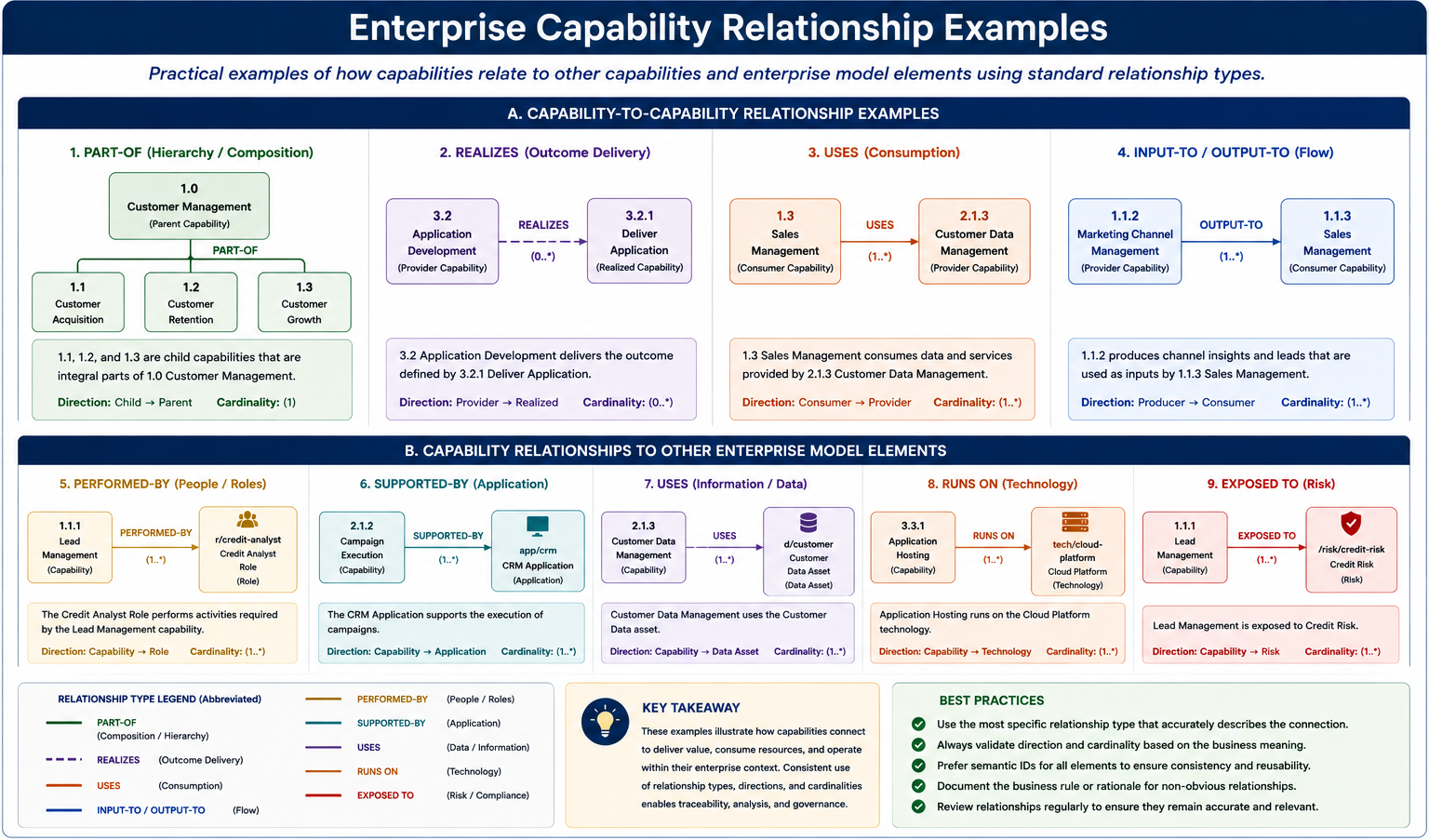
The ECM should not only organize pages by hierarchy. It should also expose meaningful relationships between capabilities and other Enterprise Model Noun Types. These relationships should be published with descriptive semantic predicates and relationship attributes so users can understand not only that two things are related, but how and why they are related.
For example, a capability may be related to an application through the predicate is enabled by, to a value stream stage through contributes to, to an organization through is owned by, to a process through is realized by, or to a control through is governed by. The predicate gives the relationship meaning, while relationship attributes can further describe criticality, strength, lifecycle status, source, confidence, or governance status.
Benefit(s)
Semantic navigation makes intranets, wikis, document repositories, search systems, and AI knowledge systems more useful. Users can browse from one capability to related capabilities, applications, people, organizations, value streams, processes, risks, controls, and documents while understanding the meaning of each relationship.
This also improves AI consumption. AI agents can interpret relationship meaning, traverse governed pathways, retrieve richer context, and produce better summaries, recommendations, impact analyses, and answers.
Best Practice: Use the Enterprise Capability Model for Learning and Ramp-Up
Description
The ECM should be intentionally used as a learning and ramp-up tool. It should help users move from a broad enterprise view to a specific capability area, then from that capability to related applications, value chains, processes, data, organizations, risks, controls, initiatives, and subject-matter experts.
Learning-oriented content should answer practical questions: What does this capability mean? Why does it matter? Who owns it? What systems enable it? What value streams use it? What data does it consume or produce? What initiatives are improving it? What risks or controls apply? What should a new person read next?
Benefit(s)
Using the model for learning and ramp-up accelerates onboarding for employees, consultants, architects, analysts, and leaders. It provides a structured alternative to informal introductions, scattered documents, and undocumented institutional knowledge.
It also reinforces a shared enterprise vocabulary. As more people use the model to learn and communicate, capability names and definitions become more consistent across planning, architecture, delivery, governance, and operations.
How to cite this page
When referencing this page in academic work, internal standards, or external publications, include the page title, IF4IT as author and publisher (The International Foundation for Information Technology (IF4IT), LLC), the URL, and your access date.
Example (informal web citation):
The International Foundation for Information Technology (IF4IT), LLC. Use Enterprise Capability Models as Enterprise Knowledge Management Taxonomies | Designing, Building, and Maintaining Comprehensive and Usable Enterprise Capability Models. https://if4it.org/best-practices/designing-building-and-maintaining-comprehensive-and-usable-enterprise-capability-models/use-enterprise-capability-models-as-enterprise-knowledge-management-taxonomies/ (accessed 2026-08-06).
See About Us for content governance and site-wide citation guidance.
Copyright for The International Foundation for Information Technology (IF4IT), LLC: 2008 - Present
Legal Disclaimers