Use Enterprise Capability Models for Assessment, Health Checks, and Heatmaps - Designing, Building, and Maintaining Comprehensive and Usable Enterprise Capability Models
Use Enterprise Capability Models for Assessment, Health Checks, and Heatmaps
(Chapter 18 of Designing, Building, and Maintaining Comprehensive and Usable Enterprise Capability Models)
Executive Summary: Chapter Overview
IF4ITThe Bottom Line
Core Concepts
| Concept | Definition & Strategic Role |
|---|---|
| Assessment Dimensions | Maturity, health, risk, performance, readiness, investment priority, and support can be evaluated separately. |
| Evidence-Based Scoring | Scores should have definitions, sources, rationale, confidence, reviewers, and dates. |
| Heatmap Views | Visual color coding helps leaders identify patterns and priorities while preserving drill-down to source records. |
Quick Q&A
Question: What makes a capability heatmap trustworthy?
Read More Below
Best Practice: Assess Capability Maturity and Health
Description
Capabilities should be assessed for maturity and health using a consistent set of evaluation dimensions. Common dimensions include current maturity, target maturity, gap severity, strategic importance, business criticality, risk exposure, regulatory sensitivity, application support, technology support, data readiness, operational performance, ownership clarity, support readiness, and investment need.
Maturity and health are related but not identical. Maturity describes how developed, repeatable, governed, measured, and optimized a capability is. Health describes whether the capability is currently fit for purpose, stable, supported, adequately enabled, appropriately governed, and aligned to business need. A capability can be mature but unhealthy if it is costly, risky, outdated, or misaligned. A capability can also be immature but healthy enough for its current business need.
Benefit(s)
Assessing maturity and health helps identify weak, critical, under-supported, over-supported, risky, or strategically important capability areas. It creates a structured basis for prioritizing attention, investment, remediation, modernization, and governance.
This practice also improves executive and stakeholder communication. Instead of relying on anecdotal assessments or isolated issue lists, the enterprise can compare capabilities using a common language and a consistent assessment method.
Best Practice: Use Capability Heatmaps
Description
Capability heatmaps should be used to visualize assessment values across the capability hierarchy. Useful heatmaps include maturity heatmaps, health heatmaps, gap heatmaps, investment heatmaps, strategic importance heatmaps, application support heatmaps, risk heatmaps, data readiness heatmaps, regulatory sensitivity heatmaps, and operational performance heatmaps.
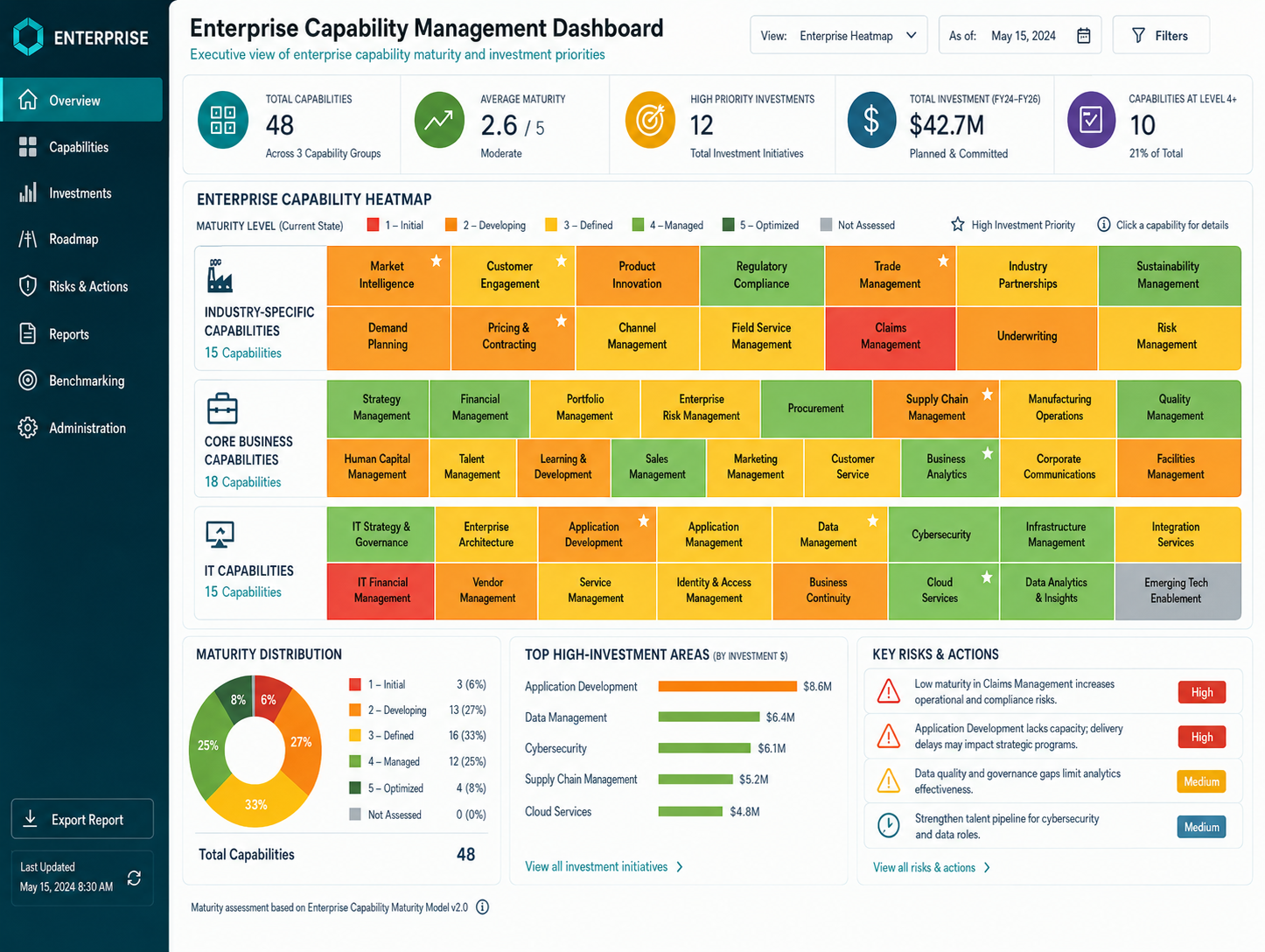
Heatmaps should be designed for decision support, not decoration. Each heatmap should have a clear purpose, a defined scoring method, a defined audience, and a clear interpretation guide. When a heatmap uses color, the meaning of each color should be explicit, and the underlying score or rating should remain available for analysis and auditability.
Benefit(s)
Capability heatmaps help leaders, architects, owners, and planners quickly identify where attention and investment are needed. They make complex assessment data easier to interpret and discuss.
This practice also helps reveal patterns that are hard to see in tables alone, such as clusters of weak capabilities, over-invested areas, under-supported strategic capabilities, or high-risk capabilities concentrated in a specific value chain or business domain.
Best Practice: Publish an Enterprise Capability Management Dashboard
Description
An Enterprise Capability Model (ECM) should support and can be visualized via an Enterprise Capability Management Dashboard, also known as an Executive Capability Dashboard. The dashboard, which is a powerful knowledge management tool, should provide executive leadership with a consolidated view of capability health, maturity, investment priority, strategic alignment, risk exposure, application support, ownership, transformation progress, and knowledge readiness.
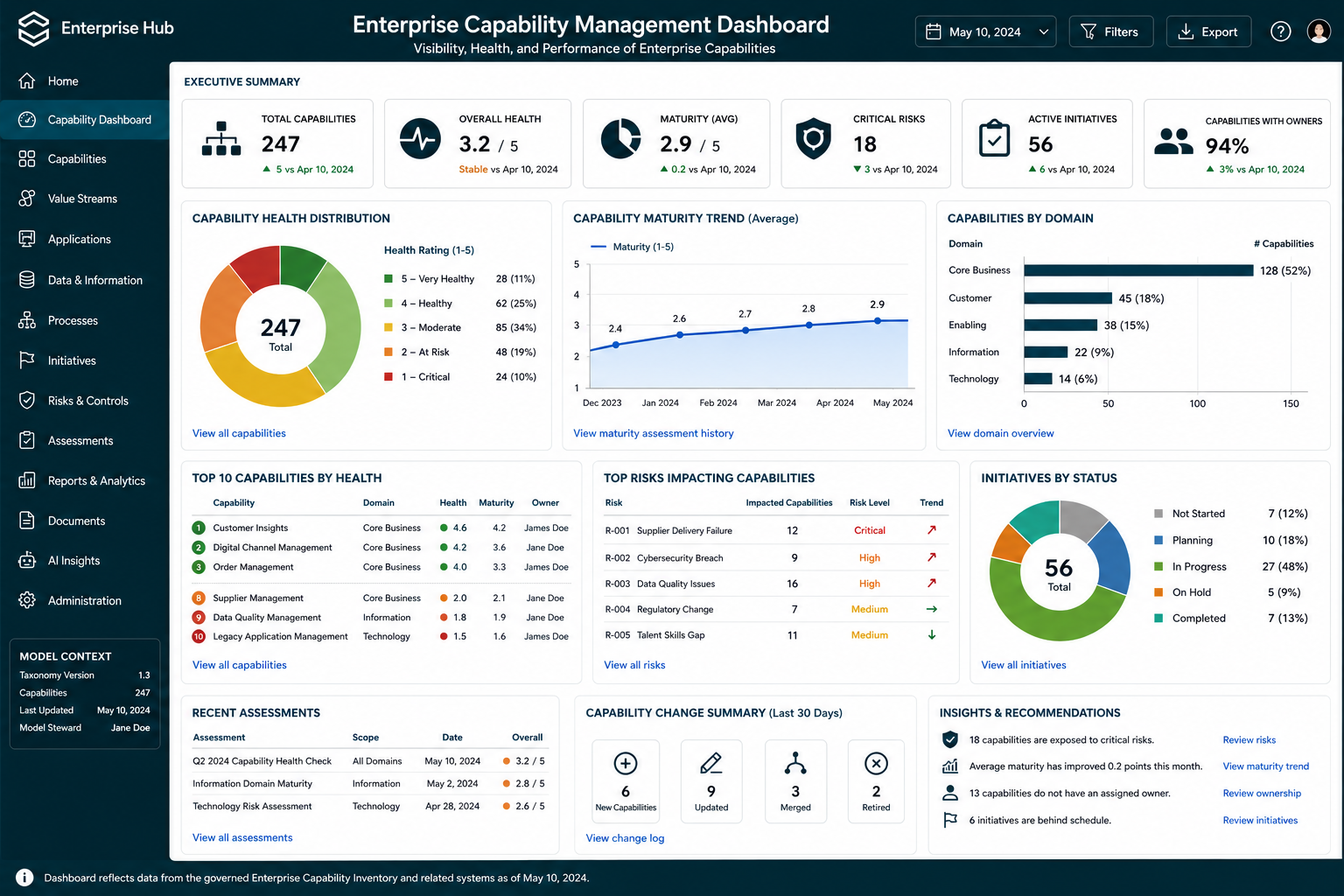
The dashboard should not replace detailed capability records, heatmaps, or generated capability knowledge pages. Instead, it should summarize and visualize the most important capability data and relationships so leaders can quickly understand which capabilities are healthy, which are under stress, which need investment, which are strategically important, and which are being improved through active initiatives.
Benefit(s)
An Enterprise Capability Management Dashboard gives executives a practical management interface for the ECM. It turns governed capability data, assessments, relationships, and improvement activity into a leadership-facing view that supports investment decisions, transformation prioritization, risk discussions, ownership reviews, and strategy execution.
This practice also reinforces the value of maintaining high-quality capability attributes and relationships. The dashboard is only credible when the underlying Capability Inventory, semantic relationships, health scores, maturity assessments, ownership data, and initiative mappings are current, governed, and trusted.
The following table illustrates common dashboard components and the executive questions they help answer.
| Dashboard Component | Executive Question Answered | Example Data Sources |
|---|---|---|
| Capability Health Summary | Which capabilities are healthy, degraded, or at risk? | Capability Health Score, Gap Status, recent assessment values. |
| Maturity Heatmap | Which capabilities are below target maturity? | Assessed Maturity, Target Maturity, maturity gap data. |
| Investment Priority View | Where should the enterprise invest next? | Investment Priority, Business Importance, Strategic Goals Alignment, initiative demand. |
| Strategic Alignment View | Which capabilities support top enterprise goals? | Strategic Goals Alignment, Value Stream relationships, executive priorities. |
| Risk and Control View | Which important capabilities carry high risk or weak control coverage? | Related Risks, Related Controls, Regulatory Sensitivity, audit findings. |
| Application Support View | Which critical capabilities depend on weak, aging, redundant, or high-risk applications? | Application-to-Capability mappings, application health, lifecycle, redundancy, incidents. |
| Initiative Alignment View | Which initiatives are improving which capabilities? | Capability-to-Initiative relationships, roadmap status, funding, delivery progress. |
| Ownership and Stewardship View | Who owns, stewards, and governs each major capability area? | Capability Owner, Capability Steward, Executive Sponsor, Owning Organization. |
| Knowledge Readiness View | Which capabilities have usable pages, SMEs, documents, and current metadata? | Capability Knowledge Pages, SME coverage, EDMS links, review dates, metadata completeness. |
| Trend View | Is capability health improving, degrading, or remaining stable over time? | Historical health scores, maturity assessments, incident trends, initiative progress. |
Best Practice: Govern Assessment Results
Description
Assessment results should be governed. The enterprise should define who can score capabilities, who can approve scores, how evidence is captured, how often assessments are refreshed, how disputes are resolved, and how changes to assessment values are documented.
Assessment governance should also define the difference between draft, proposed, reviewed, approved, and expired assessment values. AI-generated or AI-suggested scores should be treated as candidate values until reviewed and approved by accountable humans.
Benefit(s)
Governed assessment results improve trust, consistency, and comparability. Stakeholders are more likely to use maturity scores, health scores, and heatmaps when they understand how the values were produced and who approved them.
This practice also protects the enterprise from stale or subjective assessment data. A heatmap that is not governed can quickly become misleading, especially when it influences funding, transformation sequencing, risk prioritization, or executive decisions.
How to cite this page
When referencing this page in academic work, internal standards, or external publications, include the page title, IF4IT as author and publisher (The International Foundation for Information Technology (IF4IT), LLC), the URL, and your access date.
Example (informal web citation):
The International Foundation for Information Technology (IF4IT), LLC. Use Enterprise Capability Models for Assessment, Health Checks, and Heatmaps | Designing, Building, and Maintaining Comprehensive and Usable Enterprise Capability Models. https://if4it.org/best-practices/designing-building-and-maintaining-comprehensive-and-usable-enterprise-capability-models/use-enterprise-capability-models-for-assessment-health-checks-and-heatmaps/ (accessed 2026-10-06).
See About Us for content governance and site-wide citation guidance.
Copyright for The International Foundation for Information Technology (IF4IT), LLC: 2008 - Present
Legal Disclaimers