Designing, Building, and Maintaining Comprehensive and Usable Enterprise Capability Models - Use Enterprise Capability Models to Enable Formal Knowledge Management
Designing, Building, and Maintaining Comprehensive and Usable Enterprise Capability Models
Chapter 22. Use Enterprise Capability Models to Enable Formal Knowledge Management
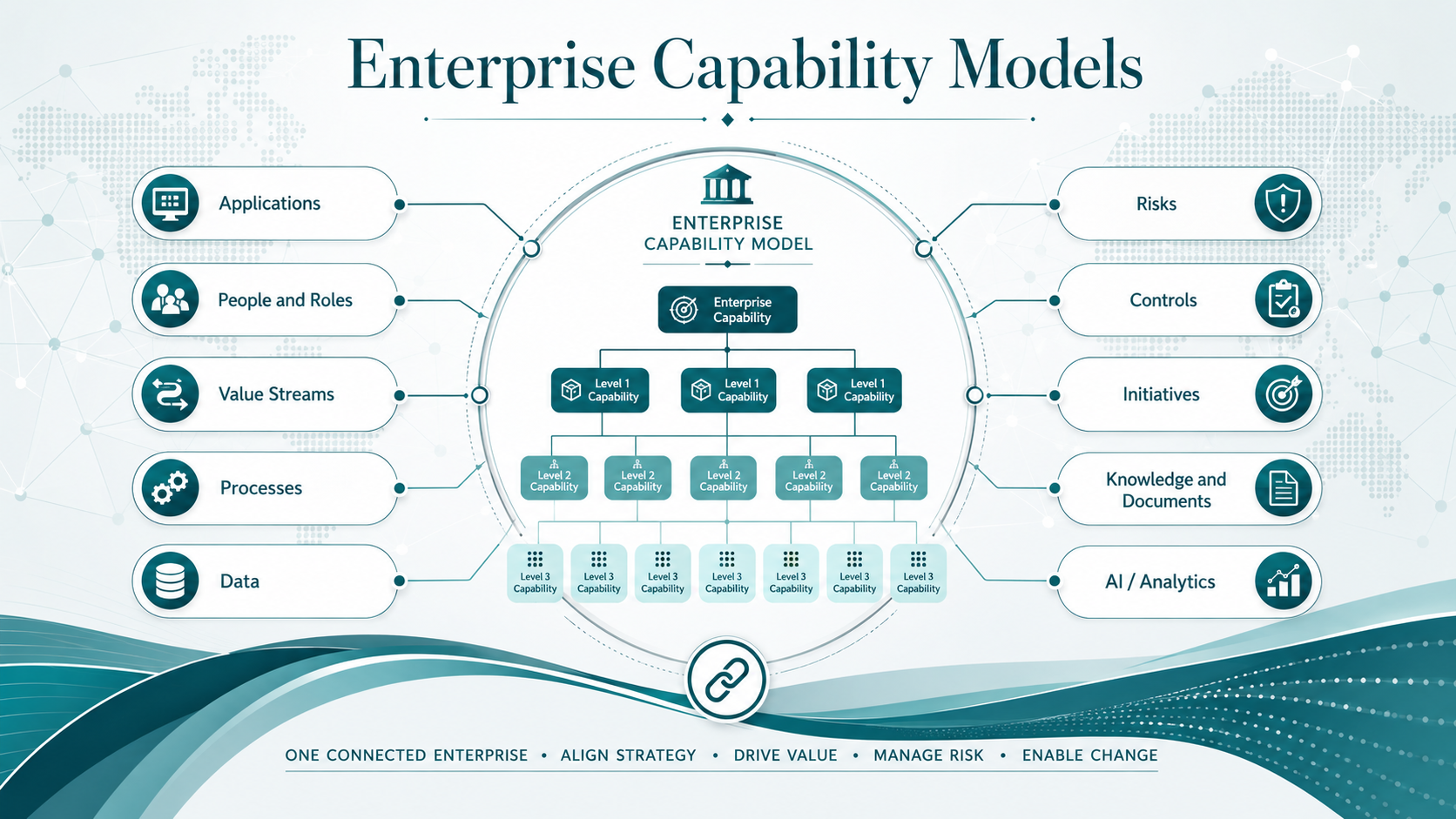
Executive Summary: Chapter Overview
IF4ITThe Bottom Line
Core Concepts
| Concept | Definition & Strategic Role |
|---|---|
| Knowledge Stewardship | Owners, stewards, SMEs, and content maintainers have defined responsibilities for capability knowledge. |
| Knowledge Assets | Documents, pages, procedures, training, dashboards, evidence, and expert context are linked to capabilities. |
| Knowledge Freshness | Review dates, completeness measures, validation, usage, and update workflows keep published knowledge trustworthy. |
Quick Q&A
Question: How does the Enterprise Capability Model support formal Knowledge Management?
Read More Below
Best Practice: Identify Knowledge Management Touch-Points Across the Enterprise Capability Model
Description
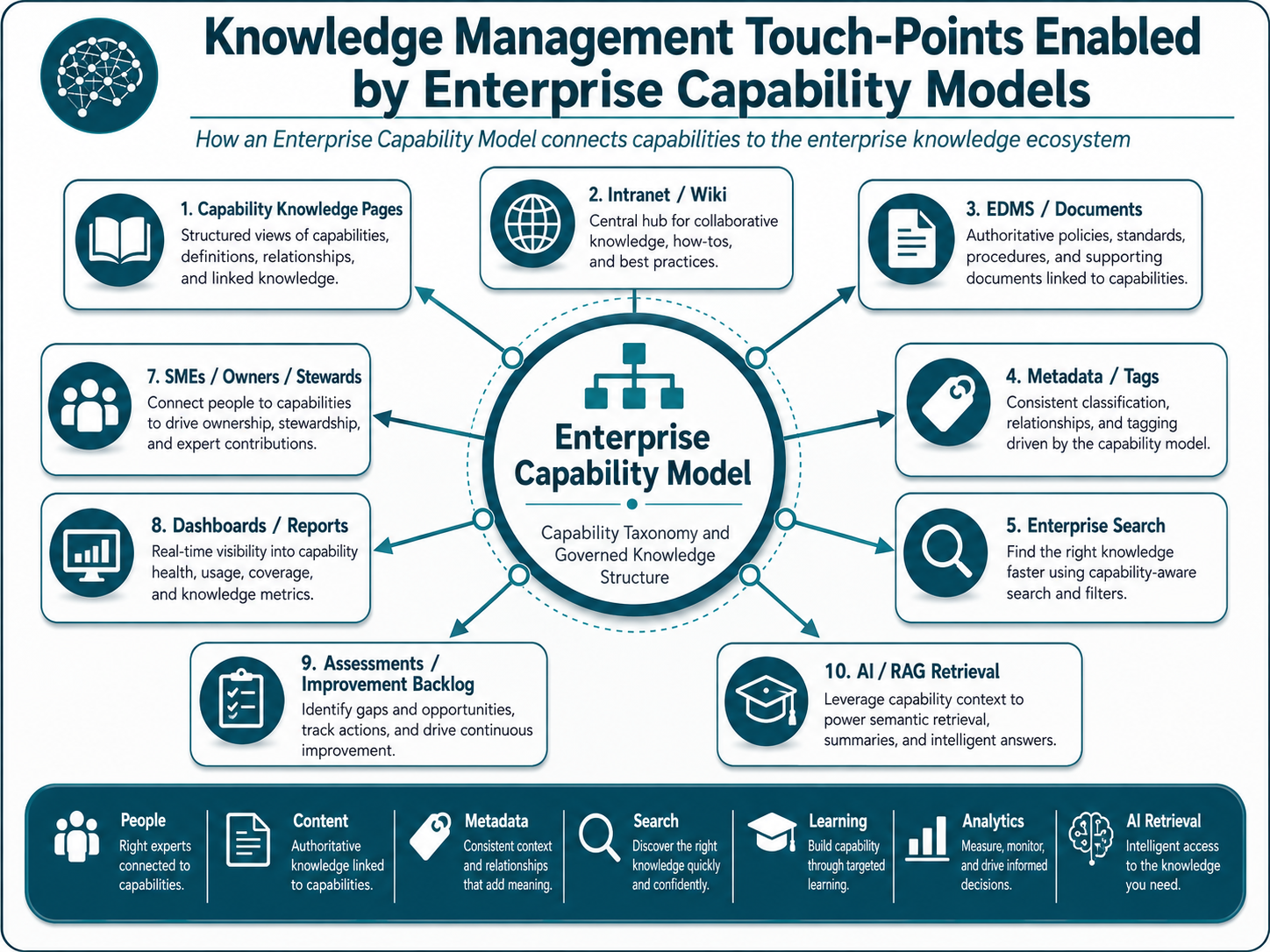
A richly developed Enterprise Capability Model (ECM) creates many Knowledge Management touch-points. The hierarchy provides a taxonomy. The Capability Inventory provides governed knowledge records. Attributes provide metadata. Semantic IDs provide stable references. Parent-child links provide navigation. Semantic relationships explain how Noun Type instances are connected. Relationship attributes provide context. Heatmaps communicate assessment knowledge. Capability knowledge pages publish governed content. Subject Matter Expert relationships support expertise discovery.
Benefit(s)
Identifying KM touch-points helps Knowledge Management professionals see how the ECM can support content classification, metadata design, knowledge publishing, expertise discovery, search, document management, knowledge reuse, and AI-assisted retrieval.
It also helps architects and model stewards design the model around practical knowledge-sharing outcomes rather than treating knowledge sharing as an accidental byproduct of modeling.
Best Practice: Use Enterprise Capability Model Elements as KM Enablers
Description
The enterprise should explicitly map model elements to the Knowledge Management capabilities they enable. This makes it easier to explain why capability hierarchy, attributes, Semantic IDs, relationships, heatmaps, pages, experts, and documents matter to KM stakeholders.
| ECM Element | KM Touch-Point | Knowledge Management Value |
|---|---|---|
| Capability Hierarchy | Taxonomy | Organizes enterprise knowledge by stable enterprise abilities. |
| Capability Inventory | Governed knowledge repository | Stores authoritative capability records, definitions, and attributes. |
| Capability Description | Context and meaning | Explains what the capability does and why it matters. |
| Semantic ID | Stable knowledge identifier | Supports durable references across documents, pages, systems, dashboards, and AI retrieval stores. |
| Capability Attributes | Metadata | Adds ownership, status, maturity, health, strategic, governance, and operational context. |
| Parent/Child Links | Navigation structure | Enables natural browsing from broad capability areas to detailed capability pages and back. |
| Semantic Relationships | Knowledge graph edges | Explains how capabilities relate to applications, people, value streams, processes, data, risks, controls, and other Noun Types. |
| Relationship Attributes | Relationship context metadata | Explains criticality, strength, source, confidence, lifecycle status, and governance status of relationships. |
| Capability Knowledge Pages | Knowledge publishing | Turns governed capability records into consumable intranet or wiki pages. |
| Subject Matter Experts | Expertise discovery | Helps users find people with practical, operational, technical, regulatory, or domain-specific knowledge. |
| Heatmaps | Assessment knowledge | Shares maturity, health, risk, priority, and gap information in visual form. |
| EDMS Metadata | Document classification | Organizes documents by the capabilities they support, govern, evidence, describe, or improve. |
| Search Facets | Knowledge discovery | Allows filtering by capability, owner, application, risk, process, value stream, or document type. |
| AI/RAG Context | Machine-consumable knowledge | Improves retrieval, summarization, recommendations, impact analysis, and generated explanations. |
| Capability Pages and Relationships | Teaching, learning, onboarding, and ramp-up | Helps employees and consultants learn what the enterprise does, who owns each area, what enables it, what documents explain it, and where to go for deeper expertise. |
| Capability Taxonomy Paths | EDMS folder and path design | Helps define folder names, virtual folders, managed terms, classification paths, document sets, and search facets without requiring every EDMS implementation to use physical folders only. |
| Capability Record Data | Metadata and automatic tagging | Provides values such as Semantic ID, parent capability, owner, steward, SME, related applications, risks, and controls that can become document metadata or suggested tags. |
Benefit(s)
Mapping model elements to KM enablers makes the Knowledge Management value of the ECM explicit. It gives KM professionals a clear way to use the model as a taxonomy, metadata framework, knowledge publishing structure, expertise-discovery mechanism, search framework, and AI-ready knowledge graph.
This also helps justify investment in model quality, attribute completeness, relationship governance, knowledge-page generation, and AI-assisted maintenance because each improvement strengthens enterprise knowledge sharing.
Best Practice: Use the Capability Taxonomy to Guide EDMS Folder, Path, Metadata, and Tag Design
Description
As a means of facilitating better Enterprise Knowledge Management, a hierarchical ECM can help design how documents are organized, named, tagged, searched, and governed in an Enterprise Document Management System (EDMS). Parent-child capability relationships can inform folder names, folder paths, virtual folder structures, managed terms, document sets, metadata fields, retention classifications, search facets, and automatic tagging rules.
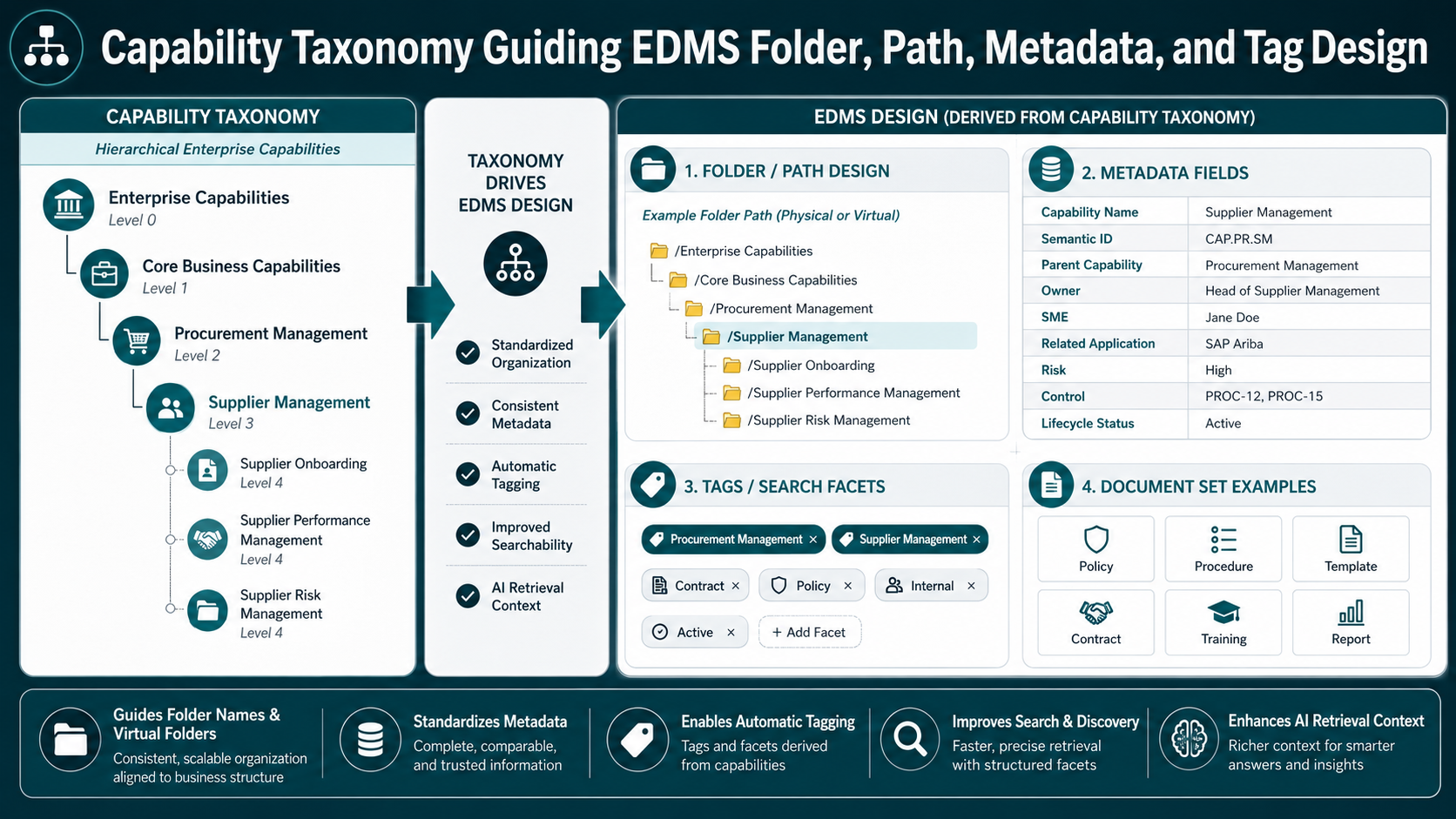
For example, a capability path such as Industry-Specific Capabilities / Healthcare Payer Capabilities / Utilization Management / Prior Authorization Management can help define a folder path, virtual folder path, taxonomy term path, document classification path, or metadata classification value in the EDMS.
| EDMS Design Element | ECM Contribution | Example |
|---|---|---|
| Folder Name | Uses the capability display name. | Prior Authorization Management |
| Folder Path | Uses the capability hierarchy path. | Healthcare Payer Capabilities / Utilization Management / Prior Authorization Management |
| Virtual Folder | Uses metadata to dynamically group documents. | All documents tagged to CAP.HEALTHCARE.PRIOR-AUTHORIZATION-MANAGEMENT |
| Managed Term | Uses the capability as a taxonomy value. | Procurement Management; Identity and Access Management |
| Metadata Field | Stores capability-related values. | Related Capability; Capability Owner; SME; Regulatory Sensitivity |
| Automatic Tag | Uses capability data to classify documents. | Tag documents with parent capability, child capability, owner, application, risk, or control. |
| Search Facet | Allows filtering by capability context. | Filter by Capability, Capability Owner, Application, Risk, Control, SME, or Document Type. |
| Retention Context | Uses capability and regulatory metadata to support records handling. | Documents tied to highly regulated capabilities can inherit stricter review or retention context. |
| AI/RAG Retrieval Metadata | Uses capability IDs and relationships to improve retrieval. | Retrieve documents related to capabilities enabled by a failing application. |
Capability data can also help automatically tag folders and documents. Each capability’s Semantic ID, display name, parent capability, child capabilities, owner, steward, SME, service organization, related applications, related processes, related controls, regulatory sensitivity, and related risks can become metadata values or suggested tags for documents stored in, linked to, or classified against that capability area.
| Capability Data Element | Possible EDMS Metadata / Tag |
|---|---|
| Capability Semantic ID | Related Capability ID |
| Capability Name | Related Capability Name |
| Capability Path | Capability Classification Path |
| Parent Capability | Parent Capability |
| Child Capabilities | Child Capability Area |
| Capability Owner | Business Owner |
| Capability Steward | Knowledge Steward |
| Subject Matter Expert (SME) | Subject Matter Expert |
| Related Application | Related Application |
| Related Process | Related Process |
| Related Risk | Related Risk |
| Related Control | Related Control |
| Regulatory Sensitivity | Regulatory Sensitivity |
| Data Sensitivity | Data Sensitivity |
| Lifecycle Status | Capability Lifecycle Status |
| Review Cadence | Knowledge Review Cadence |
Benefit(s)
Using the Capability Taxonomy to guide EDMS design improves document discoverability, navigation, search accuracy, metadata consistency, knowledge reuse, records classification, auditability, and AI-assisted retrieval. It also helps users understand where documents belong, what capability they support, who owns the related knowledge area, which SMEs can help, and how documents relate to other enterprise knowledge.
Best Practice: Use Enterprise Capability Models for Enterprise Teaching, Learning, and Ramp-Up
Description
A richly developed ECM can be used as a teaching and learning framework for new employees, existing employees, consultants, contractors, analysts, architects, and leaders. Because the model organizes enterprise knowledge by capability, users can learn about an enterprise area by navigating from high-level capability categories to more detailed child capabilities, reading capability descriptions, reviewing owners and SMEs, exploring related applications and processes, and following links to supporting policies, procedures, training materials, documents, dashboards, risks, controls, and initiatives.
This is especially useful when a new employee joins the enterprise, when a consultant needs to ramp up quickly, when an employee moves into a new role, or when an existing employee needs to understand another area of the enterprise.
Benefit(s)
Using the ECM for teaching and learning reduces dependence on tribal knowledge, accelerates onboarding, improves cross-functional understanding, helps employees find the right people and documents, and gives consultants a faster path to useful enterprise context. It also helps the enterprise standardize how knowledge is introduced, shared, searched, and reused.
How to cite this page
When referencing this page in academic work, internal standards, or external publications, include the page title, IF4IT as author and publisher (The International Foundation for Information Technology (IF4IT), LLC), the URL, and your access date.
Example (informal web citation):
The International Foundation for Information Technology (IF4IT), LLC. Use Enterprise Capability Models to Enable Formal Knowledge Management | Designing, Building, and Maintaining Comprehensive and Usable Enterprise Capability Models. https://if4it.org/best-practices/designing-building-and-maintaining-comprehensive-and-usable-enterprise-capability-models/use-enterprise-capability-models-to-enable-formal-knowledge-management/ (accessed 2026-08-06).
See About Us for content governance and site-wide citation guidance.
Copyright for The International Foundation for Information Technology (IF4IT), LLC: 2008 - Present
Legal Disclaimers