Use Stable Semantic IDs - Designing, Building, and Maintaining Comprehensive and Usable Enterprise Capability Models
Use Stable Semantic IDs
(Chapter 13 of Designing, Building, and Maintaining Comprehensive and Usable Enterprise Capability Models)
Executive Summary: Chapter Overview
IF4ITThe Bottom Line
Core Concepts
| Concept | Definition & Strategic Role |
|---|---|
| Durable Identity | Semantic IDs preserve a capability’s identity independently of its current name or hierarchy placement. |
| Human Meaning | Readable identifiers improve mapping, review, debugging, search, and AI interpretation. |
| Identity Governance | Creation, uniqueness, aliases, merges, splits, retirement, and reuse rules must be governed consistently. |
Quick Q&A
Question: What should happen to a capability Semantic ID when the capability moves within the hierarchy?
Read More Below
Best Practice: Never Use Hierarchical Position Identifiers as Durable Capability IDs
Description
Hierarchical position identifiers such as 1.0, 1.1, 1.1.1, or similar numbering schemes should not be used as durable capability IDs. They are useful for display, sorting, navigation, discussion, and printed or published views, but they reflect a capability’s current position in the hierarchy rather than its durable identity.
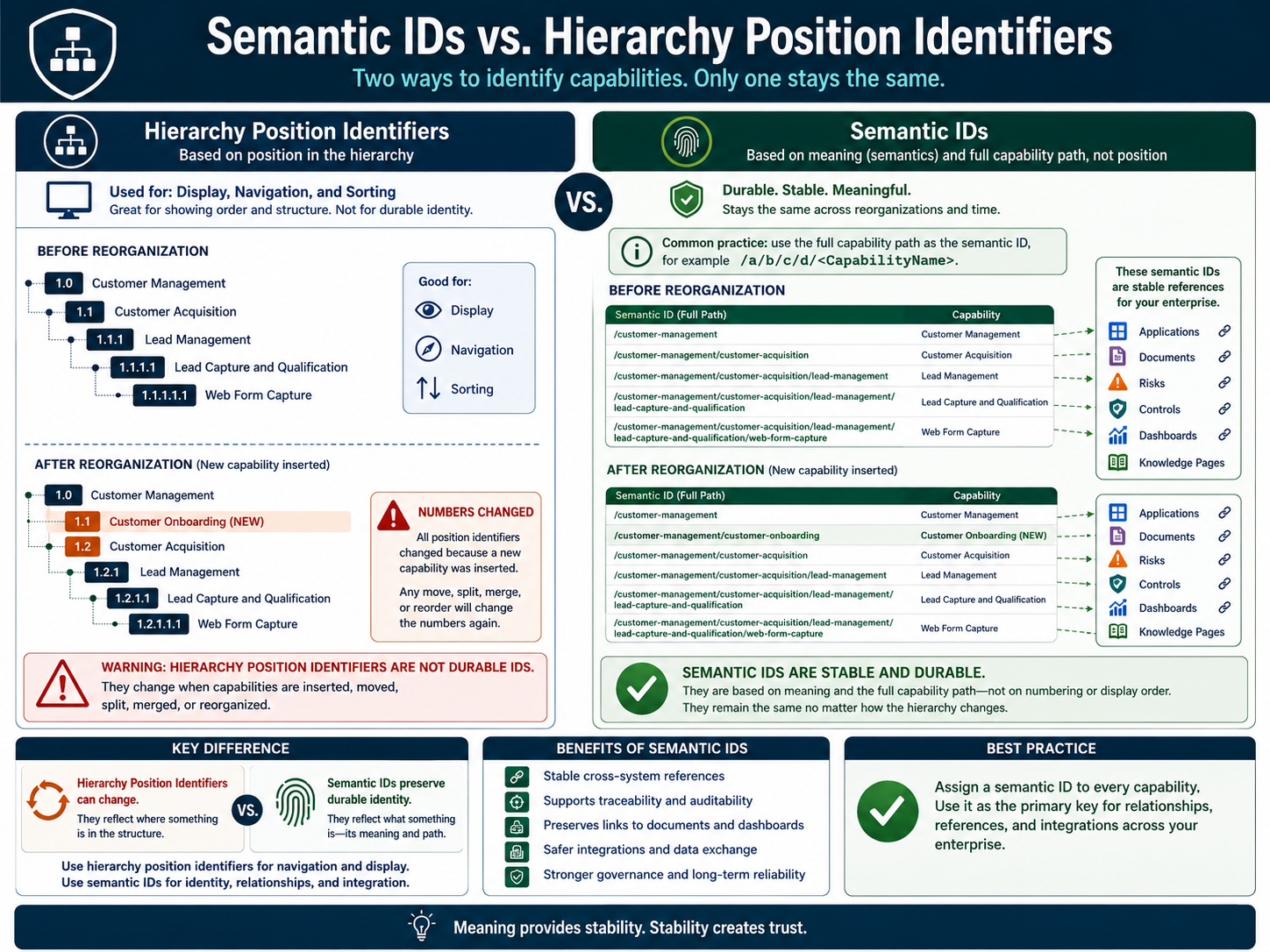
Position identifiers change when a capability is inserted, deleted, moved, split, merged, or reorganized. A capability may retain its meaning even when its position changes. Therefore, position and identity must be separated. It is for this reason that it is recommended a modeler always use Semantic IDs that describe the capability with some context.
A common means of generating a semantic identifier is to use the full path down to the capability name. For example…
“/Enterprise/IT Capabilities/Service Management/Service Request Intake”
“/Enterprise/IT Capabilities/Application Management/Application Operations/Incident Management/Incident Investigation”
/Enterprise/Core Business Capabilities/Customer Acquisition/Lead Capture and Qualification”
While these identifiers seem unreasonably long, consider that limitations on length and legality of characters come from legacy tools and technologies that have always had significant limitations. AI does not have such limitations and works off Natural Language. Long semantic identifiers with semantic context are far more meaningful and useful when using AI to model and develop things from your model(s). If required, system-friendly GUIDs can also be created, used, and maintained in addition to semantic identifiers — specifically for compliance with technologies that can’t handle such semantic IDs.
Benefit(s)
Using hierarchy position as durable identity creates fragile references. If applications, risks, controls, initiatives, value chain stages, knowledge pages, or dashboards reference a position number, those references can become wrong when the hierarchy changes.
Avoiding this practice protects referential integrity and makes the model safer to evolve over time.
Best Practice: Use Semantic IDs for Durable Identity
Description
Each capability should have a stable Semantic ID that identifies the capability as a durable enterprise concept. A Semantic ID should be human-readable, AI-friendly, unique within the Enterprise Capability Model (ECM), and stable enough to support long-term references.
Semantic IDs may be seeded from the capability path or meaningful name, but they should not be treated as temporary positional labels. Once assigned and approved, a Semantic ID should remain associated with the same capability meaning unless the capability is materially redefined.
Benefit(s)
Semantic IDs preserve referential integrity across the Enterprise Model. Applications, value chain stages, processes, data, risks, controls, initiatives, generated pages, dashboards, and AI-assisted queries can reference the same durable capability even when its display name or hierarchy position changes.
This also improves machine readability. AI agents and automation tools can reason over stable identifiers more reliably than over ambiguous names or shifting hierarchy numbers.
Best Practice: Preserve Semantic Identity Through Reorganization
Description
When the hierarchy is reorganized, the enterprise should preserve a capability’s Semantic ID when the capability’s meaning remains substantially the same. Moving a capability to a different parent, renaming it for clarity, or changing its hierarchy position should not automatically create a new identity.
New Semantic IDs should be created when a capability is materially split, merged, narrowed, broadened, or redefined in a way that changes its governed meaning. In those cases, the model should preserve history through status, change notes, predecessor-successor references, and governance records.
Benefit(s)
Preserving Semantic ID continuity protects historical analysis, relationship integrity, generated knowledge pages, and stakeholder trust. It allows the model to evolve without invalidating every downstream reference.
This practice also supports auditability. Reviewers can understand what changed, why it changed, and whether the capability identity remained stable or was intentionally replaced.
How to cite this page
When referencing this page in academic work, internal standards, or external publications, include the page title, IF4IT as author and publisher (The International Foundation for Information Technology (IF4IT), LLC), the URL, and your access date.
Example (informal web citation):
The International Foundation for Information Technology (IF4IT), LLC. Use Stable Semantic IDs | Designing, Building, and Maintaining Comprehensive and Usable Enterprise Capability Models. https://if4it.org/best-practices/designing-building-and-maintaining-comprehensive-and-usable-enterprise-capability-models/use-stable-semantic-ids/ (accessed 2026-10-06).
See About Us for content governance and site-wide citation guidance.
Copyright for The International Foundation for Information Technology (IF4IT), LLC: 2008 - Present
Legal Disclaimers