About This Document - Enterprise AI Governance Best Practices
About This Document
(Chapter 1 of Enterprise AI Governance Best Practices)
Executive Summary: Chapter Overview
IF4ITThe Bottom Line
Core Concepts
| Concept | Definition & Strategic Role |
|---|---|
| Document Scope | Defines what the Enterprise AI Governance Best Practices document covers, how it should be read, and how it connects to adjacent enterprise disciplines. |
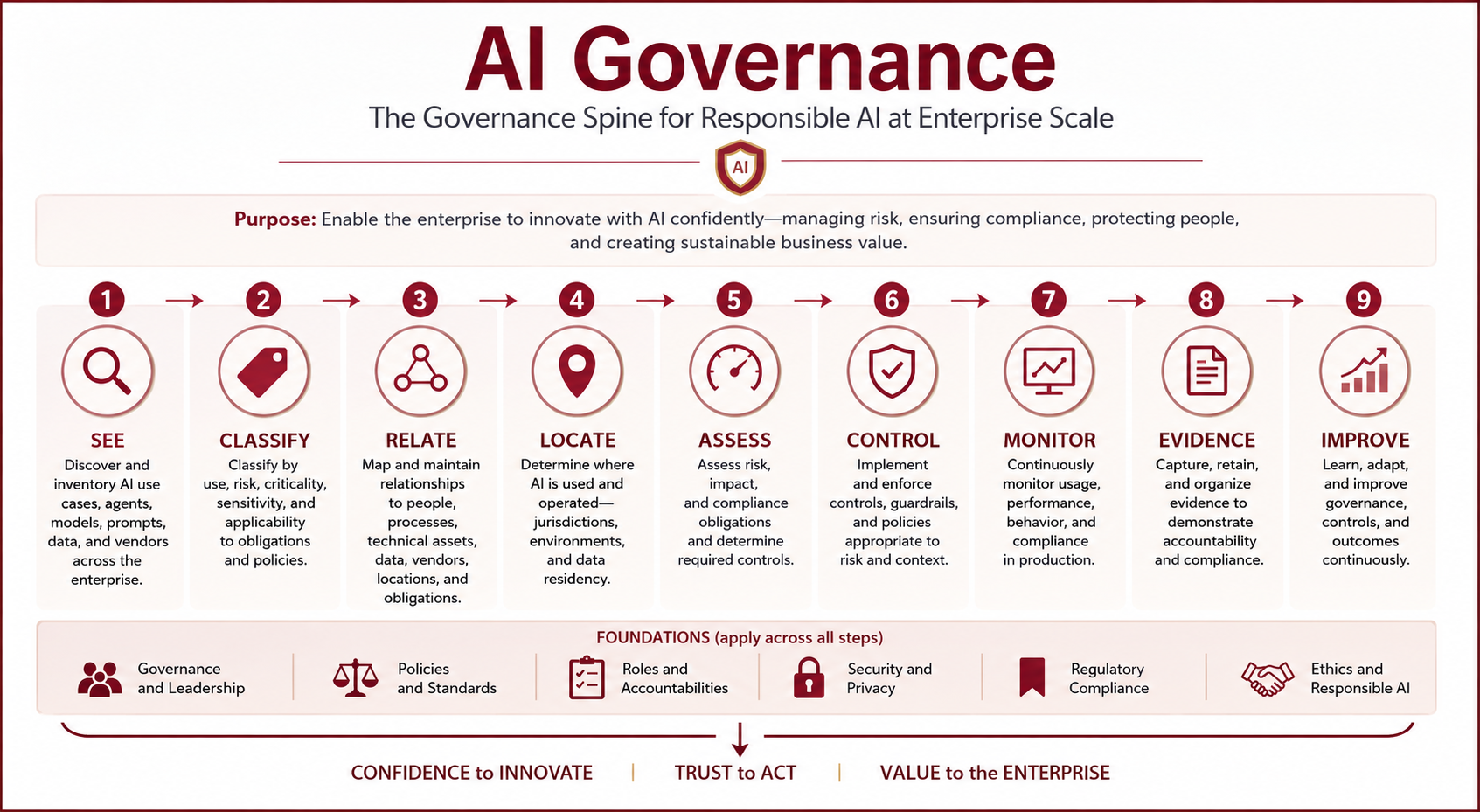
| Governance Spine | Frames the document around the recurring need to see, classify, relate, locate, assess, control, monitor, evidence, and improve AI. |
| Practical Adaptation | Explains that each enterprise must adapt the practices to its sector, scale, risk posture, regulatory environment, and AI adoption maturity. |
Quick Q&A
Question: Why should readers start with the About This Document chapter?
Question: How should an enterprise use this document without treating it as a rigid mandate?
Read More Below
Purpose of This Document
Enterprise AI Governance Best Practices defines the governance discipline an enterprise needs to make artificial intelligence visible, accountable, controlled, auditable, and improvable across business, technology, data, vendor, regulatory, and operational domains.
The purpose of this document is to help IT leaders and IT practitioners establish order in an environment where AI is already spreading across the organization. Business teams are experimenting with AI tools. Engineers are using AI to accelerate delivery. Vendors are embedding AI into products. Support teams are deploying AI agents. Leaders are being held accountable for AI uses they may not yet be able to fully see.
This document explains how enterprises can govern AI through inventories, relationships, ownership, decision rights, controls, runtime monitoring, evidence, measurement, and continuous improvement. It does not assume that the enterprise is starting from a clean slate. It assumes that AI already exists in scattered, uneven, and partially governed forms, and that the enterprise must discover, classify, govern, and improve what already exists while also establishing discipline for what comes next.
Intended Audience
This document is written for two co-primary audiences: IT leaders and IT practitioners.
The leadership audience includes CIOs, CTOs, CISOs, Chief AI Officers, Chief Data Officers, enterprise technology executives, and other leaders accountable for the enterprise’s AI posture. These readers should use the document to understand what governance capabilities must exist, what questions they should ask, and what related items are relevant.
The practitioner audience includes enterprise architects, solution architects, data architects, security architects, AI engineers, platform engineers, software engineers, and governance leads.
How to Read This Document
Leaders should read this document as a governance, accountability, and operating-model guide. They do not need to implement every detail themselves, but they do need to understand what capabilities must exist, what decisions must be made, what risks must be visible, and what evidence is required to demonstrate responsible AI governance.
Practitioners should read this document as a discipline and implementation guide. The document identifies the inventories, relationships, controls, evidence records, monitoring practices, and lifecycle disciplines needed to make AI governance real. Practitioners should pay particular attention to how AI governance connects to existing enterprise architecture, data governance, application governance, security, risk, compliance, vendor management, engineering, and operational practices.
What This Document Is
This document is an IF4IT Best Practices publication. It is intended to define a durable enterprise discipline, not to describe a specific vendor tool, platform, regulation, or implementation method.
It treats enterprise AI governance as an extension of existing enterprise disciplines, not as a wholly separate discipline invented from scratch. Enterprises already govern assets, applications, data, vendors, services, technologies, processes, risks, controls, regulations, obligations, and decisions. AI introduces new governed objects, new operational actors, new risk patterns, new evidence needs, and new regulatory pressures, but it does not eliminate the need for existing governance discipline. Instead, it increases the importance of that discipline.
What This Document Is Not
This document is not a legal opinion, regulatory primer, AI ethics framework, AI safety standard, model-risk-management manual, cybersecurity standard, vendor-platform comparison, or procurement checklist.
Those disciplines matter, and many of them are referenced throughout this document, but they are not replaced by it. The purpose of this document is to define the durable enterprise governance discipline that allows those adjacent disciplines to operate coherently.
Relationship to Other IF4IT Publications
This document builds directly on Enterprise Inventory Management Best Practices and the IF4IT Enterprise Model and Modeling Best Practices.
Enterprise Inventory Management establishes the discipline of governing enterprise inventories: the Noun Types the enterprise needs to identify, define, own, populate, maintain, and improve. The IF4IT Enterprise Model establishes the discipline of relating those Noun Types through a connected Semantic Model of the enterprise.
Enterprise AI Governance depends on both. AI cannot be governed well if AI assets, AI use cases, AI agents, AI models, AI inputs, AI outputs, prompts, vendors, locations, regulations, obligations, controls, risks, incidents, and evidence records are treated as disconnected artifacts.
Where those publications establish the foundations this document builds on, the IF4IT AI Agents Inventory and Attributes document extends it. This document establishes why an AI Agents Inventory is needed and how it is built, governed, and maintained; that document defines the AI Agent as a governed Noun Type and provides the suggested attribute baseline that each agent record should carry.
Core Thesis
The central thesis of this document is that an enterprise cannot govern AI it cannot see, classify, relate, locate, assess, control, monitor, evidence, and improve.
Visibility alone is not enough. The enterprise must also understand what each AI use is, who owns it, what it depends on, where it operates, which stakeholders it affects, which data it consumes, which models and prompts it uses, which vendors are involved, which regulations and obligations apply, which controls are in place, what evidence proves those controls operated, and how the AI use changes over time.
Mandatory Location and Jurisdictional Governance
This document gives mandatory attention to location and jurisdictional operating scope. Enterprises must govern where AI Agents and AI-using technical solutions operate, serve users, process data, affect stakeholders, or produce regulated outcomes.
Location must be understood at the level of granularity required by applicable obligations. In some cases, a broad region such as the European Union, the United States, or a country may be sufficient. In other cases, the relevant location may be a state, province, county, city, town, municipality, facility, service territory, cloud region, data residency zone, or other jurisdictional boundary.
The enterprise cannot determine which laws apply to an AI Agent unless it knows where that agent operates and whom it affects.
Mandatory Regulatory Decomposition
This document also treats regulatory decomposition as a mandatory governance practice. Enterprises must read, dissect, and translate applicable laws, regulations, standards, contractual obligations, and internal policies into governed enterprise data: Regulatory Agencies, Regulations, Regulatory Obligations, applicability conditions, controls, evidence requirements, ownership, lifecycle states, and relationships to AI Agents and other governed Noun Types.
The AI Agents Inventory may act as a primary governance anchor, but regulatory knowledge should not be duplicated as unstructured text inside AI Agent records. It should be governed through appropriate regulatory inventories and connected through the Enterprise Model.
AI-Assisted Governance Work
AI may help accelerate the work of AI governance. Enterprises may use AI to parse regulations, identify candidate obligations, summarize requirements, extract applicability conditions, suggest control mappings, and populate early versions of regulatory inventories.
However, AI-assisted regulatory decomposition is an accelerator, not an authority. Legal, compliance, privacy, security, risk, audit, and accountable business stakeholders must review, validate, correct, and approve the resulting obligations, interpretations, controls, evidence requirements, and mappings before they are treated as authoritative governance content.
Empirical Posture
The initial version of this document is grounded in reasoned enterprise governance discipline and common-sense architectural reasoning. It does not claim to report a multi-year empirical study of AI governance across enterprises.
Future versions may incorporate empirical findings as enterprise AI governance practices mature and evidence accumulates. The current version should be evaluated on whether its reasoning is clear, useful, internally consistent, operationally practical, and aligned with the governance needs enterprises face.
Adaptation by Each Enterprise
Readers should use this document as a practical foundation, not as a one-size-fits-all mandate. Each enterprise must adapt the practices to its size, sector, regulatory environment, risk posture, operating model, technology landscape, vendor ecosystem, and AI adoption maturity.
The best practices described here are intended to help enterprises start with visibility, build governed inventories, connect those inventories through a Semantic Model, assign accountability, establish controls, preserve evidence, monitor runtime behavior, respond to incidents, and improve governance over time.
How to cite this page
When referencing this page in academic work, internal standards, or external publications, include the page title, IF4IT as author and publisher (The International Foundation for Information Technology (IF4IT), LLC), the URL, and your access date.
Example (informal web citation):
The International Foundation for Information Technology (IF4IT), LLC. About This Document | Enterprise AI Governance Best Practices. https://if4it.org/best-practices/enterprise-ai-governance-best-practices/about-this-document/ (accessed 2026-09-11).
See About Us for content governance and site-wide citation guidance.
Copyright for The International Foundation for Information Technology (IF4IT), LLC: 2008 - Present
Legal Disclaimers