Enterprise AI Governance Best Practices - Adopt Enterprise AI Governance in the Enterprise
Enterprise AI Governance Best Practices
Chapter 35. Adopt Enterprise AI Governance in the Enterprise
Why Adoption Requires a Deliberate Approach
Enterprise AI Governance should be adopted deliberately because AI governance affects business strategy, technology delivery, data use, vendor management, security, privacy, legal, compliance, risk, audit, records management, operations, and employee behavior.
The enterprise should not treat AI governance as a single policy release, a one-time inventory exercise, or the creation of an AI review committee. Those actions may be useful, but they are not sufficient. Enterprise AI Governance becomes real only when governance practices are embedded into how the enterprise discovers, approves, designs, builds, buys, deploys, monitors, changes, evidences, and retires AI.
Adoption must also account for the fact that the enterprise is unlikely to start from zero. AI is probably already in use. Employees may already use productivity AI. Developers may already use coding assistants. Vendors may already have embedded AI into existing products. Business teams may already be experimenting with AI-enabled workflows. Some uses may be approved. Some may be unmanaged. Some may be unknown.
The adoption challenge is therefore twofold: govern what already exists and establish better discipline for what comes next.
Start with Visibility
The first adoption priority should be visibility.
The enterprise should identify where AI is already being used, where AI is being proposed, where vendors have embedded AI, where employees are using productivity tools, where AI Agents are being piloted, where AI interacts with sensitive data, where customer-facing or employee-impacting AI exists, and where AI may already be operating outside formal governance.
Visibility does not require a perfect inventory on day one. It requires a practical starting point. The enterprise can begin with discovery campaigns, business-unit surveys, procurement review, vendor-product review, architecture review, security-tool analysis, developer-tool review, SaaS administration review, data-access review, service-management review, and interviews with business and technology owners.
The goal is to create enough visibility to classify AI activity, prioritize risk, identify immediate exposure, and establish a governed path forward.
Establish the Minimum Viable AI Governance Model
Enterprises should begin with a minimum viable AI governance model before attempting full maturity.
A minimum viable model should define the initial AI Use Case intake process, required ownership, risk classification, approved and prohibited uses, data-use boundaries, vendor AI review, AI Agent review, location and jurisdiction review, retention expectations, evidence requirements, and escalation paths.
It should identify the first set of governed inventories or views: AI Use Cases, AI Agents, AI Models, AI Prompts, AI Risks, AI Incidents, Evidence Records, Regulatory Obligations, Controls, Locations / Jurisdictions, Vendors, Data and Information, and technical assets that contain or invoke AI.
The minimum viable model should be usable. If the first governance model is too complex, teams will avoid it. If it is too vague, it will not govern anything. The enterprise should choose a starting model that is clear, enforceable, scalable, and capable of improving over time.
Prioritize by Risk and Exposure
AI governance adoption should be risk-based.
The enterprise should not attempt to govern every AI use with the same depth at the same time. Instead, it should prioritize AI uses that are customer-facing, employee-impacting, regulated, high-risk, agentic, vendor-provided, sensitive-data-related, regionally complex, operationally critical, or already in production.
High-priority targets may include AI Agents that can act on systems, AI use in customer service, AI use in HR or employment processes, AI use in regulated decisions, AI use involving personal or sensitive data, AI embedded in major vendor platforms, AI used in software engineering, and AI operating in jurisdictions with specific obligations.
Lower-risk productivity uses can be governed through approved tools, data-use rules, training, retention policy, and lightweight monitoring.
Risk-based adoption helps the enterprise focus governance effort where it matters most.
Integrate with Existing Governance Functions
Enterprise AI Governance should be integrated with existing enterprise governance functions.
AI governance should connect to enterprise architecture, application governance, data governance, security governance, privacy, legal, compliance, risk management, audit, vendor management, procurement, records management, engineering, operations, service management, incident management, and change management.
This integration matters because AI governance cannot succeed as a disconnected governance island. Procurement should identify vendor AI. Audit should assess evidence readiness.
The adoption goal is to make existing governance processes AI-aware while adding AI-specific practices where existing processes are insufficient.
Define Governance Roles and Decision Rights
Adoption requires clear governance roles and decision rights.
The enterprise should define who owns AI Use Cases, AI Agents, AI Models, AI Prompts, data sources, vendor AI, controls, evidence, risks, incidents, and regulatory mappings. It should define who can approve AI use, who can approve sensitive data use, who can approve AI Agent authority, who can approve vendor AI, who can approve regional operation, who can approve exceptions, and who can accept residual risk.
Without clear decision rights, AI governance becomes slow, inconsistent, and difficult to defend. Teams may proceed without approval because they do not know who can approve. Reviewers may block work because authority is unclear. Leaders may be accountable for risks without knowing which decisions were made.
Decision rights should be documented, communicated, and evidenced.
Build the Governance Data Foundation
Enterprise AI Governance depends on governed data.
The enterprise should build the data foundation needed to support AI governance decisions. This does not mean all inventories must be perfect before governance begins. It means the enterprise should begin populating the records and relationships required for visibility, classification, risk assessment, control mapping, evidence, monitoring, and reporting.
The initial governance data foundation should include enough information to answer: What AI exists? Why is it used? Who owns it? What category is it? What risk tier is it? What data does it use? Which vendor is involved? Which technical assets contain or invoke it? Which locations or jurisdictions are affected? Which controls apply? What evidence exists? What is overdue for review?
Over time, the data foundation should mature into connected inventories and Enterprise Model relationships that support impact analysis, regulatory mapping, evidence readiness, and continuous improvement.
Establish Evidence and Retention Practices Early
Evidence and retention practices should be established early in AI governance adoption.
The enterprise should define what evidence is required for AI approval, AI Agent authority, AI Model evaluation, AI Prompt testing, data review, vendor review, location review, regulatory obligation mapping, control operation, incident response, and change approval.
The enterprise should define retention rules for AI interactions, AI outputs, AI responses, transcripts, tool calls, runtime traces, test records, incident records, and evidence records. Retention should be driven by laws, regulations, contracts, records-management policy, risk, business-record requirements, legal hold, audit, and AI Agent-specific needs.
If evidence and retention are not defined early, the enterprise may approve AI uses without being able to prove governance later.
Communicate, Train, and Enable
AI governance adoption requires communication, training, and enablement.
Employees should understand which AI tools are approved, which uses are prohibited, which data may be used, when human review is required, how outputs should be handled, how retention works, and how to report AI concerns.
Leaders should understand their accountability, decision rights, risk posture, investment needs, and evidence expectations. Practitioners should understand intake, classification, inventories, relationship mapping, controls, testing, monitoring, evidence, and incident response.
The enterprise should make governed AI adoption easier than unmanaged AI adoption. This may require approved tools, reusable patterns, templates, intake workflows, control libraries, AI Prompt libraries, testing patterns, vendor review checklists, training materials, and support channels.
Governance should enable responsible adoption, not restrict behavior.
Mature the Program Over Time
Enterprise AI Governance should mature over time.
A basic maturity stage may focus on policy, intake, approved tools, use case inventory, owner assignment, and risk classification. A developing stage may add AI Agent inventory, vendor AI review, data-use review, AI Prompt governance, retention rules, and evidence packages. A mature stage may add connected Enterprise Model relationships, runtime monitoring, regulatory obligation mapping, AI Agent-to-Location mappings, automated evidence collection, control testing, incident analytics, and executive dashboards.
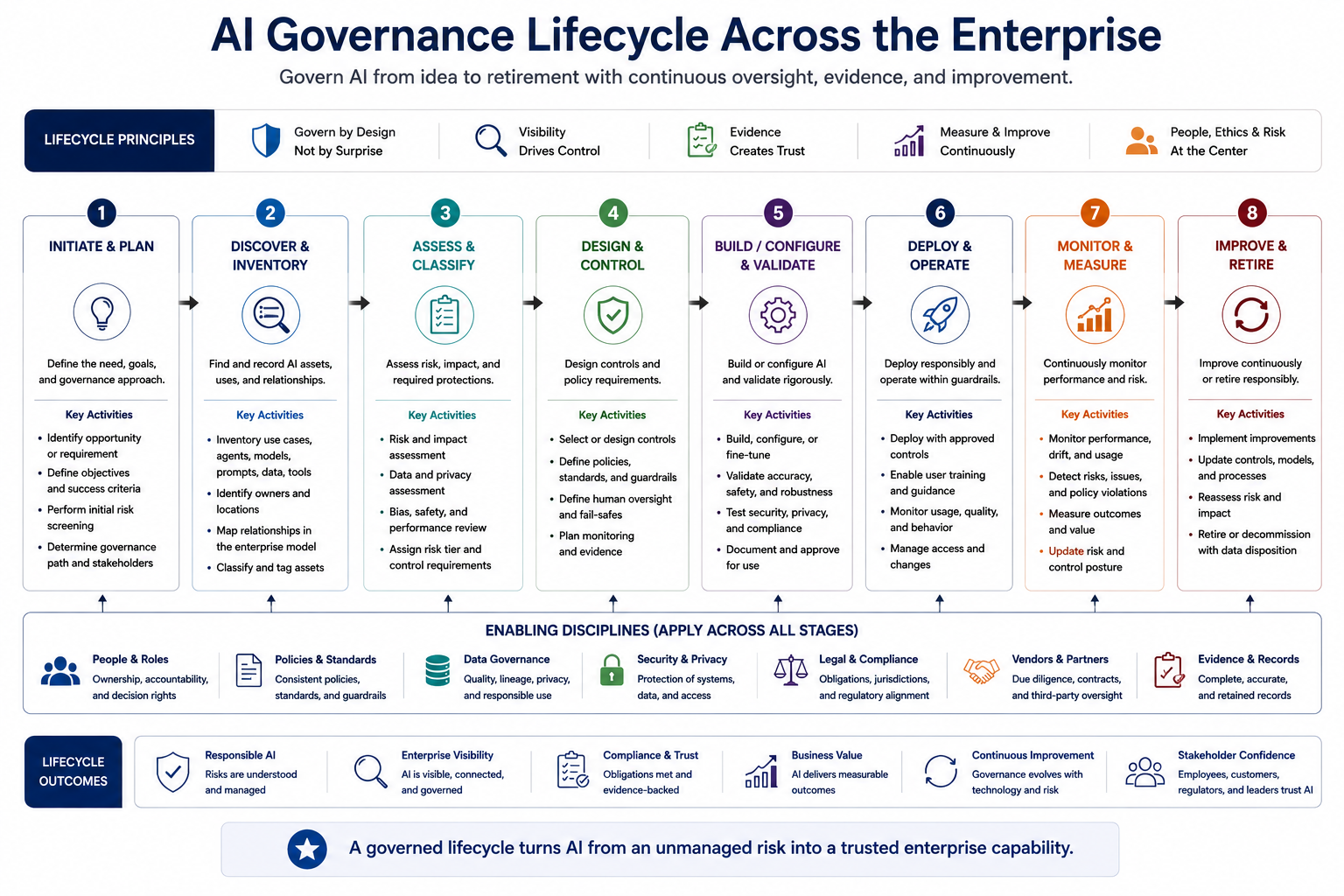
Figure: AI Governance Lifecycle Across the Enterprise
The enterprise should not wait for perfect maturity to begin. It should start with practical controls, learn from use, improve governance data, strengthen evidence, and expand automation as the program matures.
Adoption is successful when AI governance becomes part of how the enterprise operates, not a special process used only when someone remembers to invoke it.
Governance Questions for AI Governance Adoption
For aI Governance Adoption, governance should answer what exists, who owns it, what is affected, which risks, obligations, controls, evidence, incidents, changes, and gaps require action.
Copyright for the International Foundation for Information Technology (IF4IT): 2008 - Present
Legal Disclaimers