Govern Agentic AI That Acts on Systems - Enterprise AI Governance Best Practices
Govern Agentic AI That Acts on Systems
(Chapter 30 of Enterprise AI Governance Best Practices)
Executive Summary: Chapter Overview
IF4ITThe Bottom Line
Core Concepts
| Concept | Definition & Strategic Role |
|---|---|
| Agentic AI | AI that can pursue goals, choose or recommend actions, invoke tools, call APIs, execute workflows, interact with systems, or take actions. |
| Permission Boundary | The defined limit on what an AI Agent may access, invoke, modify, execute, or affect. |
| Kill Switch | A mechanism for quickly disabling, suspending, isolating, or limiting an AI Agent or AI-enabled workflow. |
Quick Q&A
Question: Why does agentic AI require stronger governance than advisory AI?
Question: What must be approved before an AI Agent acts on systems?
Read More Below
Why Agentic AI Requires Stronger Governance
Agentic AI requires stronger governance because it can act.
An AI capability that only drafts text or summarizes information may create risk, but an AI Agent that can use tools, invoke APIs, execute workflows, update records, send messages, create tickets, modify configurations, write code, trigger automations, or operate against production systems creates a different level of enterprise exposure.
Agentic AI shifts the governance question from “What did the AI say?” to “What can the AI do, under whose authority, against which systems, using which data, in which locations, and with what controls?”
This makes Agentic AI one of the highest-priority categories for Enterprise AI Governance. The enterprise must govern authority, access, autonomy, tools, prompts, models, data, runtime behavior, monitoring, containment, incident response, evidence, and lifecycle change.
What Agentic AI Is
Agentic AI is AI that can pursue goals, make decisions within a defined scope, use tools, invoke APIs, execute workflows, interact with systems, or take actions on behalf of a user, team, process, or enterprise function.
Agentic AI may be fully autonomous, semi-autonomous, supervised, event-driven, workflow-driven, conversational, embedded in an Application, exposed through a Vendor Product, or deployed as part of an operations platform.
Not every AI assistant is agentic. A simple chatbot that only answers questions from a static knowledge base may not require full agentic governance. However, when AI can choose actions, call tools, operate across systems, retain context, trigger workflows, or modify enterprise records, it should be governed as Agentic AI.
The governance posture should be based on practical authority and impact, not on marketing terminology.
Agentic AI and the AI Agents Inventory
Agentic AI must be anchored in the AI Agents Inventory.
Each AI Agent should have a governed record that identifies the agent’s name, purpose, owner, supported AI Use Cases, autonomy level, authority level, users, affected stakeholders, AI Models, AI Prompts, Data and Information sources, tools, APIs, systems accessed, permissions, technical assets, vendor dependencies, Locations / Jurisdictions, Controls, monitoring, incidents, lifecycle state, and Evidence Records.
The AI Agents Inventory must answer the core question: what can this agent do?
An agent should not be approved because its purpose sounds acceptable. It should be approved based on its actual authority, access, tools, data, operating scope, risk, controls, monitoring, and evidence.
Authority, Autonomy, and Permission Boundaries
Agentic AI governance should classify each AI Agent by authority, autonomy, and permission boundaries.
Authority describes what the agent is allowed to affect. An agent may have read-only authority, draft-only authority, recommendation authority, ticket-creation authority, record-update authority, transaction authority, communication authority, code-generation authority, infrastructure-change authority, or production-action authority.
Autonomy describes how independently the agent may operate. An agent may require human approval for every action, operate under human supervision, act autonomously within strict limits, or execute actions automatically based on events.
Permission boundaries define the systems, data, actions, users, locations, and conditions under which the agent may operate.
Higher authority and higher autonomy require stronger governance. An agent that drafts a response for human review requires less control than an agent that sends customer communications, updates claims records, modifies access permissions, deploys code, restarts services, or changes production infrastructure.
Tool, API, Workflow, and System Access
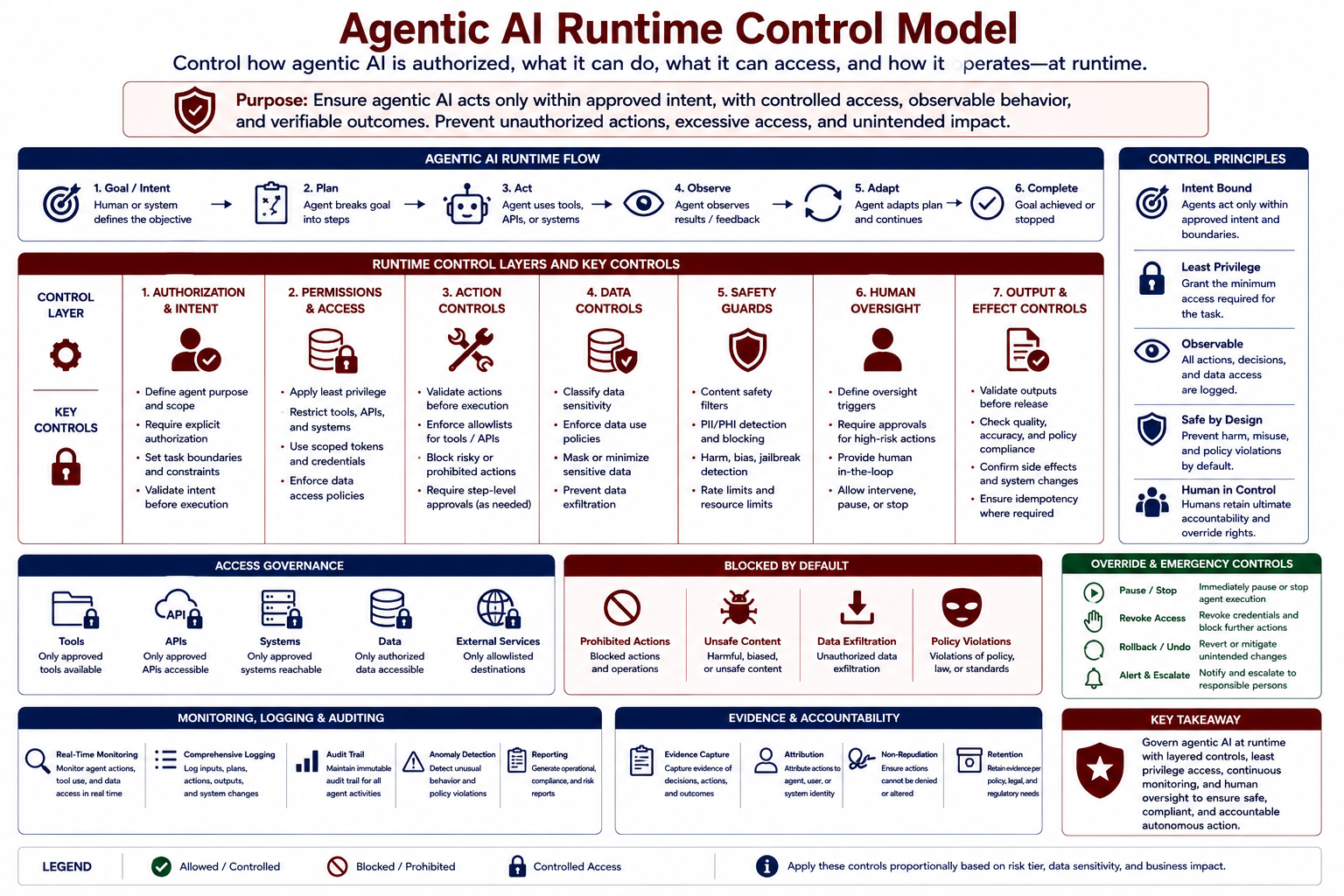
Agentic AI governance must explicitly control tool, API, workflow, and system access.
An agent’s toolset defines its operational power. The enterprise should know which tools the agent can invoke, which APIs it can call, which workflows it can trigger, which systems it can read, which systems it can write to, which credentials or identities it uses, which permissions it has, and which actions are prohibited.
The enterprise should apply least privilege to AI Agents. Agents should receive only the access needed for approved use cases. Access should be time-bound, reviewed, monitored, and revoked when no longer needed.
Some relationships may need to be reified into governed mapping records. For example, an AI Agent-to-API permission relationship may need approval status, allowed actions, prohibited actions, effective dates, access owner, control requirements, review frequency, and evidence.
Human Oversight and Approval Patterns
Agentic AI requires explicit human oversight and approval patterns.
Some agents should operate human-in-the-loop, where a person must approve actions before execution. Others may operate human-on-the-loop, where humans supervise activity and intervene when needed. Some low-risk agents may operate without direct human approval, but only within approved constraints and with appropriate monitoring.
The oversight pattern should be determined by the agent’s risk, authority, autonomy, affected stakeholders, data sensitivity, location scope, regulatory obligations, and operational criticality.
The enterprise should define when approval is required, who may approve, what information the approver must see, how approval is recorded, when escalation is required, how override works, and what evidence is retained.
Human oversight should not be a vague statement. It should be designed into the workflow and evidenced.
AI Prompts, Policies, and Behavioral Boundaries
Agentic AI behavior is shaped by AI Prompts, policies, configuration, model behavior, tool instructions, memory, context, and workflow rules.
The AI Prompts used by an AI Agent may define its role, authority, prohibited actions, escalation behavior, tool-use rules, data-handling instructions, output format, tone, disclosure behavior, regional restrictions, and human-approval requirements.
Because AI Prompts can materially change agent behavior, they must be governed. Production agent prompts should be versioned, reviewed, tested, approved, monitored, and connected to the AI Agents Inventory.
Agent behavioral boundaries should not depend only on prompts. Technical controls, access restrictions, policy engines, workflow gates, rate limits, and monitoring should reinforce prompt-level instructions.
Runtime Monitoring and Action Traceability
Agentic AI requires runtime monitoring and action traceability.
The enterprise should monitor what the agent does, not only what it says. Monitoring should include prompts, responses, tool calls, API invocations, data access, system actions, approval events, exceptions, escalations, errors, policy violations, output quality, incidents, model versions, AI Prompt versions, and runtime context.
Action traceability is especially important. If an agent updates a record, sends a message, creates a ticket, modifies a configuration, executes a script, or triggers a workflow, the enterprise should reconstruct the action. It should know what instruction caused it, which agent performed it, which identity was used, which control applied, whether approval occurred, what system was affected, and what result occurred.
Runtime monitoring and traceability should connect to AI Interaction, Output, and Evidence Retention rules.
Containment, Kill Switches, and Rollback
Agentic AI must have containment and rollback mechanisms.
If an agent behaves incorrectly, exceeds authority, triggers the wrong action, exposes data, causes operational disruption, or violates a control, the enterprise must be able to intervene quickly.
Containment mechanisms may include disabling the agent, revoking credentials, blocking tool access, suspending API permissions, disabling a workflow, isolating the runtime environment, rolling back a prompt or model version, restricting the agent to read-only mode, blocking a location, limiting users, or routing all actions to human approval.
Rollback mechanisms may be needed when an agent changes records, configurations, tickets, code, workflows, or operational states. The enterprise should know which actions can be reversed, how reversal occurs, who approves rollback, and what evidence is retained.
Agentic AI should not be deployed without a defined containment plan proportionate to its authority and risk.
Location and Jurisdictional Scope for Agents
Agentic AI must be governed by location and jurisdictional operating scope.
An AI Agent may operate in one location, serve users in another, process data in a cloud region, affect stakeholders in multiple jurisdictions, or trigger actions in systems subject to regional obligations. The same agent may be approved in one jurisdiction, restricted in another, and prohibited in a third.
The enterprise should define where each agent may operate, which locations it serves, which data-residency rules apply, which regional disclosures or restrictions apply, which local obligations govern its behavior, and which evidence proves regional approval.
For mature governance, AI Agent-to-Location relationships may be reified when they require approval status, regional controls, applicability rationale, restrictions, effective dates, and evidence.
Agentic AI Incidents
Agentic AI incidents require special attention because they may involve actions, not just outputs.
An agent may take an unauthorized action, call the wrong API, update the wrong record, send an incorrect communication, expose sensitive data, trigger an inappropriate workflow, misclassify a case, execute an unsafe command, escalate incorrectly, ignore a restriction, or act outside its approved jurisdiction.
Incident response should identify the agent, use case, model, AI Prompt, user, technical asset, tools, APIs, data, location, control failure, affected stakeholders, action taken, evidence preserved, and remediation performed.
Agent incidents should feed back into governance. They may require prompt changes, model reassessment, access reduction, control redesign, monitoring changes, user training, vendor escalation, location restriction, or agent suspension.
Lifecycle Governance for Agentic AI
Agentic AI requires disciplined lifecycle governance.
The lifecycle should include proposal, design, risk assessment, authority definition, data review, tool review, prompt review, model review, security review, privacy review, location review, testing, red teaming, approval, pilot, production release, monitoring, periodic reassessment, incident response, change management, suspension, retirement, and decommissioning.
An agent should be reassessed when its purpose changes, authority changes, autonomy changes, tools change, APIs change, permissions change, prompts change, models change, data changes, technical assets change, vendor behavior changes, location scope changes, incidents occur, or obligations change.
The key governance rule is that agent authority must not drift beyond its approved scope.
Governance Questions for Agentic AI
For Agentic AI, governance should answer what exists, who owns it, what is affected, which risks, obligations, controls, evidence, incidents, changes, and gaps require action.
How to cite this page
When referencing this page in academic work, internal standards, or external publications, include the page title, IF4IT as author and publisher (The International Foundation for Information Technology (IF4IT), LLC), the URL, and your access date.
Example (informal web citation):
The International Foundation for Information Technology (IF4IT), LLC. Govern Agentic AI That Acts on Systems | Enterprise AI Governance Best Practices. https://if4it.org/best-practices/enterprise-ai-governance-best-practices/govern-agentic-ai-that-acts-on-systems/ (accessed 2026-09-11).
See About Us for content governance and site-wide citation guidance.
Copyright for The International Foundation for Information Technology (IF4IT), LLC: 2008 - Present
Legal Disclaimers