Govern AI Decision Rights and the Operating Model - Enterprise AI Governance Best Practices
Govern AI Decision Rights and the Operating Model
(Chapter 34 of Enterprise AI Governance Best Practices)
Executive Summary: Chapter Overview
IF4ITThe Bottom Line
Core Concepts
| Concept | Definition & Strategic Role |
|---|---|
| Decision Rights | The explicit authority to make AI governance decisions, including approvals, exceptions, risk acceptances, releases, controls, and escalations. |
| Operating Model | The roles, responsibilities, workflows, review forums, approvals, escalations, controls, evidence practices, and reporting structures used to run AI governance. |
| Accountability Path | The traceable connection from AI use to owners, reviewers, approvers, risk acceptors, control owners, incident responders, and evidence custodians. |
Quick Q&A
Question: Why do decision rights matter as much as policies in AI governance?
Question: What should the AI governance operating model prevent?
Read More Below
Why AI Decision Rights Matter
Enterprise AI Governance requires clear decision rights because AI decisions often cross organizational boundaries.
An AI Use Case may involve a business owner, data owner, Application owner, AI Agent owner, AI Model owner, vendor owner, security reviewer, privacy reviewer, legal reviewer, compliance reviewer, risk reviewer, audit function, records-management function, engineering team, operations team, and executive sponsor.
If decision rights are unclear, AI governance becomes slow, inconsistent, political, or ineffective. Teams may not know who can approve AI use, who can reject it, who can accept risk, who can approve vendor AI, who can approve sensitive data use, who can enable agentic authority, who can approve regional operation, who can override a control, or who can retire an AI capability.
AI decision rights define who has authority to make which AI governance decisions under which conditions.
The AI Governance Operating Model
The AI governance operating model defines how the enterprise makes AI governance decisions, assigns accountability, operates controls, monitors AI, handles incidents, maintains evidence, and improves over time.
The operating model should define governance bodies, roles, responsibilities, workflows, escalation paths, review forums, approval gates, control owners, evidence owners, and reporting structures.
It should connect AI governance to existing enterprise functions. AI governance should not be isolated from enterprise architecture, security, privacy, legal, compliance, data governance, vendor management, procurement, records management, engineering, operations, risk management, audit, and business ownership.
The operating model should make existing governance functions AI-aware while adding AI-specific decision rights where existing practices are insufficient.
Core AI Governance Roles
Enterprise AI Governance should define core roles.
Common roles include AI Use Case Owner, AI Agent Owner, AI Model Owner, AI Prompt Owner, Data Owner, Data Steward, Application Owner, Platform Owner, Vendor Owner, Control Owner, Evidence Owner, Risk Owner, Business Owner, Product Owner, Security Reviewer, Privacy Reviewer, Legal Reviewer, Compliance Reviewer, Records Owner, Audit Reviewer, Architecture Reviewer, Engineering Owner, Operations Owner, and Executive Sponsor.
Not every role needs to be separate in every enterprise. Smaller organizations may combine roles. Larger organizations may formalize them. Importantly, accountability must be clear.
Each role should understand what it owns, what decisions it may make, what evidence it must produce, what reviews it must perform, and what escalations it must trigger.
Decision Rights by AI Lifecycle Stage
AI decision rights should align to the AI lifecycle.
During intake, the enterprise must decide whether a proposed AI Use Case is allowed, restricted, prohibited, or subject to deeper review. During design, the enterprise must decide which data, models, AI Prompts, vendors, technical assets, controls, and locations are acceptable. During retirement, the enterprise must decide how outputs, logs, evidence, data, access, and dependencies are decommissioned or retained.
Each lifecycle stage should have clear approvers and evidence requirements.
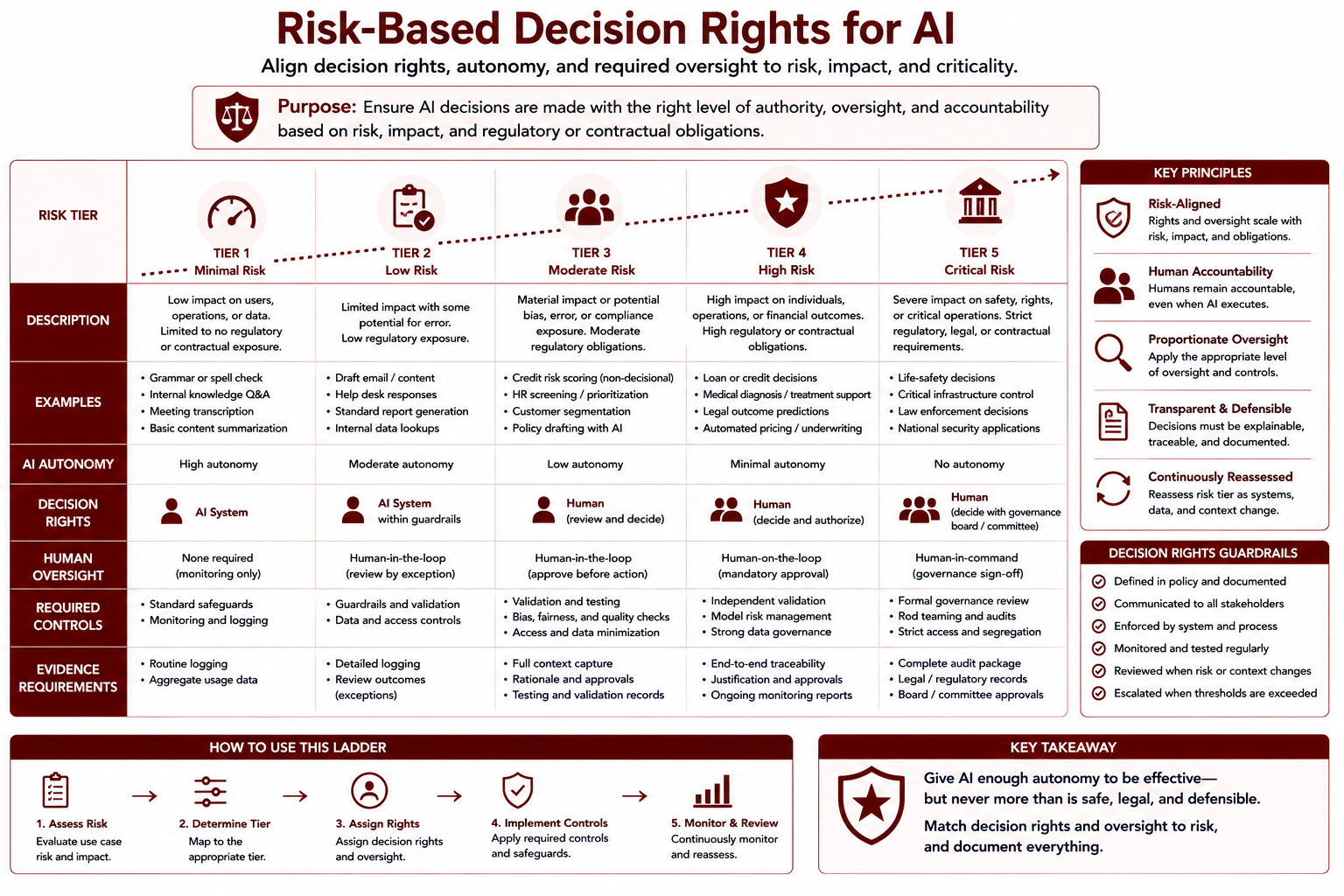
Decision Rights by Risk Tier
AI decision rights should also vary by risk tier.
Low-risk AI uses may be approved through lightweight pathways if they use approved tools, approved data, approved patterns, and standard controls. Moderate-risk uses may require business-owner approval, data review, and security or privacy review. High-risk uses may require cross-functional review, legal or compliance input, formal testing, executive visibility, and stronger evidence. Prohibited uses should be blocked or escalated for exceptional review if allowed by policy.
Agentic AI, customer-facing AI, employee-impacting AI, regulated AI, sensitive-data AI, and vendor AI should have explicit decision-right patterns.
The enterprise should avoid using the same review process for every AI use. Over-governing low-risk uses creates friction and Shadow AI. Under-governing high-risk uses creates exposure.
Cross-Functional Review
AI governance decisions often require cross-functional review.
Security may assess access, attack surface, prompt injection, tool use, and monitoring. Privacy may assess personal data, consent, minimization, retention, and data subject rights. Operations may assess supportability, monitoring, incident response, and rollback.
The operating model should define when each function must participate and what decision authority each function holds.
Cross-functional review should produce evidence, not only meeting discussion.
AI Governance Bodies and Forums
Many enterprises will need governance bodies or forums to coordinate AI decisions.
These may include an AI Governance Council, AI Risk Committee, Architecture Review Board, Data Governance Council, Model Risk Committee, Vendor Risk Committee, Security Review Forum, Privacy Review Forum, or executive AI oversight group.
The purpose of these bodies should be explicit. Some may set policy. Some may approve high-risk uses. Some may review exceptions. Some may monitor portfolio risk. Some may resolve cross-functional conflicts. Some may oversee evidence readiness and regulatory posture.
The enterprise should avoid creating governance bodies that duplicate existing functions without clear authority. Governance forums should make decisions, assign actions, resolve escalations, and preserve evidence.
Exception, Escalation, and Risk Acceptance Authority
The operating model must define who can approve exceptions, escalations, and risk acceptances.
Exceptions may involve use of restricted data, use of a non-standard model, deployment in a sensitive location, temporary control gaps, vendor limitations, retention deviations, prompt-review exceptions, or agent permission exceptions.
Escalations may arise when reviewers disagree, when risk is high, when obligations are unclear, when incidents occur, when evidence is missing, or when business pressure conflicts with governance requirements.
Risk acceptance authority should be proportionate to risk. A low-risk exception may be approved by a use case owner or governance lead. A high-risk exception may require executive, legal, compliance, security, or risk approval.
All exceptions and risk acceptances should be time-bound, reviewed, evidenced, and connected to affected AI assets.
Operating Model Integration with Enterprise Processes
AI governance should be integrated into existing enterprise processes.
AI governance should connect to procurement, vendor onboarding, application intake, architecture review, data-access approval, security review, privacy impact assessment, model review, prompt review, release management, change management, incident management, audit planning, records management, and decommissioning.
This integration matters because AI governance cannot rely on a standalone intake form that teams bypass. AI governance must appear where AI work actually happens.
For example, procurement should ask whether a Vendor Product contains AI. Architecture review should ask whether an Application invokes AI. Data-access review should ask whether data will be used by AI. Change management should ask whether a model, AI Prompt, tool, or agent authority changed. Incident management should ask whether AI was involved.
Evidence of Decision Rights and Governance Operation
The enterprise should preserve evidence that decision rights and operating-model processes operated.
Evidence may include intake records, approvals, review comments, decision logs, risk assessments, control mappings, exception approvals, training attestations, release approvals, access reviews, vendor reviews, AI Prompt approvals, model evaluations, location approvals, incident records, and governance meeting decisions.
Evidence should show who made the decision, what information was considered, which controls or obligations applied, what risks were accepted, what conditions were imposed, and when the decision must be reviewed.
A decision right without evidence is difficult to defend.
Governance Questions for Decision Rights and Operating Model
For the Decision Rights and Operating Model, governance should answer what exists, who owns it, what is affected, which risks, obligations, controls, evidence, incidents, changes, and gaps require action.
How to cite this page
When referencing this page in academic work, internal standards, or external publications, include the page title, IF4IT as author and publisher (The International Foundation for Information Technology (IF4IT), LLC), the URL, and your access date.
Example (informal web citation):
The International Foundation for Information Technology (IF4IT), LLC. Govern AI Decision Rights and the Operating Model | Enterprise AI Governance Best Practices. https://if4it.org/best-practices/enterprise-ai-governance-best-practices/govern-ai-decision-rights-and-the-operating-model/ (accessed 2026-09-20).
See About Us for content governance and site-wide citation guidance.
Copyright for The International Foundation for Information Technology (IF4IT), LLC: 2008 - Present
Legal Disclaimers