Govern AI Interaction, Output, and Evidence Retention - Enterprise AI Governance Best Practices
Govern AI Interaction, Output, and Evidence Retention
(Chapter 24 of Enterprise AI Governance Best Practices)
Executive Summary: Chapter Overview
IF4ITThe Bottom Line
Core Concepts
| Concept | Definition & Strategic Role |
|---|---|
| AI Interaction Transcript | A retained record of prompts, responses, context, tool calls, timestamps, users, agent identifiers, model versions, prompt versions, and system actions. |
| AI Retention Policy | The enterprise policy defining which AI artifacts are retained, purged, placed on hold, or preserved as business records. |
| Hold Management | The discipline for suspending ordinary deletion when litigation, audit, regulatory inquiry, investigation, or AI Incident response requires preservation. |
Quick Q&A
Question: Why should AI retention rules vary by use case and risk?
Question: What makes AI output retention different from ordinary document retention?
Read More Below
Why AI Retention Requires Explicit Governance
Enterprise AI Governance must include explicit retention rules for AI interactions, AI outputs, AI responses, transcripts, runtime traces, tool calls, retrieved context, test records, incident records, and evidence.
AI creates a retention problem because AI activity can generate large volumes of information quickly. Users may submit prompts. Testing and evaluation activities may generate prompt-response pairs that need to be preserved as evidence.
The enterprise should not assume that all AI interactions should be retained forever. Excessive retention can create privacy, security, legal, cost, confidentiality, and discovery exposure. At the same time, the enterprise should not assume that AI interactions can be deleted casually. Premature deletion can destroy records needed for audit, litigation, regulatory response, incident investigation, testing, validation, customer support, employee review, operational accountability, or control proof.
The correct retention posture is deliberate. It must be driven by obligation, risk, business purpose, evidence need, and records-management discipline.
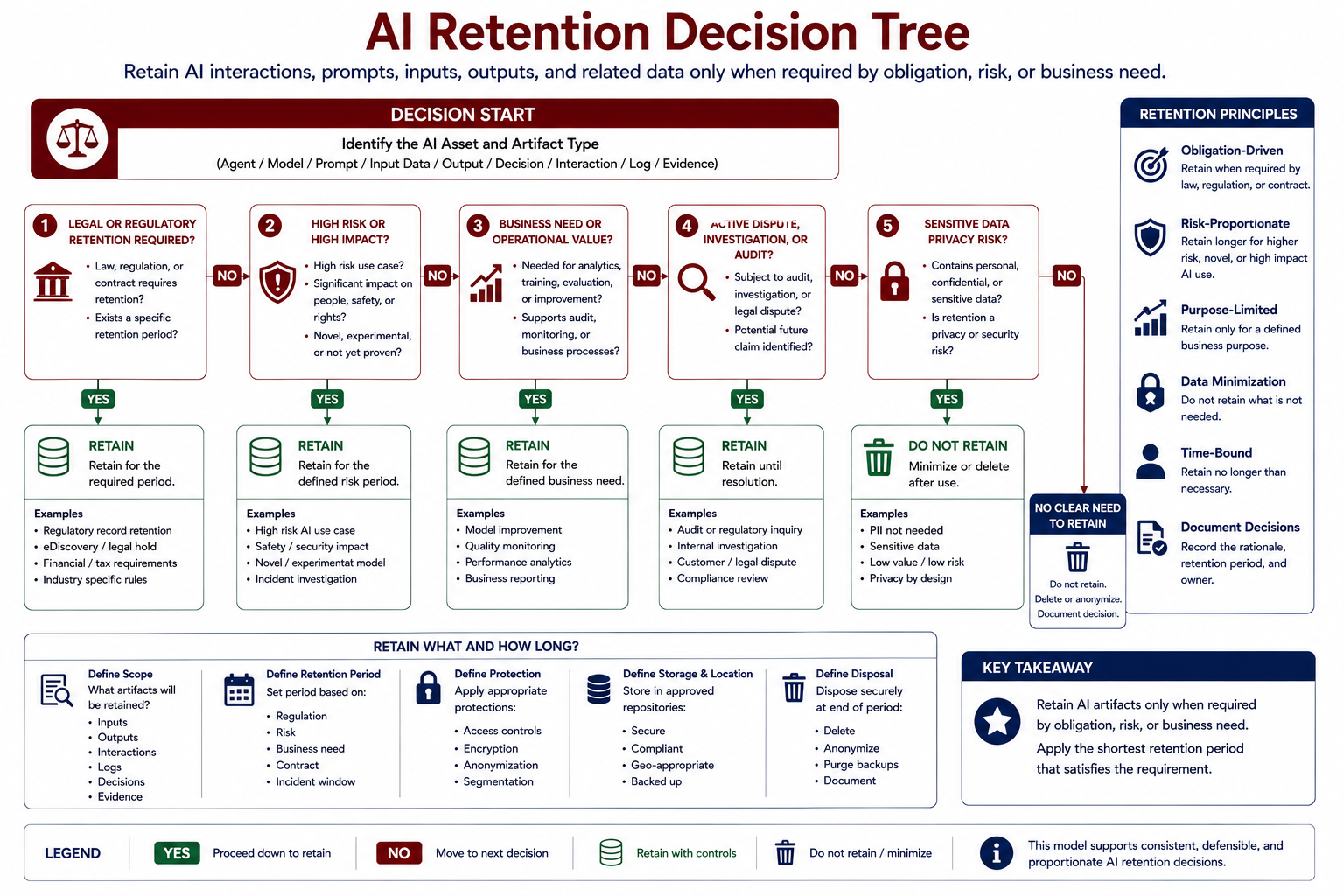
Retention Must Be Driven by Laws, Regulations, Contracts, and Records Policy
AI interaction, output, and evidence retention must be driven by applicable laws, regulations, contractual obligations, internal records-management policies, litigation-readiness needs, audit requirements, privacy obligations, business-record requirements, and AI risk classification.
Different AI uses may require different retention treatment. A low-risk internal productivity assistant may require short transcript retention or metadata-only logging. An AI Agent that can act through APIs may require action logs, approval logs, exception records, and rollback evidence.
The enterprise should avoid a single simplistic rule such as retaining all transcripts for the same period. Instead, retention should be defined by AI use category, risk tier, stakeholder impact, data sensitivity, jurisdiction, regulatory obligations, business-record status, Agent authority, and evidence requirements.
Distinguish AI Prompts, AI Responses, AI Outputs, Interaction Transcripts, and Evidence Records
Enterprise AI Governance should distinguish related but different retention objects.
An AI Prompt is an instruction or context element that guides AI behavior. Governed AI Prompts may be inventoried when they are reused, embedded, productionized, high-risk, agentic, customer-facing, regulated, or control-relevant.
An AI Response is the AI-generated reply or result returned in response to a prompt, instruction, context, event, or workflow step.
An AI Output is a broader concept. It may include generated text, summaries, recommendations, classifications, predictions, code, images, audio, decisions, workflow actions, tickets, reports, risk scores, customer messages, employee communications, or system updates.
An AI Interaction Transcript is a retained record of an interaction or session. It may include prompts, responses, user identity, timestamp, model version, AI Prompt version, retrieved context, tool calls, API invocations, actions taken, approvals, escalations, exceptions, and metadata.
An Evidence Record is a governed record preserved to prove that a decision, control, review, test, approval, incident response, monitoring activity, or remediation occurred.
These concepts should not be collapsed into one broad inventory. They serve different governance purposes and may require different retention periods, access controls, and purge rules.
Do Not Inventory Every Prompt and Response
The enterprise should not create a permanent inventory of every prompt and every response by default.
Doing so would create excessive noise and unnecessary risk. Routine AI interactions may include confidential information, personal information, regulated data, privileged content, security-sensitive information, or low-value drafts that should not be preserved indefinitely. Permanent retention of all prompt-response activity may increase privacy exposure, discovery exposure, breach impact, storage cost, and operational burden.
Instead, the enterprise should inventory governed AI Prompts and retain AI Outputs, AI Responses, prompt-response pairs, transcripts, and runtime traces only when retention is required or justified.
Retention may be justified by testing, validation, model evaluation, AI Prompt approval, incident response, regulatory obligation, litigation hold, audit need, customer communication rules, employee record rules, business-record requirements, control proof, or operational accountability.
The default governance question should not be, “Can we save everything?” It should be, “What must be retained, why must it be retained, for how long, under whose authority, with what protection, and when must it be purged?”
When Prompt-Response Pairs Must Be Preserved
Prompt-response pairs should be preserved when the relationship between the instruction and the AI output has governance value.
This is especially important for testing and validation. If an enterprise uses a prompt-response pair to prove that an AI Model, AI Agent, AI Prompt, Application, Workflow, or Vendor Product behaved correctly, that pair should be retained as test evidence. Regression testing, red-team testing, prompt-injection testing, safety testing, bias testing, hallucination testing, disclosure testing, human-oversight testing, and control testing may all require preserved prompt-response records.
Prompt-response pairs should also be preserved when they are involved in incidents, complaints, regulated decisions, customer-facing communications, employee-impacting processes, legal reviews, audit inquiries, risk acceptances, approvals, or control failures.
The enterprise should connect preserved prompt-response pairs to the relevant AI Use Case, AI Agent, AI Model, AI Prompt, technical asset, Data and Information sources, Location / Jurisdiction, Control, Incident, Risk, and Evidence Record.
This coupling should be selective, not universal. The enterprise should preserve prompt-response pairs when they are needed to prove, explain, validate, investigate, or defend AI behavior.
Enterprise AI Retention Policy
The enterprise should establish, approve, publish, communicate, and enforce an Enterprise AI Retention Policy.
The policy should define what is retained, why it is retained, where it is retained, who may access it, how long it is retained, how it is protected, when it is purged, when legal hold overrides purge, and when AI Agent-specific retention rules supersede the general policy.
The policy should address AI Prompts, AI Responses, AI Outputs, AI Interaction Transcripts, metadata, tool calls, API invocations, retrieved context, runtime traces, model-version references, AI Prompt-version references, user identifiers, approval records, evidence records, and incident records.
The policy should also define retention categories. Low-risk productivity interactions may require limited retention. Agentic AI may require tool-call logs, action records, exception traces, approval records, and rollback evidence.
An AI retention policy should be part of enterprise records management, not an isolated technical setting.
AI Agent-Specific Retention Rules
Some AI Agents require retention rules that are more specific than the general enterprise policy.
AI Agents differ by autonomy, authority, data access, stakeholder impact, location scope, tool access, and regulatory exposure. A general AI retention policy may not be sufficient for an Agent that can act on systems, affect customers, influence employees, process sensitive data, operate in regulated jurisdictions, or trigger workflows.
AI Agent-specific retention rules should define which prompts, responses, outputs, retrieved sources, tool calls, API invocations, actions, approvals, exceptions, escalations, incidents, telemetry, and evidence must be retained for that Agent.
For example, a customer-service Agent may need to retain conversation transcripts according to customer communication and complaint rules. A production-operations Agent may need action logs, approval logs, rollback records, and change traces. A security Agent may need forensic records and incident traces. An HR Agent may need employment-related retention treatment. A regulated decision-support Agent may need prompt, response, model version, AI Prompt version, data context, human reviewer, decision record, and evidence preserved for a defined period.
AI Agent-specific retention rules should be approved, documented, communicated to relevant owners and operators, and connected to the AI Agents Inventory.
Metadata-Only Logging vs. Full Transcript Retention
The enterprise should distinguish metadata-only logging from full-content transcript retention.
Metadata-only logging may capture user, timestamp, AI capability, AI Agent, AI Model, AI Prompt version, session identifier, risk category, location, tool usage, token count, action type, approval status, error status, or retention category without retaining the full prompt and response content.
Full transcript retention may capture the prompt, response, retrieved context, tool calls, action traces, uploaded files, generated outputs, and session history.
Metadata-only logging may be appropriate for low-risk uses, privacy-sensitive contexts, or cases where usage monitoring is needed but content retention would create unnecessary exposure. Full transcript retention may be required for high-risk, regulated, customer-facing, employee-impacting, agentic, incident-related, or evidence-relevant uses.
The enterprise should choose the least-retentive option that still satisfies legal, regulatory, audit, operational, evidence, and business needs.
Tool Calls, Actions, Retrieved Context, and Runtime Traces
For AI Agents and AI-enabled workflows, retention must extend beyond prompts and responses.
The enterprise may need to retain tool calls, API invocations, retrieved context, workflow steps, system actions, approvals, escalations, exceptions, errors, monitoring alerts, and rollback actions. These records may be more important than the conversational transcript itself because they show what the AI actually did.
For example, if an AI Agent updates a customer record, creates a ticket, sends a message, changes a configuration, executes a script, or triggers a workflow, the enterprise must be able to reconstruct the action. It should know what caused the action, which Agent performed it, what authority was used, which system was affected, which data was accessed, which control applied, whether human approval occurred, and what evidence exists.
Runtime traces should be retained according to the Agent’s risk, authority, regulatory exposure, and operational criticality.
Retention, Purge, Legal Hold, and Evidence Preservation
Retention governance must include purge rules and legal-hold rules.
A retention policy is incomplete if it defines what to keep but not when and how to purge. The enterprise should automatically purge AI interactions, transcripts, outputs, and logs when the approved retention period ends, unless a legal hold, audit hold, incident hold, regulatory requirement, or business-record requirement requires continued preservation.
Purge should be reliable, documented, and auditable. It should include primary records, copies, indexes, embeddings, cached content, exported files, vendor-held records, logs, and downstream repositories where feasible.
Legal hold must override ordinary purge. When an AI interaction, output, transcript, or runtime trace is relevant to litigation, investigation, audit, regulatory inquiry, complaint, incident, or dispute, it should be preserved according to legal and records-management direction.
Evidence preservation should also be deliberate. If a transcript or output becomes evidence, it should be elevated from routine retained content into an Evidence Record connected to the relevant AI Use Case, AI Agent, AI Model, AI Prompt, Control, Incident, Risk, Location / Jurisdiction, or Regulatory Obligation.
Communicating the Policy to Users, Owners, and Operators
The enterprise must communicate AI retention policy clearly.
Users should understand whether their AI interactions may be logged, retained, reviewed, used for monitoring, used as evidence, or purged. Business owners should understand which AI outputs become business records. AI Agent owners should understand Agent-specific retention rules. Developers and operators should understand logging and retention requirements. Legal, compliance, privacy, security, risk, audit, and records-management teams should understand how AI retention supports obligations and evidence.
Communication is important because retention affects behavior. Users may handle information differently if they know interactions are retained. Owners may design workflows differently if outputs become records. Operators may configure logging differently if Agent actions require traceability. Reviewers may require stronger evidence for high-risk use cases.
The policy should be understandable, accessible, and role-specific.
Governance Questions Retention Should Answer
For retention, governance should answer what exists, who owns it, what is affected, which risks, obligations, controls, evidence, incidents, changes, and gaps require action.
How to cite this page
When referencing this page in academic work, internal standards, or external publications, include the page title, IF4IT as author and publisher (The International Foundation for Information Technology (IF4IT), LLC), the URL, and your access date.
Example (informal web citation):
The International Foundation for Information Technology (IF4IT), LLC. Govern AI Interaction, Output, and Evidence Retention | Enterprise AI Governance Best Practices. https://if4it.org/best-practices/enterprise-ai-governance-best-practices/govern-ai-interaction-output-and-evidence-retention/ (accessed 2026-10-22).
See About Us for content governance and site-wide citation guidance.
Copyright for The International Foundation for Information Technology (IF4IT), LLC: 2008 - Present
Legal Disclaimers