Govern AI Outputs, Content Provenance, and Evidence - Enterprise AI Governance Best Practices
Govern AI Outputs, Content Provenance, and Evidence
(Chapter 33 of Enterprise AI Governance Best Practices)
Executive Summary: Chapter Overview
IF4ITThe Bottom Line
Core Concepts
| Concept | Definition & Strategic Role |
|---|---|
| AI Output | A result produced by AI, including text, code, classifications, recommendations, predictions, extracted fields, decisions, workflow actions, images, audio, or other artifacts. |
| Content Provenance | The ability to understand where AI-assisted content came from, which model and prompt were used, who reviewed it, and how it changed over time. |
| Source Traceability | The ability to identify which sources, records, data, retrieved context, or references influenced an AI Output. |
Quick Q&A
Question: Why do AI outputs need provenance and evidence?
Question: When should AI outputs receive stronger governance?
Read More Below
Why AI Outputs Require Governance
AI Outputs require governance because they can influence decisions, communications, actions, records, stakeholder outcomes, operations, and legal accountability.
An AI Output may be a draft, summary, classification, recommendation, prediction, generated document, code artifact, customer message, employee communication, risk score, extracted field, report, decision-support result, workflow action, ticket update, system change, or generated image, audio, or video.
Some AI Outputs are temporary working artifacts. Others become business records. Some require human review. Others may be consumed directly by downstream systems. Some affect customers, employees, vendors, regulators, patients, citizens, or other stakeholders. Some trigger obligations, create evidence, or become discoverable records.
Enterprise AI Governance must define how AI Outputs are reviewed, labeled, retained, traced, corrected, escalated, evidenced, and governed.
Distinguishing AI Responses, AI Outputs, and Evidence
Enterprise AI Governance should distinguish AI Responses, AI Outputs, and Evidence Records.
An AI Response is the AI-generated reply or result returned in response to an AI Prompt, instruction, query, event, or workflow step. An AI Output is a broader result produced by AI, including content, recommendations, classifications, actions, records, code, messages, summaries, decisions, or operational changes. An Evidence Record is a retained artifact used to prove that governance, control operation, review, testing, approval, monitoring, or remediation occurred.
These objects may overlap, but they are not the same.
A response in a routine brainstorming session may not need long-term retention. A customer-facing AI-generated message may become a business record. A prompt-response pair used in regression testing may become evidence. A tool-call trace from an AI Agent may become incident evidence. A generated decision-support summary may become part of an audit record.
The governance model should define when AI Responses and AI Outputs remain transient, when they become records, and when they become Evidence Records.
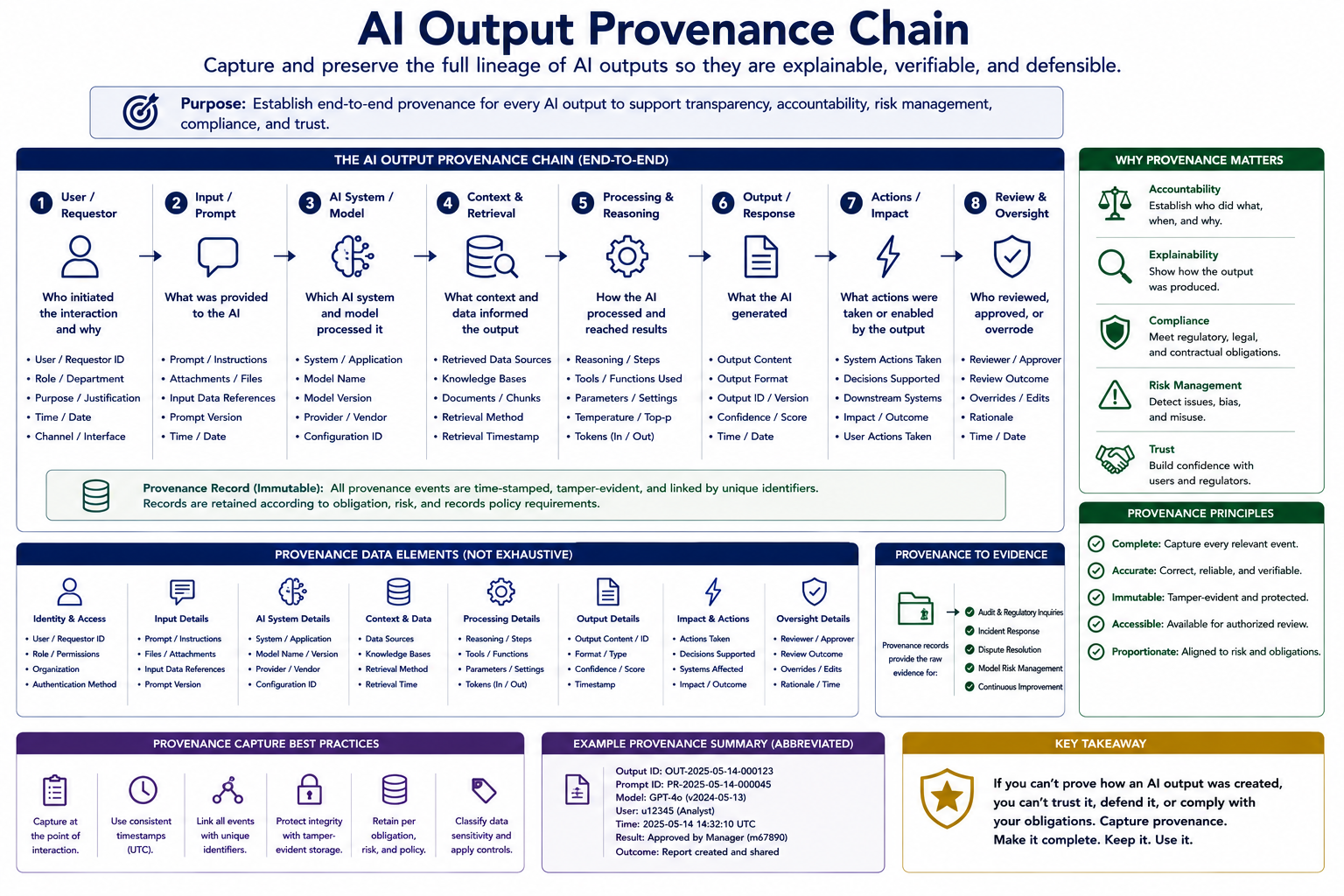
Content Provenance
Content provenance is the ability to understand where AI-generated or AI-assisted content came from, what influenced it, and how it changed over time.
For AI Outputs, provenance may include the AI Use Case, AI Agent, AI Model, AI Prompt, AI Prompt version, model version, input data, retrieved sources, RAG corpus, user, timestamp, technical asset, vendor, location, tool calls, workflow context, reviewer, approval record, and output destination.
Provenance matters because AI Outputs can appear authoritative even when they are wrong, stale, biased, incomplete, or generated from unapproved sources. Provenance helps the enterprise validate, correct, explain, defend, or discard outputs.
For high-risk, regulated, customer-facing, employee-impacting, or agentic AI, provenance should be stronger. The enterprise should reconstruct the inputs, instructions, sources, model context, review process, and controls that produced the output.
Source Traceability and Retrieved Context
AI Outputs that depend on retrieval, summarization, document analysis, or RAG should preserve source traceability.
Source traceability allows the enterprise to identify which documents, records, data sources, knowledge articles, policies, procedures, contracts, regulatory materials, tickets, logs, or other sources influenced the output.
This is especially important when AI summarizes policy, interprets procedure, drafts regulated content, supports customer service, analyzes incidents, produces legal or compliance work products, or generates outputs that may be audited or challenged.
The enterprise should define when source references, citations, retrieved context, retrieval logs, source document versions, and source timestamps must be retained. It should define when source content should not be retained because privacy, confidentiality, privilege, or minimization requirements require more restrictive handling.
Human Review of AI Outputs
Human review should be defined for AI Outputs that create material risk.
The enterprise should specify when human review is required, who performs the review, what the reviewer must assess, how review is documented, and what evidence is retained.
Review may focus on accuracy, completeness, bias, fairness, tone, safety, compliance, data exposure, privacy, intellectual property, security, customer impact, employee impact, regulatory requirements, and business fitness.
Human review should be proportional to risk. Low-risk internal drafts may require ordinary user judgment. Customer-facing outputs may require business review. Regulated, legal, HR, healthcare, financial, security, or operational outputs may require qualified functional review. Agentic outputs that trigger system actions may require workflow approval or post-action monitoring.
Human review is not effective unless it is operationalized and evidenced.
Labeling, Disclosure, and Use Restrictions
Some AI Outputs require labeling, disclosure, or use restrictions.
An enterprise may need to label AI-generated content internally, disclose AI involvement to customers or employees, mark output as draft or unverified, restrict downstream use, prevent external sharing, require citation to source materials, or prevent use in final decisions without review.
Disclosure and labeling requirements may be driven by law, regulation, internal policy, customer expectations, employee protections, contractual commitments, or ethical commitments.
The enterprise should avoid relying on ad hoc user judgment for these requirements. Where possible, labeling and disclosure should be built into Applications, Workflows, AI Prompts, AI Agents, Vendor Products, or output-handling processes.
Output Retention and Records Management
AI Outputs must be governed through records-management discipline.
The enterprise should define which AI Outputs are transient, which are working drafts, which are business records, which are customer communications, which are employee records, which are regulated records, which are Evidence Records, and which must be purged.
Retention should align with the Enterprise AI Retention Policy, legal obligations, regulatory obligations, contractual obligations, privacy obligations, audit requirements, business-record rules, litigation holds, and AI Agent-specific retention rules.
The enterprise should avoid two extremes: retaining every AI Output forever and deleting outputs needed for accountability. Both are governance failures.
The correct approach is obligation-driven, risk-driven, and policy-driven retention.
Evidence of Output Governance
The enterprise should preserve evidence that output governance operated where required.
Evidence may include output-review records, approval logs, prompt-response test records, source-trace records, disclosure records, output-retention records, monitoring logs, incident records, correction records, human-review attestations, and control-test results.
For high-risk outputs, evidence should show which AI capability produced the output, which sources were used, which human reviewed it, which controls applied, which obligations were considered, and whether the output was approved, corrected, rejected, escalated, retained, or purged.
Evidence should be connected to the AI Use Case, AI Agent, AI Model, AI Prompt, Data and Information, technical asset, Vendor Product, Location / Jurisdiction, Regulatory Obligation, Control, Incident, and Risk.
Correcting and Withdrawing AI Outputs
AI Output governance should include correction and withdrawal practices.
AI may produce inaccurate, misleading, biased, harmful, incomplete, stale, unsafe, or unauthorized outputs. The enterprise should define how such outputs are identified, corrected, retracted, superseded, escalated, or removed from downstream use.
Correction practices may differ by output type. A draft document may be revised. A customer communication may require correction notice. A business record may require amendment. A system update may require rollback. A generated recommendation may require review of downstream decisions. A harmful output may require incident response.
The enterprise should retain evidence of correction and withdrawal actions where required.
AI Output Monitoring
AI Outputs should be monitored according to risk.
Monitoring may include output-quality checks, sampling, user feedback, escalation rates, complaint trends, hallucination signals, bias indicators, content-policy violations, disclosure failures, customer-impact indicators, employee-impact indicators, drift signals, and incident trends.
Monitoring should be connected to the AI Use Case, AI Agent, AI Model, AI Prompt, Data Sources, technical asset, Vendor Product, Control, and Evidence Records.
Output monitoring allows the enterprise to detect degradation, misuse, unexpected behavior, stakeholder harm, and control failure.
Governance Questions for AI Outputs and Evidence
For AI Outputs and Evidence, governance should answer what exists, who owns it, what is affected, which risks, obligations, controls, evidence, incidents, changes, and gaps require action.
How to cite this page
When referencing this page in academic work, internal standards, or external publications, include the page title, IF4IT as author and publisher (The International Foundation for Information Technology (IF4IT), LLC), the URL, and your access date.
Example (informal web citation):
The International Foundation for Information Technology (IF4IT), LLC. Govern AI Outputs, Content Provenance, and Evidence | Enterprise AI Governance Best Practices. https://if4it.org/best-practices/enterprise-ai-governance-best-practices/govern-ai-outputs-content-provenance-and-evidence/ (accessed 2026-09-20).
See About Us for content governance and site-wide citation guidance.
Copyright for The International Foundation for Information Technology (IF4IT), LLC: 2008 - Present
Legal Disclaimers