Enterprise AI Governance Best Practices - Measure AI Governance Health and Quality
Enterprise AI Governance Best Practices
Chapter 38. Measure AI Governance Health and Quality
Executive Summary: Chapter Overview
IF4ITThe Bottom Line
Core Concepts
| Concept | Definition & Strategic Role |
|---|---|
| AI Governance KPI | A metric used to evaluate whether AI governance is achieving intended performance objectives, such as inventory completeness or review timeliness. |
| AI Governance KRI | A metric used to identify increasing AI risk, control weakness, exposure, or governance deterioration. |
| Quality Signal | A measurement that indicates whether inventories, relationships, controls, evidence, monitoring, and decisions remain complete, current, and reliable. |
Quick Q&A
Question: Why should AI governance measurement include both KPIs and KRIs?
Question: What should leaders do with AI governance metrics?
Read More Below
Why AI Governance Measurement Matters
Enterprise AI Governance must be measured because unmeasured governance becomes opinion, not management.
Leaders need to know whether AI governance is improving, where risk is concentrated, where visibility is weak, where controls are missing, where evidence is incomplete, where incidents are increasing, where obligations are changing, and whether AI adoption is creating value without unacceptable exposure.
Practitioners need to know whether inventories are complete, records are current, reviews are overdue, controls are operating, evidence is available, incidents are remediated, and AI assets are governed according to risk.
Measurement allows the enterprise to move from reactive governance to managed governance. It turns AI governance into an operating discipline that can be monitored, reported, improved, and audited.
Measures, Metrics, KPIs, and KRIs
AI governance measurement should distinguish measures, metrics, key performance indicators, and key risk indicators.
A measure is a raw observation or count, such as the number of AI Use Cases recorded. A metric is a calculated or interpreted measure, such as the percentage of active AI Use Cases with assigned owners. A key performance indicator, or KPI, shows whether governance performance is meeting desired objectives. A key risk indicator, or KRI, shows whether risk is increasing, control weakness is emerging, or exposure is outside tolerance.
For example, the number of AI Agents is a measure. The percentage of AI Agents with approved location mappings is a metric. The percentage of high-risk AI Agents with current approval and monitoring evidence may be a KPI. The number of high-authority AI Agents with overdue access reviews may be a KRI.
The enterprise should use a balanced measurement model that includes coverage, quality, control, risk, evidence, incident, adoption, and value indicators.
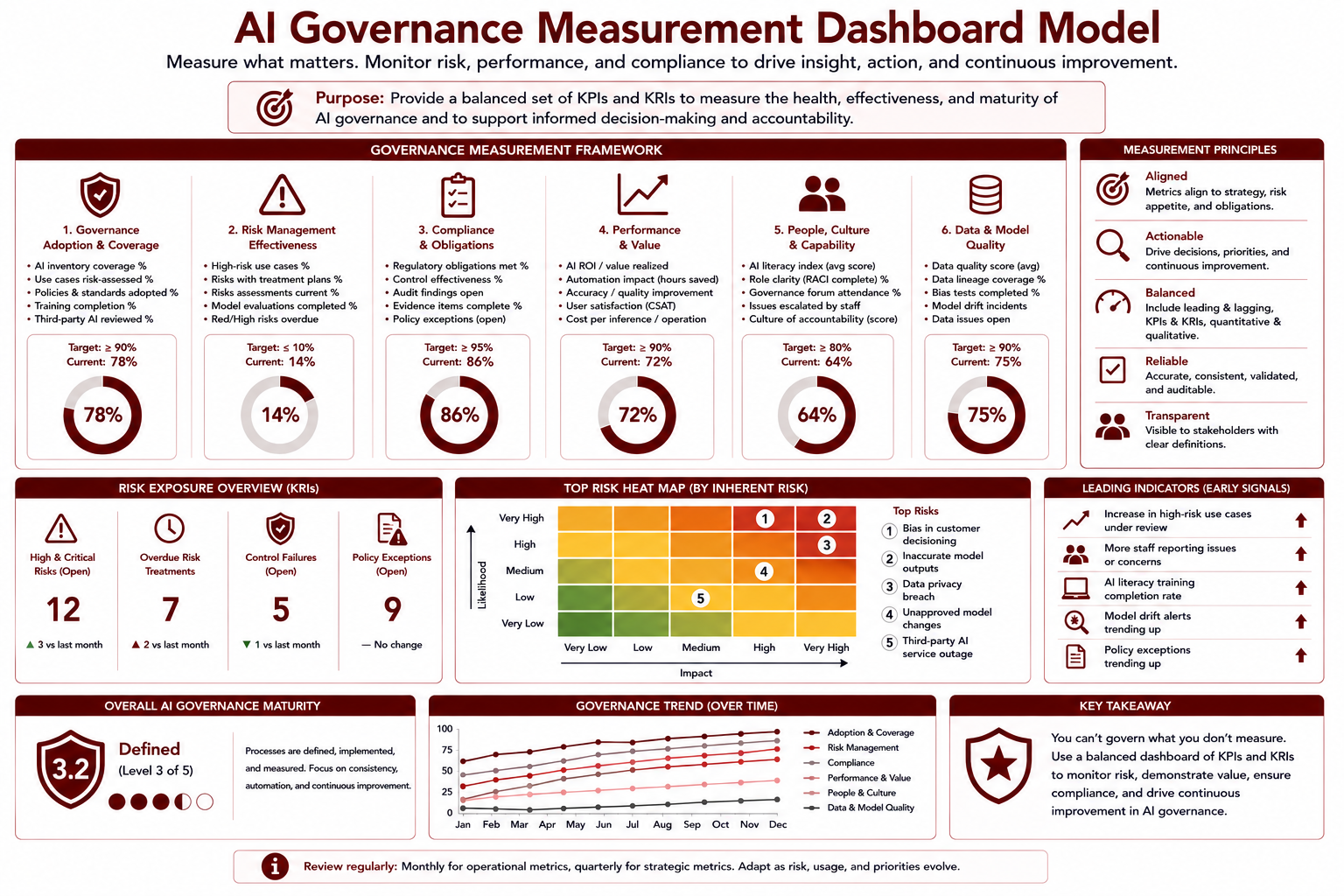
Figure: AI Governance Measurement Dashboard Model
Inventory Completeness and Currency
Inventory completeness and currency are foundational AI governance measures.
The enterprise should measure whether AI Use Cases, AI Agents, AI Models, AI Prompts, AI Risks, AI Incidents, Evidence Records, Vendor Products, Data Sources, Locations / Jurisdictions, Regulatory Obligations, Controls, and related technical assets are captured and current.
Useful measures may include the number of active AI Use Cases, number of AI Agents, percentage of AI assets with owners, percentage with lifecycle state, percentage with risk classification, percentage with data-source mapping, percentage with location scope, percentage with vendor mapping, percentage with control mapping, percentage with evidence package, and percentage overdue for review.
Currency matters because an inventory that is out of date creates false confidence. The enterprise should measure stale records, overdue reviews, missing owners, unknown risk classifications, and records not updated after material change.
Relationship Completeness
AI governance quality depends on relationship completeness.
It is not enough to know that AI assets exist. The enterprise must know how they relate to use cases, agents, models, AI Prompts, data, technical assets, vendors, locations, regulations, obligations, controls, risks, incidents, outputs, and evidence.
Useful relationship measures may include the percentage of AI Use Cases connected to AI Agents or technical assets, percentage of AI Agents connected to AI Models and AI Prompts, percentage of AI Agents connected to tool/API access records, percentage of AI Use Cases connected to data sources, percentage of vendor AI capabilities connected to contracts, percentage of high-risk AI uses connected to Regulatory Obligations, and percentage of controls connected to Evidence Records.
Relationship gaps are governance gaps. If an AI Agent has no mapped data sources, the enterprise may not understand data exposure. If a customer-facing AI use has no location mapping, regulatory applicability may be unknown. If a control has no evidence, control operation may be unprovable.
Risk and Control Metrics
AI governance measurement should include risk and control metrics.
Risk metrics may include the number of high-risk AI Use Cases, number of high-authority AI Agents, number of AI uses involving sensitive data, number of customer-facing AI capabilities, number of employee-impacting AI capabilities, number of AI uses in regulated domains, number of vendor AI dependencies, number of location-restricted AI uses, and number of accepted risks.
Control metrics may include the percentage of high-risk AI uses with required controls, percentage of controls tested, percentage of controls operating effectively, percentage of controls with current evidence, number of failed controls, number of overdue control reviews, and number of remediation actions open.
Risk and control metrics should be connected. The enterprise should see whether higher-risk AI uses have stronger controls and better evidence.
Evidence Readiness Metrics
Evidence readiness is one of the most important AI governance quality indicators.
Evidence readiness measures whether the enterprise can prove that governance operated. Useful metrics may include percentage of approved AI Use Cases with evidence packages, percentage of high-risk AI uses with current review evidence, percentage of AI Agents with monitoring evidence, percentage of AI Prompts with test evidence, percentage of AI Models with evaluation evidence, percentage of vendor AI capabilities with contractual evidence, percentage of controls with operating evidence, and percentage of incidents with preserved evidence.
Evidence gaps should be treated as governance gaps. If the enterprise cannot produce evidence, it may not be able to demonstrate compliance, defend decisions, support audit, respond to litigation, or prove control operation.
Evidence readiness should be measured before audits, regulatory inquiries, or incidents require it.
Incident and Issue Metrics
AI governance measurement should include incident and issue trends.
Useful incident metrics may include number of AI Incidents by severity, incident category, affected AI Use Case, affected AI Agent, affected AI Model, affected AI Prompt, affected Vendor Product, affected Location / Jurisdiction, affected stakeholder type, root cause, time to detect, time to contain, time to remediate, recurrence rate, and evidence-preservation completeness.
Issue metrics may include open remediation actions, overdue remediation actions, repeated control failures, unresolved vendor findings, stale data-source issues, prompt-test failures, model-evaluation failures, retention failures, and policy exceptions.
Incident and issue metrics help the enterprise understand whether governance is preventing problems, detecting them early, and improving after they occur.
Regulatory and Location Metrics
AI governance measurement should include regulatory and location metrics.
Useful measures may include number of applicable Regulations, number of decomposed Regulatory Obligations, percentage of obligations mapped to controls, percentage of obligations with evidence requirements, percentage of high-risk AI uses mapped to applicable obligations, number of AI Agents operating by Location / Jurisdiction, number of AI assets with unknown location scope, number of AI uses affected by regulatory change, and number of regional restrictions or approvals.
Location metrics are especially important because AI obligations often depend on where AI operates, serves users, processes data, affects stakeholders, or produces outputs.
The enterprise should measure whether location and jurisdictional scope is known at the required level of granularity. Unknown location scope should be treated as a governance weakness.
Vendor AI Metrics
Vendor AI creates distinct measurement needs.
Useful metrics may include number of Vendor Products with AI features, number of enabled vendor AI capabilities, percentage of vendor AI capabilities reviewed, percentage with data-processing terms reviewed, percentage with retention terms known, percentage with regional processing known, percentage with subprocessor records, percentage with contract controls, and related items.
Vendor AI metrics help the enterprise see AI exposure that originates outside internally built systems.
These metrics should be connected to vendor risk management, procurement, legal, privacy, security, data governance, and application governance.
Adoption and Value Metrics
AI governance should also measure adoption and value.
Governance should not only measure risk and control. It should help the enterprise understand whether approved AI use is delivering value.
Useful adoption and value metrics may include number of approved AI Use Cases, number moved from pilot to production, productivity improvements, cycle-time reductions, cost avoidance, quality improvements, customer-service improvements, engineering acceleration, operational efficiency, user adoption, user satisfaction, and retirement of ineffective AI uses.
Value metrics should be interpreted carefully. AI value should not be measured only by usage volume. High usage of poorly governed AI may increase risk. Low usage of a high-value specialized AI capability may still be appropriate. The enterprise should measure value in relation to approved purpose, risk, cost, and outcomes.
Maturity and Continuous Improvement
AI governance measurement should support maturity assessment and continuous improvement.
Maturity may be assessed across inventory completeness, relationship modeling, risk classification, control coverage, evidence readiness, location mapping, regulatory decomposition, vendor AI governance, AI Agent governance, incident response, retention governance, operating-model clarity, and measurement quality.
The enterprise may begin with basic visibility and gradually mature toward connected inventories, automated discovery, integrated controls, runtime monitoring, evidence packages, regulatory impact analysis, agentic action traceability, and predictive governance analytics.
Measurement should identify where the enterprise should improve next. The goal is not to create metrics for their own sake. The goal is to improve AI governance health and quality over time.
Governance Questions for AI Governance Measurement
For AI Governance Measurement, governance should answer what exists, who owns it, what is affected, which risks, obligations, controls, evidence, incidents, changes, and gaps require action.
How to cite this page
When referencing this page in academic work, internal standards, or external publications, include the page title, IF4IT as author and publisher (The International Foundation for Information Technology (IF4IT), LLC), the URL, and your access date.
Example (informal web citation):
The International Foundation for Information Technology (IF4IT), LLC. Measure AI Governance Health and Quality | Enterprise AI Governance Best Practices. https://if4it.org/best-practices/enterprise-ai-governance-best-practices/measure-ai-governance-health-and-quality/ (accessed 2026-07-28).
See About Us for content governance and site-wide citation guidance.
Copyright for The International Foundation for Information Technology (IF4IT), LLC: 2008 - Present
Legal Disclaimers