Enterprise AI Governance Best Practices - Relationship to EIM and the IF4IT Enterprise Model
Enterprise AI Governance Best Practices
Chapter 6. Relationship to EIM and the IF4IT Enterprise Model
Executive Summary: Chapter Overview
IF4ITThe Bottom Line
Core Concepts
| Concept | Definition & Strategic Role |
|---|---|
| Inventory Discipline | EIM defines the governed Noun Types, Noun Instances, owners, lifecycle states, quality expectations, and improvement practices AI governance requires. |
| Semantic Relationships | The IF4IT Enterprise Model connects AI Agents, Use Cases, Models, Prompts, Data, Vendors, Locations, Obligations, Controls, Evidence, Risks, and Incidents. |
| Graph Reasoning | Connected inventories enable indirect analysis, such as determining which agents are affected by a new jurisdictional obligation or vendor change. |
Quick Q&A
Question: Why are isolated AI registries insufficient for Enterprise AI Governance?
Question: How do EIM and the [IF4IT Enterprise Model](https://if4it.org/best-practices/if4it-enterprise-model-and-modeling-best-practices/) work together for AI governance?
Read More Below
Why This Relationship Matters
Enterprise AI Governance depends on two existing IF4IT disciplines: Enterprise Inventory Management and the IF4IT Enterprise Model.
Enterprise Inventory Management, or EIM, establishes the discipline of identifying, defining, governing, populating, maintaining, and improving the inventories the enterprise depends on. The IF4IT Enterprise Model establishes the discipline of connecting those inventories through a Semantic Model of the enterprise.
Enterprise AI Governance depends on both. AI cannot be governed coherently if AI-related records are scattered across disconnected spreadsheets, vendor portals, model registries, security tools, procurement systems, data catalogs, architecture repositories, ticketing systems, and audit files. Those records may each contain useful information, but they do not create enterprise governance intelligence unless they are connected.
The relationship matters because AI governance questions are relationship questions. Which AI Agents support which AI Use Cases? Which AI Models are used by which AI-Using Technical Solutions? Which Prompts shape which outputs? Which Data and Information sources feed which AI capabilities? Which Vendors provide which AI features? Which Locations or Jurisdictions are served by which AI Agents? Which Regulations create which Regulatory Obligations? Which gaps require action?
Those questions cannot be answered by a single inventory alone. They require governed inventories and a connected Enterprise Model.
What EIM Contributes
Enterprise Inventory Management contributes the inventory discipline that AI governance requires.
EIM teaches that enterprises need governed inventories of the important Noun Types they depend on. A Noun Type is a governed class of thing the enterprise needs to identify, track, relate, own, assess, control, and improve. A Noun Instance is a specific instance of that Noun Type. A Noun Inventory is the governed collection of those instances.
Enterprise AI Governance extends that logic to AI-related Noun Types. The enterprise needs governed inventories for AI Use Cases, AI Agents, AI-Using Technical Solutions, AI Models, Prompts, AI Input Data, AI Outputs, AI Risks, AI Incidents, AI Governance Evidence Packages, Locations / Jurisdictions, Regulations, Regulatory Agencies, Regulatory Obligations, Controls, Vendors, Stakeholders, and other related Noun Types.
EIM also contributes the principle that inventories require ownership, lifecycle management, quality expectations, currency, governance, and improvement. An AI Agents Inventory that is not owned, maintained, reviewed, and improved is not a reliable governance asset. A Regulations Inventory that is outdated cannot support regulatory impact analysis. A Regulatory Obligations Inventory that is not decomposed into actionable obligations cannot support control mapping or evidence generation. A Locations / Jurisdictions Inventory that is too coarse cannot support location-specific AI governance.
EIM therefore provides the foundation for turning AI governance from policy language into governed enterprise data.
What the IF4IT Enterprise Model Contributes
The IF4IT Enterprise Model contributes the relationship discipline that AI governance requires.
Inventories tell the enterprise what exists. The Enterprise Model tells the enterprise how those things relate.
For Enterprise AI Governance, this distinction is critical. It is not enough to know that an AI Agent exists. The enterprise must know which Use Cases the agent supports, which Technical Solutions contain or invoke it, which Models it uses, which Prompts guide it, which Data and Information it accesses, which Systems and APIs it can act on, which Vendors or Contracts are involved, which Stakeholders it affects, which Locations or Jurisdictions it serves, which Regulations and Regulatory Obligations apply, which Controls govern it, which Evidence supports it, which Incidents involved it, and which Risks it creates or mitigates.
The IF4IT Enterprise Model provides the structure for those relationships. It allows the enterprise to connect AI governance records into a graph of enterprise meaning rather than a collection of disconnected lists.
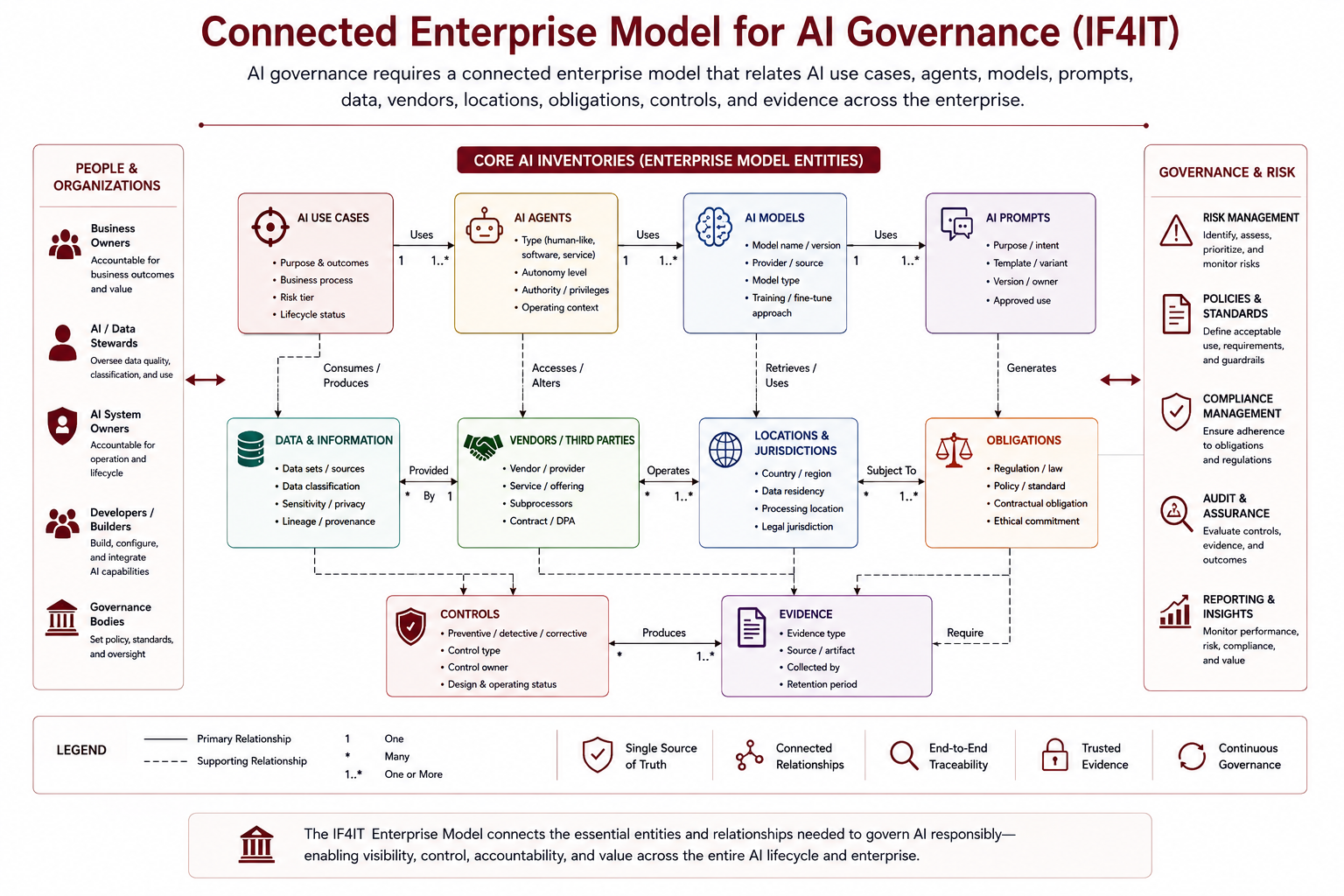
Figure: Connected Enterprise Model for AI Governance.
This is especially important because AI governance often requires indirect reasoning. An AI Agent may be impacted by a new law not because the law names that agent directly, but because the agent operates in a jurisdiction, supports a use case, affects a stakeholder type, uses a sensitive data category, produces a consequential output, or depends on a vendor capability subject to a contractual obligation. The Enterprise Model makes that reasoning possible.
Taxonomy and Ontology
EIM and the IF4IT Enterprise Model play different but complementary roles.
EIM establishes the enterprise inventory taxonomy. It helps the enterprise understand which Noun Types need to be inventoried and why those inventories matter. For Enterprise AI Governance, this includes AI-specific Noun Types and non-AI Noun Types that AI governance depends on.
The IF4IT Enterprise Model establishes the ontology. It helps the enterprise understand how Noun Types relate to each other. It defines the relationship patterns that allow the enterprise to traverse from one governed thing to another.
In simple terms, EIM says what must be governed. The IF4IT Enterprise Model says how governed things connect.
Enterprise AI Governance needs both. Without the taxonomy, the enterprise does not know what inventories to build. Without the ontology, the enterprise cannot understand dependency, exposure, obligation, control, impact, or evidence relationships across inventories.
For example, EIM helps establish that AI Agents, Locations / Jurisdictions, Regulations, Regulatory Obligations, Controls, and Evidence Records are important governed Noun Types. The Enterprise Model helps establish that an AI Agent operates in a Location, a Regulation applies in that Location, a Regulation contains Regulatory Obligations, a Regulatory Obligation applies to certain AI uses, a Control satisfies or supports that obligation, and an Evidence Record proves that the control operated.
AI Governance as an Extension of Existing Disciplines
Enterprise AI Governance should not be designed as a disconnected governance island.
The enterprise already has disciplines for application governance, data governance, security governance, technology governance, vendor governance, architecture governance, risk management, compliance, audit, procurement, software engineering, operations, and incident management. AI introduces new requirements into those disciplines, but it does not make those disciplines irrelevant.
Enterprise AI Governance extends and connects them.
Application governance needs to know which Applications and Technical Solutions contain AI. Data governance needs to know which data sources feed AI and which data AI exposes. Architecture needs the connected model of how all of this fits together.
The practical goal is not to create a separate AI governance bureaucracy that duplicates the enterprise’s existing governance functions. The goal is to make existing governance functions AI-aware, connect them through common inventories and relationships, and add AI-specific practices where existing practices are insufficient.
AI as Graph Compiler and Runtime vs. AI as Governed Object
The IF4IT Enterprise Model treats AI as a powerful way to compile, validate, query, reason over, and operate against the Enterprise Model. In that context, AI helps the enterprise understand and use its own Semantic Model. AI can help interpret enterprise data, generate views, identify gaps, validate relationships, support impact analysis, and act as a runtime interface into the enterprise graph.
Enterprise AI Governance adds a complementary perspective: AI is also a governed object within the Enterprise Model.
That means AI is both something the enterprise may use to reason about the enterprise and something the enterprise must govern as part of the enterprise. AI may help build and operate the graph, but AI must also appear inside the graph.
This distinction matters. An AI Agent that helps analyze enterprise risk is itself an AI Agent that needs ownership, approval, data-access rules, prompts, models, telemetry, location scope, controls, and evidence. An AI capability that helps decompose regulations into Regulatory Obligations must itself be governed for source traceability, human review, legal approval, prompt management, output evidence, and error risk. An AI assistant that helps architects query the Enterprise Model must itself be inventoried, classified, monitored, and controlled.
In other words, AI can be both the tool used to help govern the enterprise and one of the things being governed by the enterprise.
Regulatory Noun Types and AI Governance
Enterprise AI Governance makes regulatory Noun Types especially important.
A regulation is not operational until the enterprise decomposes it into governed components. The enterprise must understand which Regulatory Agency issued or enforces the rule, which Regulation or regulatory instrument contains the rule, which Regulatory Obligations are created by that rule, which applicability conditions determine when those obligations apply, which Controls satisfy or support those obligations, and which Evidence proves the controls operated.
These regulatory Noun Types are not only legal or compliance concerns. They become enterprise modeling concerns because they must connect to AI Agents, AI Use Cases, AI-Using Technical Solutions, AI Models, Prompts, Data and Information, Vendors, Locations / Jurisdictions, Stakeholders, Risks, Incidents, Controls, and Evidence Records.
This relationship is one reason Enterprise AI Governance may require updates or extensions to existing EIM and IF4IT Enterprise Model materials. Those materials already establish the general importance of enterprise inventories and semantic relationships. Enterprise AI Governance makes certain regulatory inventories and relationship patterns more visible and more urgent.
The critical relationship pattern is: AI Agent or AI Use Case -> Location / Jurisdiction -> Regulation -> Regulatory Obligation -> Control -> Evidence.
Other paths will also matter. For example: AI-Using Technical Solution -> Vendor -> Contract -> Regulatory Obligation -> Control -> Evidence. AI Agent -> Data and Information -> Data Sensitivity Type -> Privacy Obligation -> Control -> Evidence. AI Output -> Stakeholder -> Location / Jurisdiction -> Disclosure Obligation -> Evidence.
These paths show why AI governance cannot be reduced to a flat list of AI systems. It requires a connected regulatory model.
Location and Jurisdiction as Enterprise Model Concerns
Location and jurisdiction are not descriptive fields. They are governance-critical relationship concepts.
An AI Agent may operate in one country, serve users in another, process data in a cloud region, affect employees in a specific state, produce outputs for customers in a city, or be prohibited from operating in a particular jurisdiction. Each of those facts can change the legal, regulatory, privacy, security, contractual, audit, and operational obligations that apply.
For that reason, Enterprise AI Governance needs a governed Locations / Jurisdictions Inventory and explicit relationships between AI assets and locations. The most important of these is the AI Agent-to-Location Mapping Inventory, which records where an AI Agent operates, serves, processes data, affects stakeholders, or is restricted from operating.
The required granularity of location cannot be assumed in advance. Some obligations may apply at a supranational region such as the European Union. Others may apply at a country, state, province, county, city, town, facility, service territory, cloud region, or data residency zone. The enterprise must determine the necessary granularity by reading and decomposing the obligations that apply to its business, sector, data, stakeholders, and AI uses.
This makes location and jurisdiction part of the Enterprise Model, not metadata on an AI record. The enterprise must traverse from an AI Agent to the Locations it serves, from those Locations to applicable Regulations, from those Regulations to Regulatory Obligations, from those obligations to Controls, and from those Controls to Evidence.
Evidence as a Connected Enterprise Asset
Evidence is one of the most important outputs of Enterprise AI Governance.
A governance program that cannot produce evidence cannot demonstrate that governance operated. Policies, intentions, and meeting notes are not enough. The enterprise needs governed evidence records showing what was discovered, classified, assessed, approved, tested, monitored, changed, restricted, escalated, remediated, and retired.
Evidence should be connected to the Noun Types it proves something about. A use case approval should connect to the AI Use Case. An incident record should connect to the AI Incident, affected AI assets, affected stakeholders, locations, controls, outputs, and remediation actions.
The Enterprise Model turns evidence from a file archive into a governance asset. It allows the enterprise to understand not only that evidence exists, but what the evidence supports, which obligations it helps satisfy, which AI uses it covers, and where gaps remain.
The Practical Implication for This Document
The practical implication is that this document will repeatedly return to inventories and relationships.
When this document discusses AI Use Cases, it will also discuss related AI Agents, Models, Prompts, Data, Stakeholders, Locations, Risks, Controls, and Evidence. When it discusses AI Agents, it will also discuss authority, tools, APIs, data access, technical solutions, locations, regulations, obligations, telemetry, incidents, and decommissioning. When it discusses Vendors, it will also discuss contracts, AI features, data exposure, regional availability, obligations, changes, and evidence. When it discusses Regulations, it will also discuss Regulatory Agencies, Regulatory Obligations, applicability conditions, controls, and evidence.
This repetition is intentional. It reflects the connected nature of Enterprise AI Governance.
Readers should understand that the document is not defining separate topics. It is defining a connected governance model. The value of Enterprise AI Governance does not come only from having an AI Use Cases Inventory, AI Agents Inventory, Models Inventory, Prompts Inventory, or Regulatory Obligations Inventory. The value comes from connecting those inventories so the enterprise can answer governance questions, make better decisions, prove accountability, respond to change, and improve over time.
How to cite this page
When referencing this page in academic work, internal standards, or external publications, include the page title, IF4IT as author and publisher (The International Foundation for Information Technology (IF4IT), LLC), the URL, and your access date.
Example (informal web citation):
The International Foundation for Information Technology (IF4IT), LLC. Relationship to EIM and the IF4IT Enterprise Model | Enterprise AI Governance Best Practices. https://if4it.org/best-practices/enterprise-ai-governance-best-practices/relationship-to-eim-and-the-if4it-enterprise-model/ (accessed 2026-07-28).
See About Us for content governance and site-wide citation guidance.
Copyright for The International Foundation for Information Technology (IF4IT), LLC: 2008 - Present
Legal Disclaimers