Respond to AI Incidents and Preserve Governance Evidence - Enterprise AI Governance Best Practices
Respond to AI Incidents and Preserve Governance Evidence
(Chapter 37 of Enterprise AI Governance Best Practices)
Executive Summary: Chapter Overview
IF4ITThe Bottom Line
Core Concepts
| Concept | Definition & Strategic Role |
|---|---|
| AI Incident | An event or condition where AI behavior, performance, failure, or use creates actual or potential harm, policy violation, control failure, regulatory exposure, or accountability concern. |
| Incident Hold | A preservation requirement that prevents deletion or purge of records relevant to an AI Incident. |
| Lessons Learned | The controlled feedback process that turns incident findings into improved controls, monitoring, training, inventories, and governance requirements. |
Quick Q&A
Question: Why must evidence preservation start early in an AI incident?
Question: What should an AI incident record connect to?
Read More Below
Why AI Incident Response Requires Explicit Governance
Enterprise AI Governance must include explicit AI incident response because AI can fail, expose data, produce harmful outputs, trigger incorrect actions, violate controls, or harm stakeholders.
An AI Incident may involve an inaccurate output, biased result, harmful recommendation, unauthorized data exposure, prompt injection, prompt leakage, unsafe generated content, vendor AI failure, model drift, incorrect classification, customer-facing misinformation, employee-impacting error, unauthorized Agent action, tool misuse, API misuse, regional compliance failure, retention failure, disclosure failure, or evidence failure.
AI incidents may be technical, operational, regulatory, ethical, security-related, privacy-related, vendor-related, or business-related. They may affect internal users, customers, employees, partners, regulators, patients, citizens, systems, data, operations, or the enterprise’s legal and reputational position.
The enterprise should not treat AI incidents as ordinary technology incidents only. Many AI incidents require cross-functional response because they may involve business owners, AI Agent owners, model owners, AI Prompt owners, data owners, security, privacy, legal, compliance, risk, audit, records management, vendor management, engineering, operations, communications, and executive leadership.
What an AI Incident Is
An AI Incident is an event or condition in which an AI capability behaves, performs, fails, or is used to create actual or potential harm, policy violation, control failure, regulatory exposure, stakeholder impact, operational disruption, security exposure, privacy exposure, or accountability concern.
An AI Incident may be caused by the AI capability itself, the data it uses, the AI Model, the AI Prompt, the AI Agent, the Application, the Workflow, the Vendor Product, the Runtime Environment, the user, the configuration, the control environment, or the surrounding business process.
AI incidents should include both actual harm and near misses. A harmful customer output is an incident. An AI Agent blocked from taking an unauthorized action may also be an incident or control event worth recording. A prompt-injection attempt that fails may still be important security telemetry. A vendor AI feature enabled without approval may be a governance incident even before harm occurs.
The enterprise should define AI Incident categories clearly so that users, owners, operators, reviewers, and monitoring functions know what must be reported.
AI Incidents Inventory
AI Incidents should be governed as Noun Instances in an AI Incidents Inventory or connected incident-management system.
An AI Incident record should identify the incident title, description, date and time, detection source, reporter, severity, status, affected AI Use Case, affected AI Agent, affected AI Model, affected AI Prompt, affected technical asset, affected Data and Information, affected Vendor Product or Vendor Service, affected Stakeholders, affected Locations / Jurisdictions, related Regulatory Obligations, related Controls, related Evidence Records, root cause, containment actions, remediation actions, notification decisions, legal hold status, closure decision, and lessons learned.
The AI Incidents Inventory should connect to enterprise incident management, security incident response, privacy incident response, operational incident management, vendor incident management, risk management, compliance, audit, and records management.
The purpose is not to create a separate incident universe. The purpose is to make AI involvement visible, classifiable, investigable, remediable, and evidencable inside the enterprise’s existing incident disciplines.
Incident Detection and Reporting
AI incidents may be detected through many channels.
Users may report bad outputs, harmful responses, incorrect summaries, offensive content, privacy concerns, or suspicious behavior. Customers may complain about AI-generated communications or outcomes. Security teams may detect malicious use or attempted manipulation.
The enterprise should define reporting paths for AI incidents. Users should know how to report AI concerns. Operators should know when monitoring alerts become incidents. Vendors should know what must be reported. Governance teams should know when issues require escalation.
AI incident reporting should be easy enough that people report concerns early. If reporting is unclear or punitive, incidents may remain hidden until harm increases.
Incident Classification and Severity
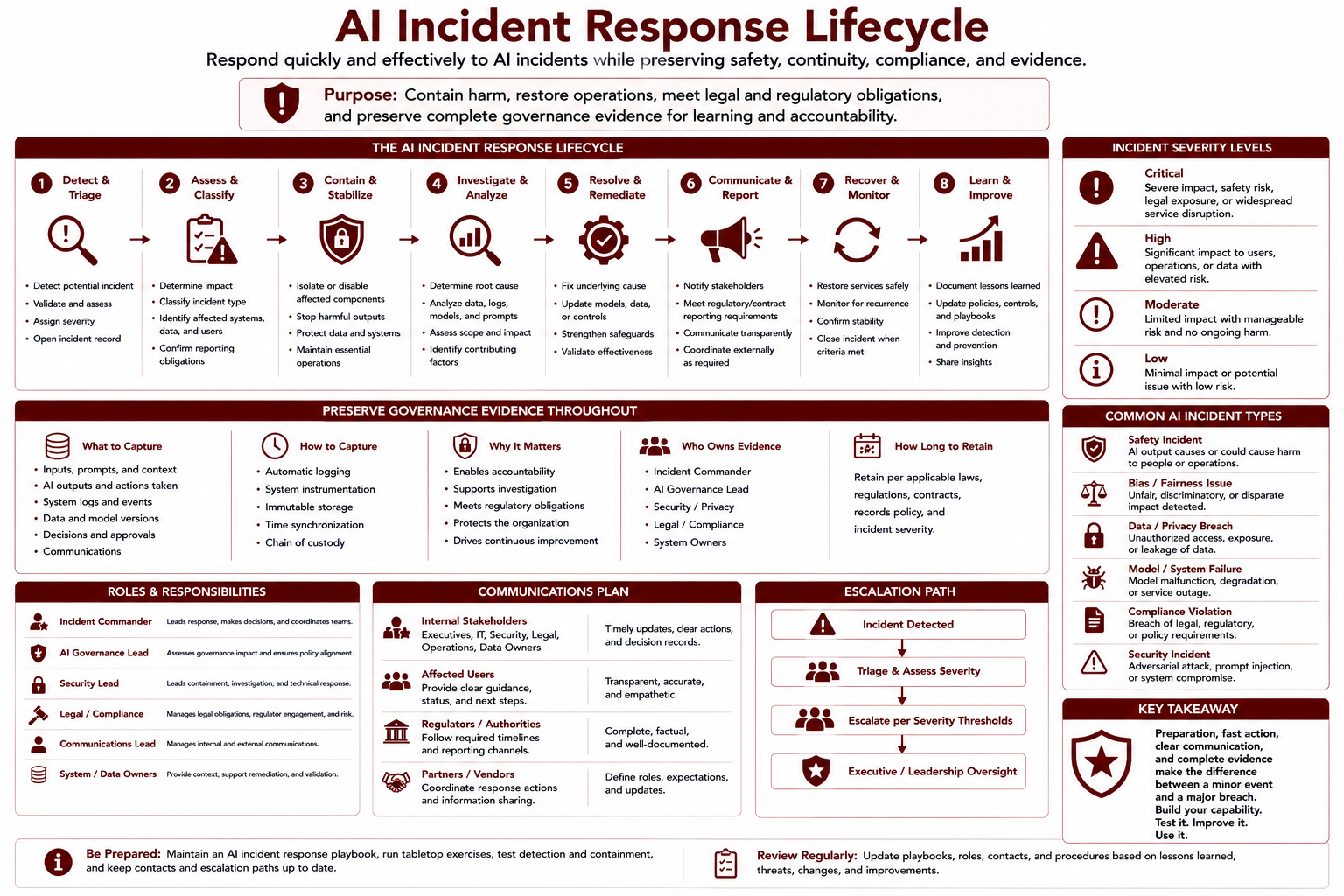
AI incidents should be classified by category and severity.
Classification should consider the type of failure, affected stakeholders, data sensitivity, regulatory obligations, location scope, operational impact, financial impact, reputational impact, security impact, privacy impact, customer impact, employee impact, vendor involvement, and whether the incident involved autonomous or semi-autonomous action.
Severity should also consider whether the AI incident created actual harm, potential harm, control failure, legal exposure, audit exposure, regulatory notification duty, public communication need, business disruption, or evidence-preservation requirement.
A low-severity incident may involve an internal low-risk AI output corrected before use. A high-severity incident may involve customer-facing misinformation, sensitive data exposure, discriminatory impact, unauthorized Agent action, regulated decision error, vendor breach, or failure to preserve required evidence.
Severity should drive escalation, containment, investigation depth, notification review, remediation urgency, and evidence preservation.
Containment and Immediate Response
AI incident response should include containment.
Containment actions may include disabling an AI Agent, suspending a model, rolling back an AI Prompt, disabling a vendor AI feature, revoking tool or API access, blocking a location, moving an Agent to read-only mode, requiring human approval, disabling a Workflow, removing a RAG source, restricting a user group, isolating a Runtime Environment, withdrawing an output, correcting a customer communication, or preserving affected records.
Containment should be proportionate to severity and risk. The enterprise should avoid both overreaction and underreaction. A minor internal output error may require correction and monitoring. An unauthorized Agent action affecting production systems may require immediate suspension, access revocation, rollback, and incident escalation.
For Agentic AI, containment must be planned before deployment. The enterprise should know how to stop the Agent, revoke authority, preserve traces, and reverse actions where feasible.
Investigation and Root Cause Analysis
AI incident investigation should identify what happened, why it happened, what was affected, and what must change.
Investigators should examine the AI Use Case, AI Agent, AI Model, AI Prompt, input data, retrieved context, AI Response, AI Output, tool calls, API invocations, workflow steps, user actions, technical asset configuration, vendor behavior, location scope, controls, monitoring signals, and evidence records.
Root causes may include weak data quality, stale retrieval content, prompt weakness, model limitation, model drift, poor user training, excessive Agent authority, missing human oversight, vendor change, weak testing, inadequate control design, incorrect configuration, security attack, privacy failure, missing disclosure, retention misconfiguration, or unclear decision rights.
Root cause analysis should not stop at the AI output. The enterprise should determine whether the incident reflects a broader governance weakness that may affect other AI Use Cases, AI Agents, AI Models, AI Prompts, Applications, Vendors, Locations, Controls, or obligations.
Evidence Preservation During AI Incidents
AI incident response must preserve governance evidence.
When an AI incident occurs, the enterprise should preserve relevant prompts, AI Responses, AI Outputs, AI Interaction Transcripts, AI Prompt versions, AI Model versions, retrieved context, source documents, tool calls, API logs, action traces, approval records, access records, configuration records, monitoring alerts, vendor notices, user reports, incident communications, containment actions, and remediation records.
Evidence preservation should happen early because logs, transcripts, context, and vendor records may expire or be purged under ordinary retention rules. Legal hold, audit hold, regulatory hold, or incident hold may need to override normal purge schedules.
Preserved evidence should be connected to the AI Incident record and related AI Use Case, AI Agent, AI Model, AI Prompt, technical asset, Vendor Product, Data and Information, Location / Jurisdiction, Control, Regulatory Obligation, Risk, and Evidence Record.
If evidence is not preserved, the enterprise may be unable to reconstruct what happened or defend its response.
Notification and Escalation
Some AI incidents may require notification or escalation.
Notification obligations may arise from law, regulation, contract, privacy rules, cybersecurity rules, employment rules, consumer protection rules, sector-specific requirements, customer commitments, vendor agreements, or internal policy. Notifications may need to go to regulators, customers, employees, partners, vendors, auditors, executives, legal counsel, insurers, or affected stakeholders.
The enterprise should define who determines notification obligations. Legal, compliance, privacy, security, risk, communications, business owners, and executive leadership may all need to participate depending on severity and context.
Notification decisions should be evidenced. The enterprise should preserve the rationale for notification or non-notification, the stakeholders notified, timing, content, approval, delivery evidence, and follow-up actions.
Remediation and Corrective Action
AI incident response should result in remediation and corrective action.
Remediation may include correcting outputs, notifying affected parties, restoring data, rolling back actions, changing AI Prompts, changing models, removing retrieval sources, reducing Agent authority, changing access controls, adding human oversight, updating disclosures, revising vendor terms, improving monitoring, retraining users, updating retention rules, strengthening testing, or redesigning the AI Use Case.
Corrective actions should be tracked to completion. Each action should have an owner, due date, status, evidence, and validation step.
The enterprise should assess whether remediation applies only to the incident or to a class of similar AI uses. A prompt-injection weakness in one Agent may indicate weaknesses in other Agents. A vendor AI issue in one product may affect other products. A retention failure in one workflow may indicate a broader records-management gap.
Post-Incident Review and Governance Improvement
Every material AI incident should feed governance improvement.
Post-incident review should identify what controls worked, what controls failed, what evidence was missing, whether detection was timely, whether escalation was effective, whether containment was sufficient, whether notification was required, whether remediation was completed, and whether governance practices need to change.
The review should update relevant inventories and relationships. AI Risk records may need to change. AI Use Case classification may need to change. AI Agent authority may need to be reduced. AI Prompt testing may need to be strengthened. Model evaluation may need to be repeated. Data sources may need review. Vendor controls may need renegotiation. Retention rules may need adjustment. Controls may need redesign.
An incident that does not improve governance is a missed learning opportunity.
Governance Questions for AI Incident Response
For AI Incident Response, governance should answer what exists, who owns it, what is affected, which risks, obligations, controls, evidence, incidents, changes, and gaps require action.
How to cite this page
When referencing this page in academic work, internal standards, or external publications, include the page title, IF4IT as author and publisher (The International Foundation for Information Technology (IF4IT), LLC), the URL, and your access date.
Example (informal web citation):
The International Foundation for Information Technology (IF4IT), LLC. Respond to AI Incidents and Preserve Governance Evidence | Enterprise AI Governance Best Practices. https://if4it.org/best-practices/enterprise-ai-governance-best-practices/respond-to-ai-incidents-and-preserve-governance-evidence/ (accessed 2026-09-11).
See About Us for content governance and site-wide citation guidance.
Copyright for The International Foundation for Information Technology (IF4IT), LLC: 2008 - Present
Legal Disclaimers