The Lived Reality of Enterprise AI Adoption - Enterprise AI Governance Best Practices
The Lived Reality of Enterprise AI Adoption
(Chapter 3 of Enterprise AI Governance Best Practices)
Executive Summary: Chapter Overview
IF4ITThe Bottom Line
Core Concepts
| Concept | Definition & Strategic Role |
|---|---|
| Parallel Deployment | AI appears simultaneously across functions, tools, vendors, platforms, and workflows, making single-channel governance unrealistic. |
| Accountability Gap | Leaders become responsible for AI outcomes before the enterprise has complete visibility, ownership, controls, and evidence. |
| Governed Acceleration | A balanced posture that enables innovation while applying the right level of visibility, approval, monitoring, and control. |
Quick Q&A
Question: Why does parallel AI deployment create an accountability problem for enterprise leaders?
Question: Why should AI governance avoid a clean-slate assumption?
Read More Below
Parallel AI Deployment Across the Enterprise
Enterprise AI adoption rarely begins as a single, centrally planned program. In most enterprises, AI appears in many places at once.
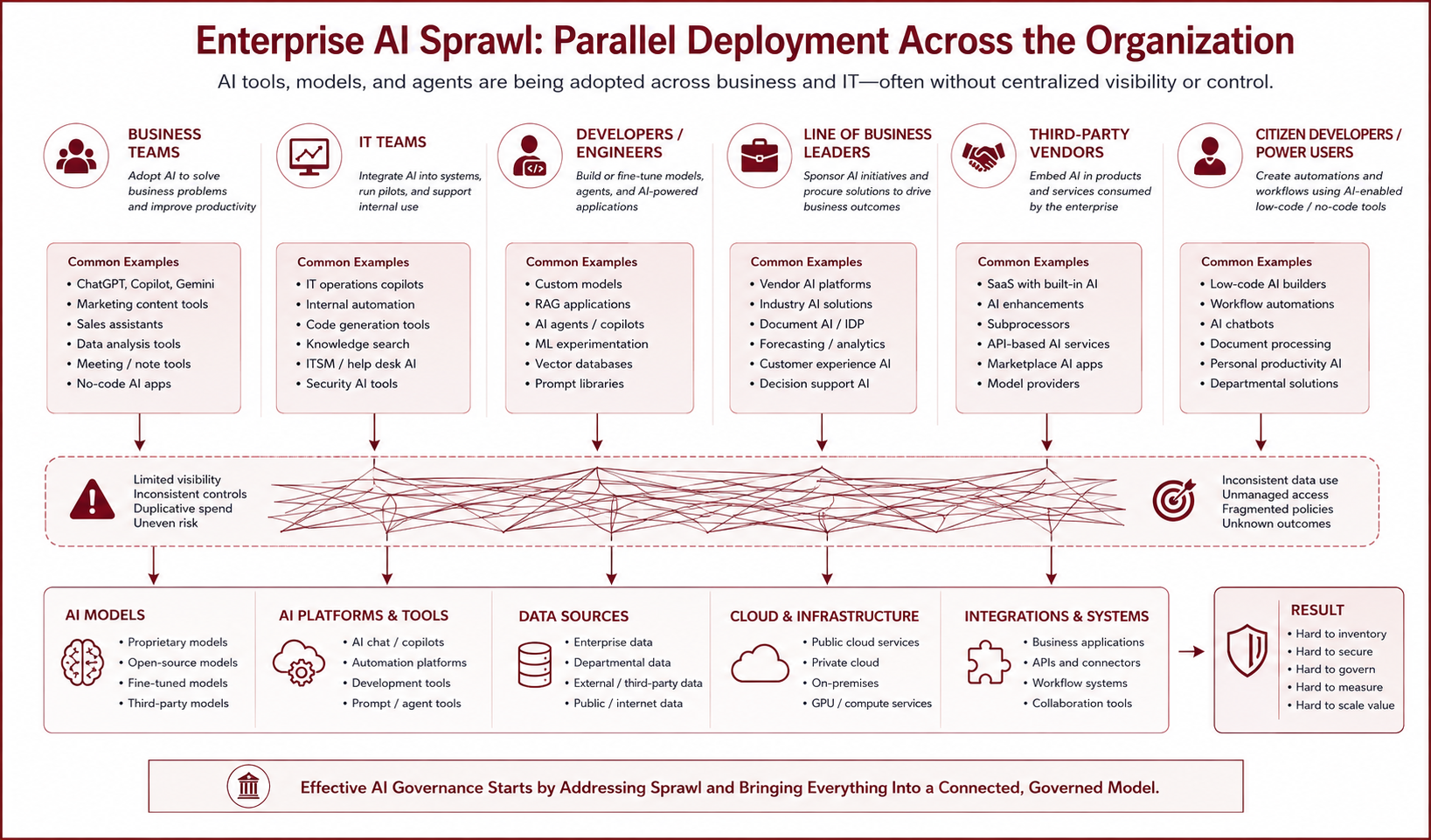
Marketing teams use AI to generate content, segment customers, summarize campaigns, and accelerate creative work. Sales teams use AI to qualify leads, draft communications, prepare account plans, and analyze customer behavior. IT teams use AI for incident response, observability, service-desk automation, knowledge management, infrastructure operations, cybersecurity, and enterprise architecture.
At the same time, vendors embed AI into products the enterprise already uses. Existing SaaS platforms add AI assistants, AI search, AI summarization, AI recommendations, AI workflow automation, AI analytics, and AI-generated content features. Some features are obvious to users. Others are hidden inside product workflows, administrative consoles, analytics engines, support portals, configuration options, or service tiers.
This creates a practical enterprise governance problem: AI adoption is not happening in one place, through one channel, under one owner, or inside one technology stack. It is emerging across business functions, IT teams, vendor platforms, data environments, employee workflows, customer experiences, and operational systems at the same time.
The Accountability Gap
Enterprise leaders are increasingly accountable for AI use they may not be able to fully see.
A CIO, CTO, CISO, Chief AI Officer, Chief Data Officer, or enterprise technology executive may be asked whether the enterprise knows where AI is being used, which AI uses affect customers or employees, which AI agents can act on systems, which vendor products contain AI, which models are approved, which data is exposed, which regions or jurisdictions are affected, which regulations apply, which controls are in place, and what evidence exists to prove those controls are operating.
In many enterprises, the honest answer is incomplete. Business units may know about their own experiments. But no single view connects AI Use Cases, AI Agents, AI-Using Technical Solutions, AI Models, Prompts, Data and Information, Vendors, Locations / Jurisdictions, Regulations, Regulatory Obligations, Controls, Risks, Incidents, Outputs, and Evidence.
That gap is the accountability problem. The enterprise may be responsible for AI outcomes without having the governed inventory, Semantic Model, decision rights, controls, telemetry, and evidence needed to understand or defend those outcomes.
Why Clean-Slate Governance Assumptions Fail
Many governance programs are designed as if the enterprise can start from a controlled beginning: define a policy, create an intake process, approve new work, and govern everything from that point forward. That assumption does not fit the current AI adoption reality.
Most enterprises already have AI in use before formal AI governance catches up. Employees may already use public AI tools. Data may already be flowing through AI-enabled services.
For this reason, the first AI governance challenge is not only governing future AI work. It is discovering and governing the AI that already exists.
A clean-slate approach also fails because AI use changes quickly. Models change. Prompts change. Vendor features change. Data sources change. Business processes change. Regulations change. Locations served by an AI capability may expand. A productivity tool may become embedded in a business process. An advisory AI capability may become an agentic AI capability. A low-risk internal use may become customer-facing. A pilot may become production without a mature approval record.
Enterprise AI governance must be designed for discovery, classification, remediation, and continuous change. It cannot depend only on up-front approval gates.
Why Governance Must Catch Up Without Stopping Innovation
AI governance should not be framed as an attempt to stop AI adoption. Enterprises need AI to improve productivity, accelerate engineering, enhance customer experience, increase operational efficiency, improve decision support, reduce manual work, and create new products and services. A governance discipline that is perceived only as delay, restriction, or bureaucracy will be bypassed.
The better goal is governed acceleration.
Governed acceleration means the enterprise enables responsible AI adoption by making the right things visible, classifiable, approvable, controllable, monitorable, and improvable. It gives leaders confidence that AI adoption is not unmanaged chaos. It gives practitioners clear pathways for approval, implementation, testing, monitoring, and evidence. It gives business teams a way to innovate without creating unnecessary regulatory, security, data, vendor, ethical, or operational exposure.
This requires a balanced operating posture. The enterprise must be strict enough to prevent unacceptable uses, unmanaged data exposure, unauthorized agentic action, unapproved customer impact, weak vendor controls, missing evidence, and regional regulatory violations. It must also be practical enough to support experimentation, learning, pilots, productivity improvement, and responsible scaling.
The point is not to require the same level of governance for every AI use. The point is to know enough about each AI use to apply the right level of governance.
The Enterprise AI Governance Problem
The lived reality of enterprise AI adoption can be summarized as a visibility, relationship, control, and evidence problem.
The enterprise must know what AI exists. It must classify that AI by use case, category, risk, owner, stakeholder, technology, vendor, model, data, prompt, output, location, and lifecycle state. It must preserve evidence that shows what was approved, what operated, what changed, what failed, and what was remediated.
This is why Enterprise AI Governance must be built on governed inventories and a connected Enterprise Model. A policy alone cannot answer which AI Agents operate in a specific jurisdiction. A risk register alone cannot reveal all AI currently operating across the enterprise.
Enterprise AI Governance is the discipline that connects these concerns into a coherent operating model. It gives the enterprise a way to move from scattered AI adoption toward governed AI adoption, without pretending that the enterprise is starting from zero and without requiring innovation to stop while governance catches up.
How to cite this page
When referencing this page in academic work, internal standards, or external publications, include the page title, IF4IT as author and publisher (The International Foundation for Information Technology (IF4IT), LLC), the URL, and your access date.
Example (informal web citation):
The International Foundation for Information Technology (IF4IT), LLC. The Lived Reality of Enterprise AI Adoption | Enterprise AI Governance Best Practices. https://if4it.org/best-practices/enterprise-ai-governance-best-practices/the-lived-reality-of-enterprise-ai-adoption/ (accessed 2026-09-11).
See About Us for content governance and site-wide citation guidance.
Copyright for The International Foundation for Information Technology (IF4IT), LLC: 2008 - Present
Legal Disclaimers