Enterprise Architecture Value Model
Executive Summary: Document Overview
IF4ITThe Bottom Line
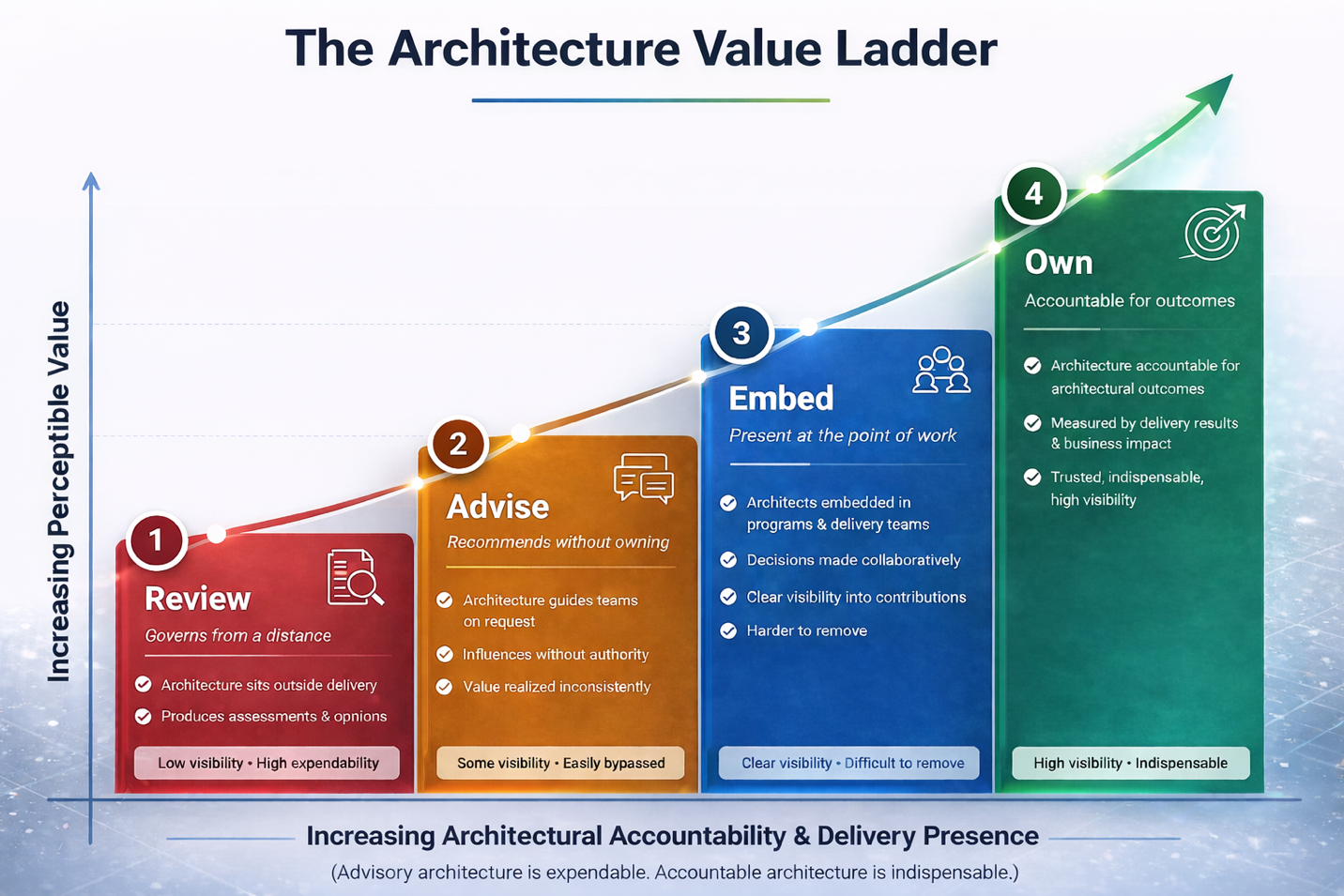
The Enterprise Architecture Value Model explains that an architecture function becomes strategically valuable when it moves beyond review and advice into accountable delivery and ownership. It gives CIOs, CTOs, Chief Architects, and Heads of Software Engineering a practical ladder for assessing where architecture sits today and what must change for the function to become indispensable.
Core Pillars & Document Modules
| Document Pillar / Focus Area | Strategic Business Outcome & Intent |
|---|---|
| Architecture Value Ladder | Defines the four organizational positions available to an architecture function: Review, Advise, Embed, and Own, so leaders can assess current maturity and target the next level of value. |
| Delivery Accountability | Shifts architecture from producing guidance and documentation to owning outcomes that affect delivery success, operational stability, and executive confidence. |
| Horizontal Ownership | Positions architecture to own shared platforms, tooling, automation, observability, enterprise model capabilities, and other cross-portfolio solutions that the enterprise depends on. |
| Architecture and Engineering Convergence | Explains why cloud, platform engineering, infrastructure-as-code, AI-assisted development, and Vibe Coding require architecture functions to develop real engineering capability. |
Quick Q&A (Macro Executive Reference)
Question: What is the central message of the Enterprise Architecture Value Model?
Answer: Architecture functions create the most durable enterprise value when they move from advisory governance to accountable ownership of outcomes, platforms, and horizontal capabilities that other teams depend on.
Question: Why are Level 1 and Level 2 architecture functions vulnerable?
Answer: They may produce useful standards, models, reviews, and advice, but they usually own nothing operationally critical, which makes their value hard to perceive during budget, staffing, and restructuring decisions.
Question: What does Level 4 require from architecture leadership?
Answer: Level 4 requires authority, funding, staffing, and engineering capability to own and operate horizontal enterprise platforms and solutions, making architecture structurally indispensable rather than merely influential.
Read Full Table of Contents Below
Table of Contents
Overview and Glossary
The Architecture Value Ladder — Model Overview
- Understand why most architecture functions remain at Levels 1 and 2
- Understand the structural reasons governance without enforcement fails
- Understand why documentation without ownership produces invisible value
- Recognize the convergence of architecture and software engineering
- Understand why the ladder is a survival framework
- Understand where governance disciplines like APM and TPM sit on the ladder
Level 1 — Review: Governs from a Distance
- Understand the characteristics of a Level 1 architecture function
- Know what a Level 1 architecture function produces
- Recognize the signals that indicate a Level 1 posture
- Understand the organizational risk of remaining at Level 1
- Understand what is required to advance from Level 1 to Level 2
Level 2 — Advise: Recommends without Owning
- Understand the characteristics of a Level 2 architecture function
- Recognize the limits of influence without authority
- Know what a Level 2 architecture function produces
- Recognize the signals that indicate a Level 2 posture
- Understand what is required to advance from Level 2 to Level 3
Level 3 — Embed: Present at the Point of Work
- Understand the characteristics of a Level 3 architecture function
- Embed architects in at-risk and high-risk initiatives
- Staff the embedded practice correctly
- Know what a Level 3 architecture function produces
- Recognize the signals that indicate a Level 3 posture
- Understand what is required to advance from Level 3 to Level 4
Level 4 — Own: Accountable for Outcomes
- Understand the characteristics of a Level 4 architecture function
- Understand horizontal ownership as the foundation of indispensability
- Understand how horizontal ownership creates enterprise transparency
- Use ownership to earn standards enforcement without policy authority
- Think at scale — reuse, repeatability, and cross-portfolio automation
- Recognize the breadth of horizontal solution areas available to you
- Own the Enterprise Model — the intelligence platform that governs all inventories
- Own the enterprise automation estate and service catalog
- Own development tooling, build systems, and Vibe Coding platforms
- Own Enterprise Observability as a governance and intelligence instrument
- Own API management, integration platforms, and enterprise data and BI
- Own AI and machine learning platforms and the enterprise Intranet
- Know what a Level 4 architecture function produces
- Recognize the signals that indicate a Level 4 posture
Building and Staffing the Level 4 Architecture Function
- Recognize that your Level 4 architecture function is a large IT portfolio
- Build your architecture team with real software engineering capabilities
- Define the engineering roles of your Level 4 architecture function
- Earn strategic access through ownership — not advocacy
- Connect architecture’s horizontal ownership to your full IT Management strategy
The Path Forward — Assessing and Advancing
- Assess your current position on the Architecture Value Ladder
- Build the organizational case for the Level 4 architecture function
- Sequence the move up the ladder
- Address the tension between operational ownership and architectural governance
- Measure your architecture function by the right metrics
- Use the Architecture Value Ladder as a recurring leadership instrument
- Treat your architecture function’s organizational maturity as a leadership responsibility
Copyright for The International Foundation for Information Technology (IF4IT), LLC: 2008 - Present