Enterprise Inventory Management Best Practices
Executive Summary: Document Overview
IF4ITThe Bottom Line
Core Pillars & Document Modules
| Document Pillar / Focus Area | Strategic Business Outcome & Intent |
|---|---|
| Enterprise Inventory Foundations | Establish a shared definition of enterprise inventories, their strategic value, and their role as governed products that collectively create the Enterprise Model. |
| Governance, Ownership, and Quality | Assign accountable owners and stewards, define authoritative sources, and maintain inventory coverage, accuracy, currency, and lifecycle discipline. |
| Standardized Inventory Design | Apply consistent Noun Type, semantic identifier, attribute-category, classification, and relationship patterns so inventories can operate as coherent parts of one enterprise knowledge model. |
| Automation, Integration, and Continuous Improvement | Use integrations, automation, and AI-assisted methods to populate, connect, validate, measure, and continuously improve inventories at enterprise scale. |
Quick Q&A (Macro Executive Reference)
Question: What is Enterprise Inventory Management?
Enterprise Inventory Management is the discipline of identifying, creating, populating, governing, connecting, and continuously maintaining the inventories that describe what an enterprise is, has, does, and depends upon.
Question: How do enterprise inventories form the Enterprise Model?
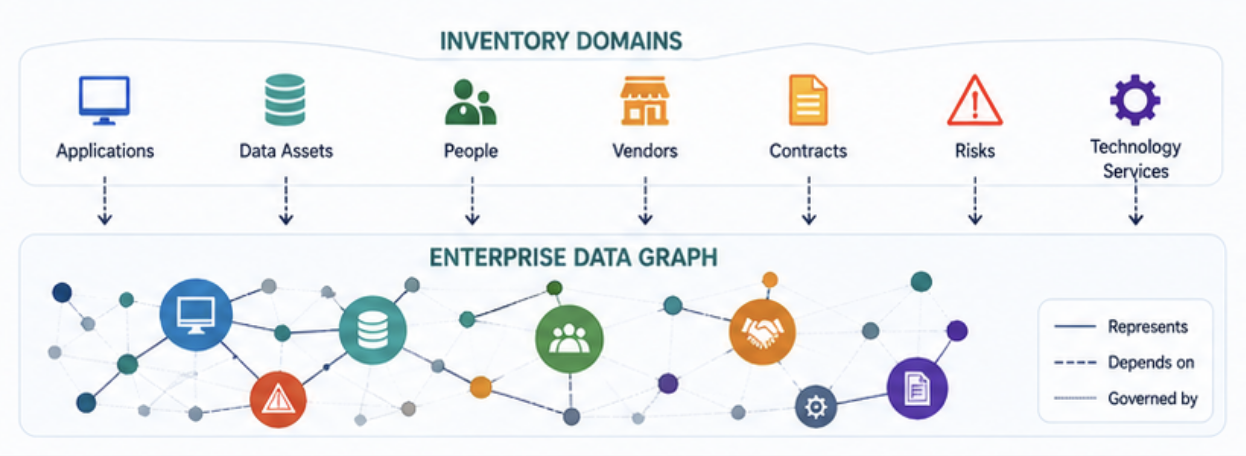
Answer: Each governed inventory represents one type of enterprise thing, and semantic relationships connect its instances to instances in other inventories. Together, these connected inventories create a unified, queryable Enterprise Model that supports cross-domain understanding and analysis.
Question: What makes an enterprise inventory trustworthy and useful?
Read Full Table of Contents Below
Table of Contents
Overview and Glossary
Foundation and Strategy
- Understand what an Enterprise Inventory is and why it matters
- Distinguish between an Inventory, a Register, a Catalog, and a Repository
- Treat enterprise inventories as managed products with their own lifecycles
- Treat the aggregate of all inventories as your Enterprise Model
- Understand that inventories compound in value as they connect
- Understand the relationship between inventories and organizational intelligence
- Use inventories to establish a single, shared source of truth across the enterprise
- Understand the cost of not maintaining enterprise inventories
- Align your inventory strategy with enterprise governance and architectural goals
- Use Application Portfolio Management to govern the Applications and Integrations layers of the Enterprise Model
- Build a business case for enterprise inventory investment
Common Enterprise Inventory Types
Standard Attribute Categories
- Understand the standard attribute category palette and its role in inventory schema design
- Apply the standard attribute category sequence when designing any Noun Type inventory
Governance and Ownership
- Establish an enterprise-wide inventory governance model
- Define clear ownership for every inventory
- Define inventory management roles and responsibilities
- Establish a governance policy for creating, maintaining, and retiring inventories
- Assign enterprise-scoped ownership of cross-organizational inventories to an enterprise governance function
- Distinguish between inventories with natural federated homes and those that require centralized enterprise-scoped ownership
- Use IT Operating Environments governance to anchor the environments layer of the Enterprise Model
- Ensure inventory ownership is always current and never orphaned
Inventory Design and Architecture
- Design inventories to be interoperable and linked — not isolated silos
- Define a consistent schema and taxonomy for each inventory type
- Establish a unique identifier strategy across all inventories
- Separate descriptive attributes from relationship attributes in inventory design
- Build and maintain key mappings and relationships between important inventory items — and use AI to help discover and validate them
- Design inventories to support both operational and analytical use cases
- Design for federation — balance centralized governance with distributed contribution
- Plan for inventory scale from the beginning
Inventory Lifecycle Management
- Recognize that an inventory is never “done” — and that stale data actively misleads
- Treat every inventory as a managed product with a defined lifecycle
- Define entry criteria for adding items to an inventory
- Establish a change management process for inventory updates
- Manage inventory gaps explicitly — known unknowns are better than unknown unknowns
- Distinguish between authoritative sources and derived data
- Establish a regular review and validation cadence for every inventory
- Retire inventory entries properly — mark as inactive before removing
- Retire entire inventories when they no longer serve organizational needs
Population, Automation, and AI
- Start with discovery — know what you have before you claim to manage it
- Consider starting with versioned spreadsheets before investing in complex tooling
- Define and enforce data quality standards for every inventory
- Automate inventory discovery wherever technically feasible
- Use AI to extract, reconcile, and populate inventory data from unstructured sources
- Use AI to detect anomalies, gaps, and inconsistencies across inventories
- Use AI to maintain inventory currency — flag stale entries proactively
- Validate AI-generated inventory data before treating it as authoritative
Integration and Interoperability
- Treat enterprise inventories as the foundation for trustworthy enterprise AI
- Connect inventories to the CMDB to unify operational and architectural views
- Connect inventories to the Service Catalog to link capabilities to delivery mechanisms
- Connect inventories to the Enterprise Model to enable impact analysis
- Use the IF4IT Applications Inventory and Attributes as the reference model for governing your applications inventory
- Expose inventory data through APIs for downstream consumption
- Establish a master data management approach for shared inventory attributes
- Avoid inventory duplication — federate rather than replicate
Measurement and Improvement
- Define metrics and KPIs for inventory health and completeness
- Measure inventory coverage, accuracy, and currency as distinct dimensions
- Use inventory data to drive enterprise decisions and reduce organizational blind spots
- Report inventory health to leadership as a measure of enterprise intelligence maturity
- Use AI to analyze inventory patterns and recommend systemic improvements
- Build a culture of inventory stewardship across the enterprise
Copyright for The International Foundation for Information Technology (IF4IT), LLC: 2008 - Present