Overview - Enterprise Inventory Management Best Practices
Overview
(Chapter 1 of Enterprise Inventory Management Best Practices)
Executive Summary: Chapter Overview
IF4ITThe Bottom Line
Core Concepts
| Concept | Definition & Strategic Role |
|---|---|
| Overview | The central practice addressed by this chapter and the capability the enterprise must govern deliberately. |
| Governance and Accountability | The ownership, standards, controls, and operating discipline required to keep inventory information reliable and actionable. |
| Enterprise Model Integration | The way this practice contributes to connected enterprise knowledge, cross-inventory analysis, and better decisions. |
Quick Q&A
Question: What should an enterprise do to apply the guidance in this chapter on overview?
Read More Below
What Is Enterprise Inventory Management?
Enterprise Inventory Management is the discipline of identifying, creating, populating, governing, and continuously maintaining the inventories that collectively describe everything an enterprise is, has, does, and depends upon. Every organization has things it needs to keep track of: the systems it runs, the people who work for it, the vendors it depends on, the risks it faces, the contracts it holds, the data it manages. Each of these categories of things is a distinct inventory — a managed collection of items of a defined type that the organization needs to understand in order to operate effectively.
The problem in most organizations is not that inventories do not exist. It is that they exist in isolation, maintained by different teams using different tools, following different standards, with different definitions of what belongs and what does not. Data exists in silos. Ownership is unclear. Currency and accuracy are unknown. And because the inventories are disconnected, the organization cannot ask cross-cutting questions about itself — it cannot trace a risk to the system that causes it, or a system to the vendor that supports it, or a vendor to the contract that governs it. The enterprise has parts but no whole.
The Enterprise Model
The Enterprise Model is a data graph that represents the aggregate of all enterprise inventories and the relationships between them. It is not a single system or a single database. It is the sum of all maintained, connected inventories — a unified intelligence layer that allows the organization to understand itself as a whole rather than as a collection of disconnected parts. When inventories are well-designed, well-maintained, and interconnected, the Enterprise Model becomes the most powerful decision-support tool the organization possesses.
Because the Enterprise Model is a graph, the inventories, classifications, and hierarchies that organizations work with are best understood not as separate kinds of structure but as views of that one graph. A view is a segmented set of the data — the graph seen through a particular relationship. An inventory is the view of the graph segmented to a single Noun Type. A classification is the view that groups a Noun Type’s instances by a governing relationship. A hierarchy is not a distinct structure at all: it is the graph traversed along a single relationship type, in one direction. The capability hierarchy, for example, is simply the graph of capabilities followed along the parent-of relationship; follow a different relationship and a different shape appears, or no hierarchy at all. The tree exists in the traversal, not in the data.
This is why some inventories are naturally flat while others are deeply hierarchical, and why the same underlying data can be presented in more than one organized form: each form is a different governed view of the single Enterprise Model graph. Some of these views the enterprise chooses to author and govern as authoritative — an inventory’s classification scheme, a Noun Type’s parent-child hierarchy, a master list of recognized Inventory Types — while others can be generated ad hoc by querying the graph along whatever relationship a question requires. The distinction between an authoritative, governed view and an incidental projection is itself a governance decision. What never changes is that every view, governed or incidental, ultimately resolves back into the one graph when the organization zooms out. The graph is the ground truth; inventories, classifications, and hierarchies are the ways the enterprise looks at it.
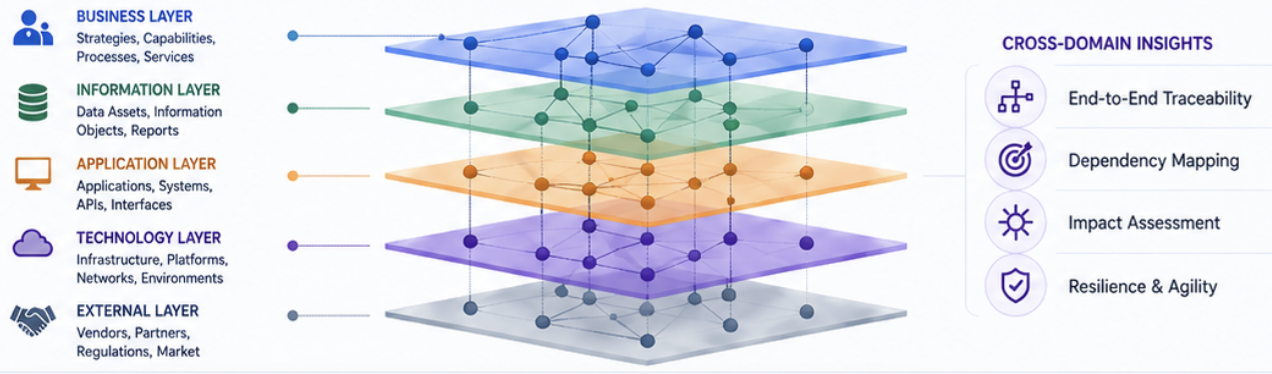
Enterprise Inventory Management is the discipline that builds and sustains the Enterprise Model. Every inventory created, governed, and maintained according to the best practices in this document is a node in the Enterprise Model. Every relationship mapped between inventory items is a connection in that model. The more complete and accurate the inventories, the more powerful and useful the Enterprise Model becomes.
How to Use This Document
This document contains best practices organized across nine domains: Foundation and Strategy, Common Enterprise Inventory Types, Governance and Ownership, Inventory Design and Architecture, Inventory Lifecycle Management, Population and Automation and AI, Integration and Interoperability, and Measurement and Improvement. Each best practice follows a consistent structure: an Overview, one or more Best Practice recommendations, and Benefits.
The Common Enterprise Inventory Types section contains a reference table of recognized inventory types that represent the full spectrum of what organizations typically need to inventory. This table is illustrative, not exhaustive — the specific inventories your organization needs depend on its size, complexity, and strategic priorities. The best practices in all other sections apply to any inventory type.
How to cite this page
When referencing this page in academic work, internal standards, or external publications, include the page title, IF4IT as author and publisher (The International Foundation for Information Technology (IF4IT), LLC), the URL, and your access date.
Example (informal web citation):
The International Foundation for Information Technology (IF4IT), LLC. Enterprise Inventory Management Best Practices. https://if4it.org/best-practices/enterprise-inventory-management/overview/ (accessed 2026-09-11).
See About Us for content governance and site-wide citation guidance.
Copyright for The International Foundation for Information Technology (IF4IT), LLC: 2008 - Present
Legal Disclaimers