Enterprise Inventory Management Best Practices - Treat enterprise inventories as the foundation for trustworthy enterprise AI
Enterprise Inventory Management Best Practices
Chapter 50. Treat enterprise inventories as the foundation for trustworthy enterprise AI
Executive Summary: Chapter Overview
IF4ITThe Bottom Line
Core Concepts
| Concept | Definition & Strategic Role |
|---|---|
| enterprise inventories foundation | The central practice addressed by this chapter and the capability the enterprise must govern deliberately. |
| trustworthy AI | The ownership, standards, controls, and operating discipline required to keep inventory information reliable and actionable. |
| Enterprise Model Integration | The way this practice contributes to connected enterprise knowledge, cross-inventory analysis, and better decisions. |
Quick Q&A
Question: What should an enterprise do to apply the guidance in this chapter on treat enterprise inventories as the foundation for trustworthy enterprise ai?
Read More Below
Overview
Enterprises are increasingly turning to artificial intelligence to reason over their own operations — to answer questions, surface risks, and recommend decisions that span the entire organization. The quality of those answers is governed almost entirely by the quality of the data the AI reasons over. An AI asked to reason about the enterprise can only be as accurate, as complete, and as trustworthy as the inventories beneath it. Where those inventories are governed, connected, and current, AI becomes a powerful interpreter of the Enterprise Model. Where they are absent, fragmented, or stale, AI produces answers that are confident, fluent, and wrong — which is more dangerous than no answer at all.
Best Practice
Treat the building and maintenance of enterprise inventories as a precondition for, not a beneficiary of, enterprise AI. It is tempting to view AI as a way to compensate for missing inventory data — to ask the model to infer what the organization never recorded. This inverts the dependency. AI does not relieve the organization of the need for governed inventories; it raises the stakes on having them, because AI will confidently extend, summarize, and act upon whatever data it is given, including data that is incomplete or out of date.
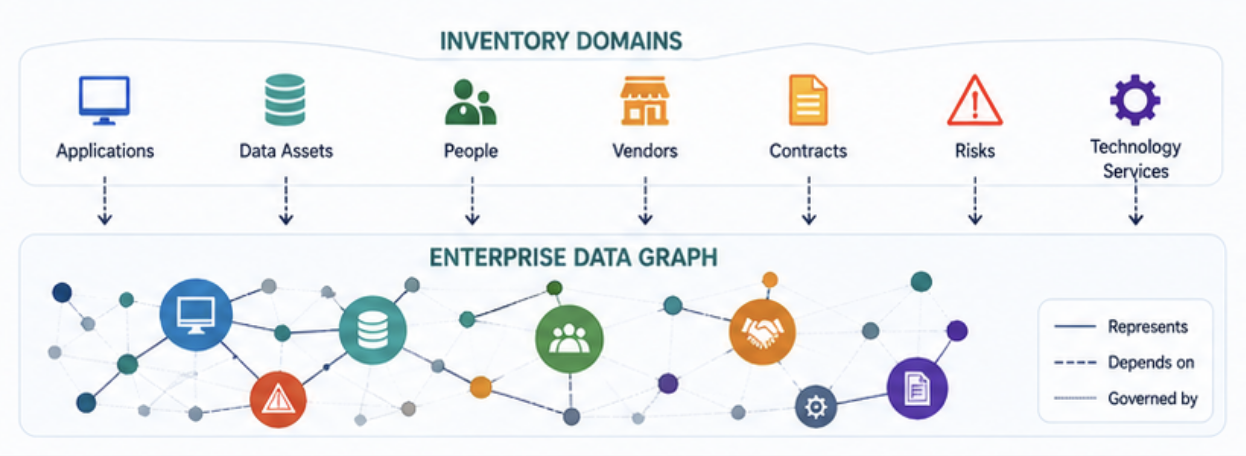
Consider the kind of question enterprises increasingly want to ask of AI: which applications process regulated customer data and run on technologies that are approaching end of life? A question like this can only be answered if the relevant inventories exist, are connected to one another, and are current — an applications inventory, a data and information inventory with sensitivity classifications, a technologies inventory with lifecycle status, and the governed relationships among them. The AI does not know these things; it reads them from the Enterprise Model. The inventories are the source of truth, and the AI is the interface to it. An organization that wants trustworthy AI answers about itself must therefore invest first in the inventories that make those answers possible, and must sustain them, because an AI reasoning over stale inventory data will report the stale answer with the same confidence as a correct one.
Benefit(s)
Organizations that treat inventories as the foundation for AI position themselves to use AI safely and effectively across the enterprise, rather than discovering — after deploying it — that their AI cannot be trusted because the data beneath it was never governed. Well-maintained inventories turn AI from a source of plausible-sounding risk into a genuine force multiplier: a means of querying, navigating, and reasoning over the Enterprise Model at a speed and scale no human team could match. The investment in inventories thus compounds: the same governed data that supports human decision-making becomes the substrate that makes enterprise AI trustworthy.
How to cite this page
When referencing this page in academic work, internal standards, or external publications, include the page title, IF4IT as author and publisher (The International Foundation for Information Technology (IF4IT), LLC), the URL, and your access date.
Example (informal web citation):
The International Foundation for Information Technology (IF4IT), LLC. Treat enterprise inventories as the foundation for trustworthy enterprise AI | Enterprise Inventory Management Best Practices. https://if4it.org/best-practices/enterprise-inventory-management/treat-enterprise-inventories-as-the-foundation-for-trustworthy-enterprise-ai/ (accessed 2026-08-06).
See About Us for content governance and site-wide citation guidance.
Copyright for The International Foundation for Information Technology (IF4IT), LLC: 2008 - Present
Legal Disclaimers