Treat every inventory as a managed product with a defined lifecycle - Enterprise Inventory Management Best Practices
Treat every inventory as a managed product with a defined lifecycle
(Chapter 34 of Enterprise Inventory Management Best Practices)
Executive Summary: Chapter Overview
IF4ITThe Bottom Line
Core Concepts
| Concept | Definition & Strategic Role |
|---|---|
| inventory managed product | The central practice addressed by this chapter and the capability the enterprise must govern deliberately. |
| defined lifecycle | The ownership, standards, controls, and operating discipline required to keep inventory information reliable and actionable. |
| Enterprise Model Integration | The way this practice contributes to connected enterprise knowledge, cross-inventory analysis, and better decisions. |
Quick Q&A
Question: What should an enterprise do to apply the guidance in this chapter on treat every inventory as a managed product with a defined lifecycle?
Read More Below
Overview
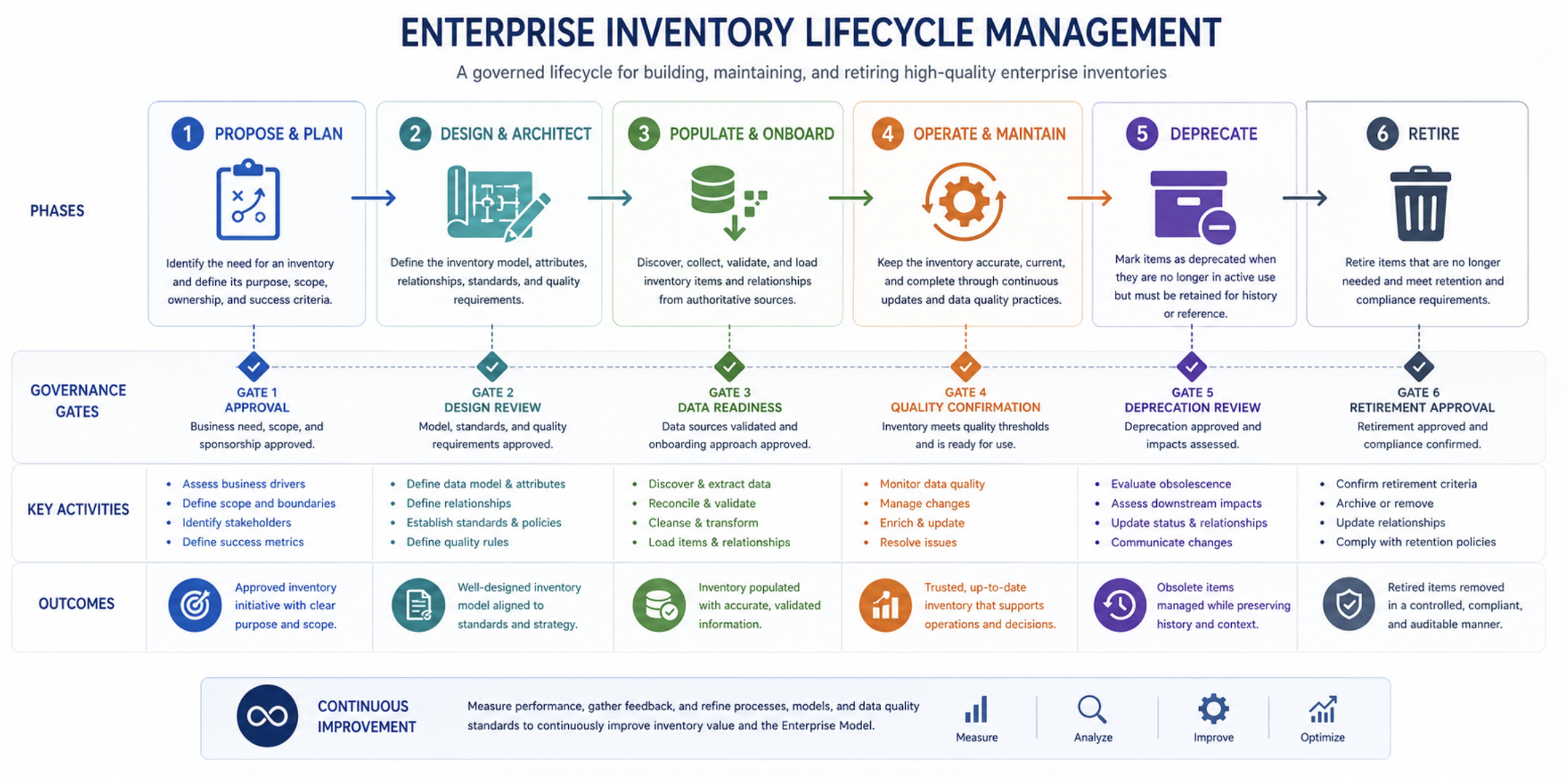
An inventory that has no defined lifecycle has no defined end state and no governed path from creation to retirement. It accumulates entries without discipline, persists beyond its useful life without process, and consumes organizational resources indefinitely. Treating inventories as permanent, unchanging data collections rather than managed products with lifecycles is one of the most common causes of inventory proliferation — the accumulation of overlapping, redundant, and outdated inventories that consume maintenance effort without providing proportional value.
Best Practice
Define a formal lifecycle for enterprise inventories with at minimum four stages: Proposed (the need for an inventory has been identified and documented, pending governance approval), Active (the inventory is approved, populated, and available for enterprise use), Deprecated (the inventory is being phased out — available but no longer recommended for new use cases), and Retired (the inventory has been removed from active enterprise use). Each stage transition requires governance approval and appropriate stakeholder communication.
Benefit(s)
A formal inventory lifecycle gives the organization deliberate control over the composition of its inventory landscape. Inventories are created intentionally through a defined process. They are retired cleanly when they no longer serve organizational needs. The Enterprise Model reflects the current, deliberate inventory strategy of the organization rather than the accumulated artifact of decisions made and never revisited. Resources are allocated to inventories that deliver ongoing value rather than distributed across all inventories regardless of their current relevance.
How to cite this page
When referencing this page in academic work, internal standards, or external publications, include the page title, IF4IT as author and publisher (The International Foundation for Information Technology (IF4IT), LLC), the URL, and your access date.
Example (informal web citation):
The International Foundation for Information Technology (IF4IT), LLC. Treat every inventory as a managed product with a defined lifecycle | Enterprise Inventory Management Best Practices. https://if4it.org/best-practices/enterprise-inventory-management/treat-every-inventory-as-a-managed-product-with-a-defined-lifecycle/ (accessed 2026-09-11).
See About Us for content governance and site-wide citation guidance.
Copyright for The International Foundation for Information Technology (IF4IT), LLC: 2008 - Present
Legal Disclaimers