Enterprise Inventory Management Best Practices - Treat the aggregate of all inventories as your Enterprise Model
Enterprise Inventory Management Best Practices
Chapter 6. Treat the aggregate of all inventories as your Enterprise Model
Executive Summary: Chapter Overview
IF4ITThe Bottom Line
Core Concepts
| Concept | Definition & Strategic Role |
|---|---|
| aggregate all inventories | The central practice addressed by this chapter and the capability the enterprise must govern deliberately. |
| Enterprise Model | The ownership, standards, controls, and operating discipline required to keep inventory information reliable and actionable. |
| Enterprise Model Integration | The way this practice contributes to connected enterprise knowledge, cross-inventory analysis, and better decisions. |
Quick Q&A
Question: What should an enterprise do to apply the guidance in this chapter on treat the aggregate of all inventories as your enterprise model?
Read More Below
Overview
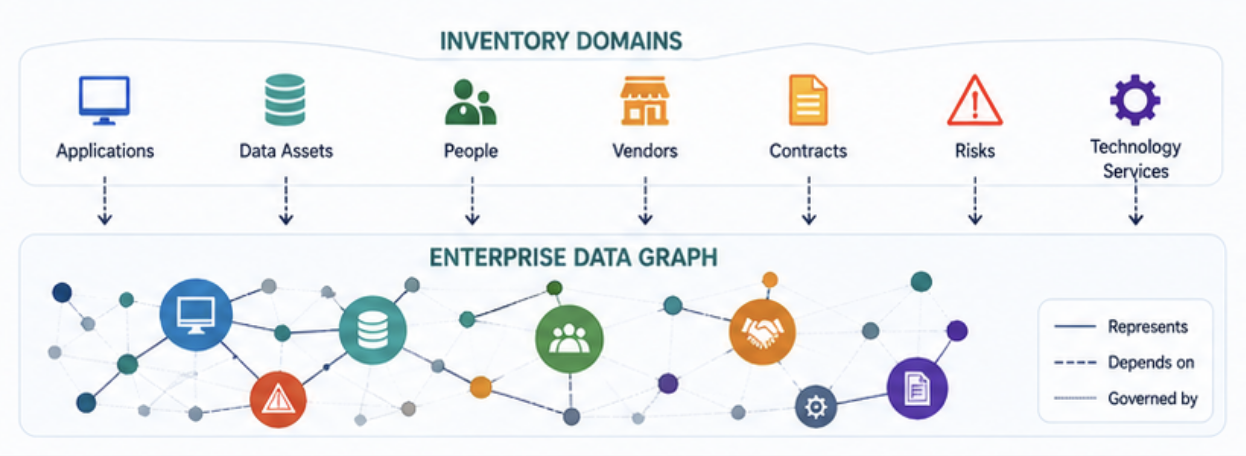
Individual inventories are valuable. A well-maintained Systems and Applications Inventory tells you what systems you run. A well-maintained Vendors and Suppliers Inventory tells you who you depend on. A well-maintained Risks and Issues Inventory tells you what threatens you. But each of these alone provides only a partial view of the enterprise. The real intelligence emerges when the inventories are connected — when you can trace a risk to the system that creates it, trace that system to the vendor that supports it, trace that vendor to the contract that governs the relationship, and trace that contract to the regulatory obligation it fulfills.
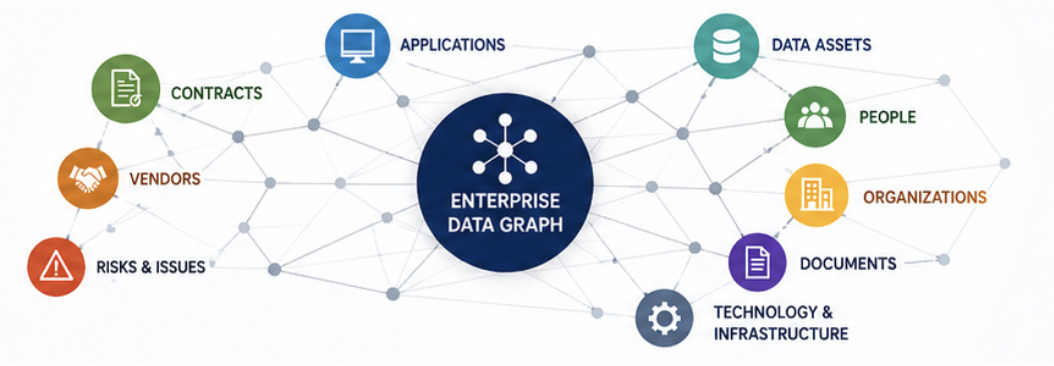
Design and maintain enterprise inventories with the Enterprise Model as the explicit goal. Every inventory decision — what attributes to capture, what identifier scheme to use, what relationships to record — should be made in the context of how that inventory will connect to other inventories. Treat the Enterprise Model as the target architecture and each inventory as a component of that architecture, not as an isolated collection.
Assign accountability for the Enterprise Model as a whole to a function with enterprise-wide scope — typically Enterprise Architecture. Individual inventories have individual owners. The Enterprise Model has a steward accountable for its overall coherence, completeness, and connectivity.
Benefit(s)
Organizations that build toward the Enterprise Model gain analytical capabilities that isolated inventories cannot provide. Impact analysis becomes possible — if a vendor is acquired, what systems are affected? If a regulation changes, what processes and data assets are implicated? If a system is retired, what services and integrations will break? These questions are only answerable when inventories are connected. The Enterprise Model transforms the organization’s self-knowledge from fragmented and siloed to integrated and queryable.
How to cite this page
When referencing this page in academic work, internal standards, or external publications, include the page title, IF4IT as author and publisher (The International Foundation for Information Technology (IF4IT), LLC), the URL, and your access date.
Example (informal web citation):
The International Foundation for Information Technology (IF4IT), LLC. Treat the aggregate of all inventories as your Enterprise Model | Enterprise Inventory Management Best Practices. https://if4it.org/best-practices/enterprise-inventory-management/treat-the-aggregate-of-all-inventories-as-your-enterprise-model/ (accessed 2026-08-06).
See About Us for content governance and site-wide citation guidance.
Copyright for The International Foundation for Information Technology (IF4IT), LLC: 2008 - Present
Legal Disclaimers