Assign Ownership and Governance for Each GxP Discipline - GxP Compliance Framework
Assign Ownership and Governance for Each GxP Discipline
(Chapter 15 of GxP Compliance Framework)
Executive Summary: Chapter Overview
IF4ITThe Bottom Line
Core Concepts
| Concept | Definition & Strategic Role |
|---|---|
| Accountable Owner vs. Executing Function | The distinction between the function answerable to a regulator for a discipline’s compliance and the function that performs or maintains the underlying technical work — these are frequently, and deliberately, different functions. |
| Separation of Duties | The GxP principle — formalized explicitly in 21 CFR 211.22 for Good Manufacturing Practice — that the function producing or executing work should be organizationally independent from the function certifying its compliance. |
| Ownership Gap | A discipline with no clearly assigned accountable owner, typically discovered during a regulatory audit rather than proactively by the organization itself. |
| Cross-Domain Ownership Coordination | The governance approach required when a discipline like GDocP or GVP spans multiple domains rather than sitting inside one — ownership sits with a coordinating function, such as the enterprise Quality Management System, rather than a single siloed department. |
Quick Q&A
Question: Why shouldn't IT own Good Automated Manufacturing Practice (GAMP) compliance, given that IT builds and maintains the validated systems?
Question: What should an organization do when the Suggested Ownership column in the Complete List doesn't match its actual org chart?
Question: What's the risk of leaving a GxP discipline without an assigned owner?
Read More Below
Overview
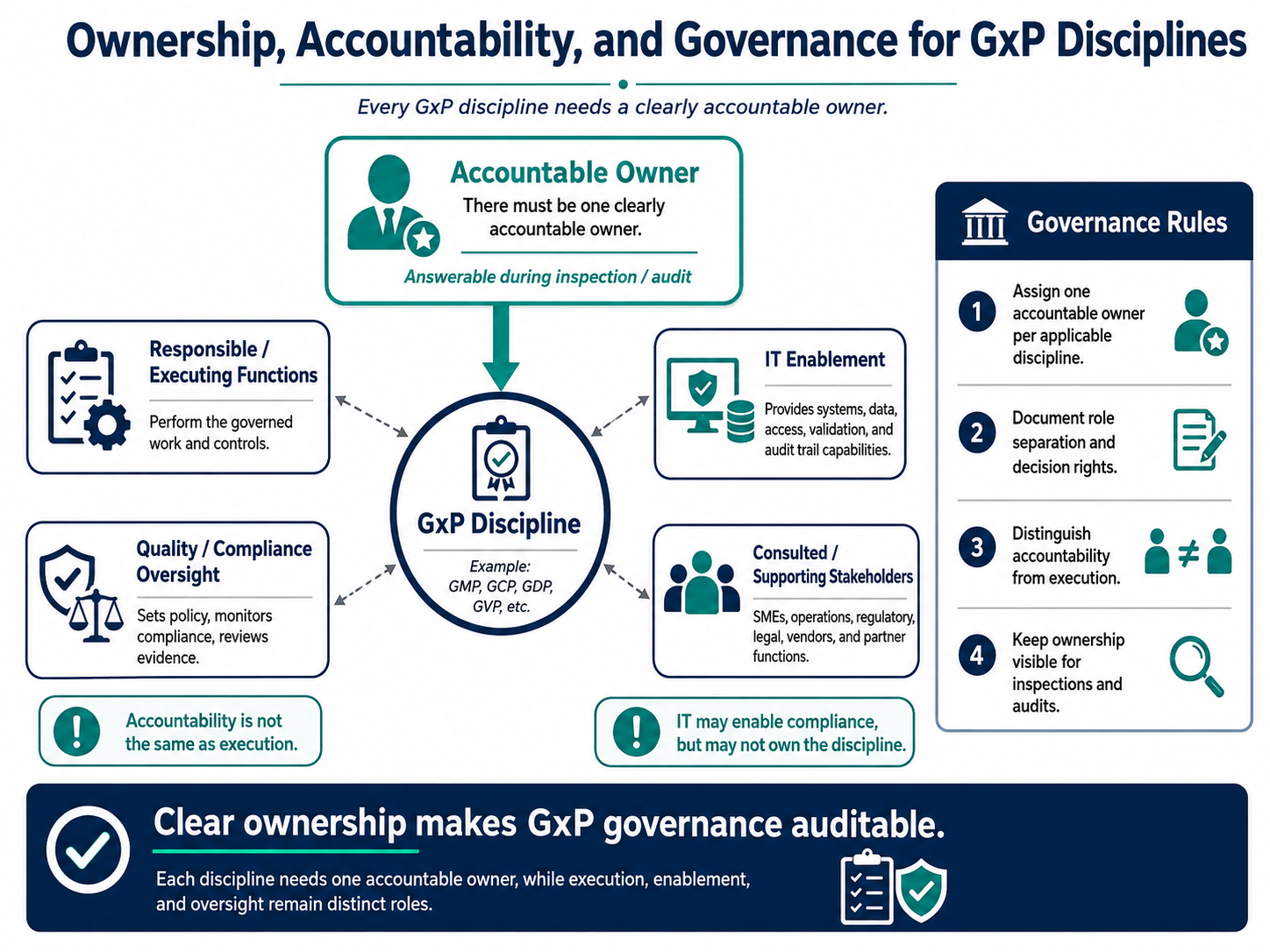
Every GxP discipline documented in the Complete List of GxP Types and Acronyms needs one clearly accountable internal owner — a specific function within the enterprise that is answerable for that discipline’s compliance during a regulatory inspection, not merely a department that happens to touch it. This chapter expands the catalog’s Suggested Ownership column into an actionable method, because that column is a starting point calibrated to a typical enterprise structure, not a fixed answer for every organization.
The single most common ownership mistake — and the reason the Suggested Ownership column was revised before this chapter was written — is conflating execution with accountability. Consider Good Automated Manufacturing Practice: IT builds, configures, and maintains the automated systems and computerized infrastructure GAMP governs. But accountability for confirming those systems are actually validated, and for certifying that validation to a regulator, sits with Quality Assurance — a function structurally independent of the team that built the system being validated. This is the same separation-of-duties principle formalized explicitly in 21 CFR 211.22 for Good Manufacturing Practice, where the Quality Unit must be organizationally independent from Production. Apply that same principle across the board: a discipline’s executing function and its accountable owner are frequently different, and should be, by design.
This distinction explains why Compliance and Quality Assurance functions appear as the Suggested Ownership for roughly half of the twenty-one disciplines in the Complete List, while IT appears as owner of none — even though IT remains an essential executing partner for disciplines like GAMP and, in practice, for the underlying systems supporting GDocP, GCDMP, and others. Ownership in this Framework’s sense means regulatory accountability, not technical execution.
Assigning ownership in your own enterprise is a mapping exercise, not a wholesale adoption of the catalog’s suggestions. Start by identifying, for each discipline relevant to your organization, which existing function performs the accountable role the catalog describes — even if that function goes by a different name locally, or is combined with responsibilities the catalog splits apart. A small organization might have a single Quality function accountable for GMP, GDocP, and GAP together; a large multinational might split Quality by domain or geography, with a distinct GQP owner in its Japan operations alongside a separate GMP owner elsewhere. What matters is that the mapping is explicit and documented, not that your organization’s structure matches the catalog’s defaults.
Cross-domain disciplines need particular attention during this exercise. Good Documentation Practice and Good Pharmacovigilance Practice, for example, both apply across multiple domains rather than sitting neatly inside one — GDocP’s ALCOA+ rules govern documentation in R&D, Clinical Development, Manufacturing, and Supply Chain simultaneously, not just within Cross-Functional Operations where this Framework has chaptered it. For disciplines like these, a single departmental owner is often insufficient; instead, ownership typically sits with a coordinating function — the enterprise Quality Management System introduced under Good Quality Practice — that sets the standard centrally while individual domains execute against it locally.
Finally, the risk of leaving a discipline unassigned is worse than it might first appear. An ownership gap is rarely discovered proactively — it’s typically surfaced by a regulator during an inspection, when an auditor asks “who owns this?” and the honest answer is no one. That finding is treated far more seriously than a discipline that’s owned but imperfectly executed, because it signals no one has been tracking whether the discipline’s requirements are being met at all. With ownership assigned, the next step is confirming that ownership actually covers your enterprise’s complete GxP footprint — including disciplines this Framework’s Complete List may not yet reflect. See “Identify Additional or Emerging Forms of GxP Relevant to Your Enterprise” for a repeatable method to close that gap.
Best Practice: Advance Maturity Deliberately for GxP Ownership and Governance
At the Crawl stage, ownership for each GxP discipline typically exists only as informal, tribal knowledge — “everyone knows Regulatory Affairs handles GCP” — with no documented record connecting a specific discipline to a specific accountable function or individual.
At the Walk stage, organizations maintain a documented ownership map or RACI matrix covering every GxP discipline relevant to their operations, reviewed and updated on a defined schedule rather than left to go stale as the organization changes.
At the Run stage, ownership and governance are tracked through an integrated Governance, Risk, and Compliance (GRC) system that connects each discipline’s owner directly to its associated SOPs, audit findings, and CAPA records, with automated escalation when an ownership gap surfaces — a discipline losing its assigned owner during a reorganization, for instance — rather than waiting for the gap to surface during an inspection.
Best Practice
Complete the ownership mapping exercise for every discipline relevant to your enterprise before an audit forces the question, and document the mapping explicitly — an unwritten “everyone knows Quality handles that” is functionally the same as no ownership at all when a regulator asks for evidence. Apply the separation-of-duties principle deliberately wherever a discipline’s executing function and its accountable owner might otherwise collapse into the same team, and treat any case where they haven’t as worth a second look, not an efficiency to preserve.
Benefit(s)
Explicit, documented ownership turns “who is responsible for this” from a question asked defensively during an audit into a fact the organization can state confidently before one begins. Applying separation of duties consistently — not just where regulation happens to mandate it, like GMP’s Quality Unit requirement — also catches compliance gaps earlier, since an independent accountable owner has no incentive to overlook a problem the executing team might prefer stayed quiet. And a clean ownership map makes onboarding new staff and reorganizations dramatically less risky, since institutional knowledge about who owns what lives in documented governance structure rather than in a few people’s memory.
How to cite this page
When referencing this page in academic work, internal standards, or external publications, include the page title, IF4IT as author and publisher (The International Foundation for Information Technology (IF4IT), LLC), the URL, and your access date.
Example (informal web citation):
The International Foundation for Information Technology (IF4IT), LLC. Assign Ownership and Governance for Each GxP Discipline | GxP Compliance Framework. https://if4it.org/best-practices/gxp-compliance-framework/assign-ownership-and-governance-for-each-gxp-discipline/ (accessed 2026-10-22).
See About Us for content governance and site-wide citation guidance.
Copyright for The International Foundation for Information Technology (IF4IT), LLC: 2008 - Present
Legal Disclaimers