Identify Additional or Emerging Forms of GxP Relevant to Your Enterprise - GxP Compliance Framework
Identify Additional or Emerging Forms of GxP Relevant to Your Enterprise
(Chapter 16 of GxP Compliance Framework)
Executive Summary: Chapter Overview
IF4ITThe Bottom Line
Core Concepts
| Concept | Definition & Strategic Role |
|---|---|
| Emerging Discipline | A GxP-adjacent practice area with real, identifiable regulatory-body backing that is still actively developing — recognizable by joint agency guidance, iterative principle documents, and explicit acknowledgment from the issuing bodies that the standard is still maturing. |
| Source Verification | The practice of confirming a candidate discipline’s name, regulatory body, and scope directly against primary regulatory or industry-body publications, rather than accepting secondary or AI-summarized research uncritically. |
| False Positive Acronym | An acronym that appears plausible or is used informally in industry material but does not correspond to any codified, regulator- or standards-body-published discipline — several of which were identified and removed during this Framework’s own drafting process. |
| Industry-Specific Extension | A GxP-adjacent discipline specific to a subsector — food safety, cosmetics, veterinary medicine, or medical devices, for example — that may be fully real and codified within its own subsector without appearing in a pharmaceutical-centric catalog like this Framework’s. |
Quick Q&A
Question: How can I tell if a "Good X Practice" acronym I've encountered is genuinely real, rather than an informal or mistaken usage?
Question: Is Good Machine Learning Practice (GMLP) already part of the Complete List in this Framework?
Question: Should every GxP-adjacent governance concern eventually get its own "Good X Practice" acronym?
Read More Below
Overview
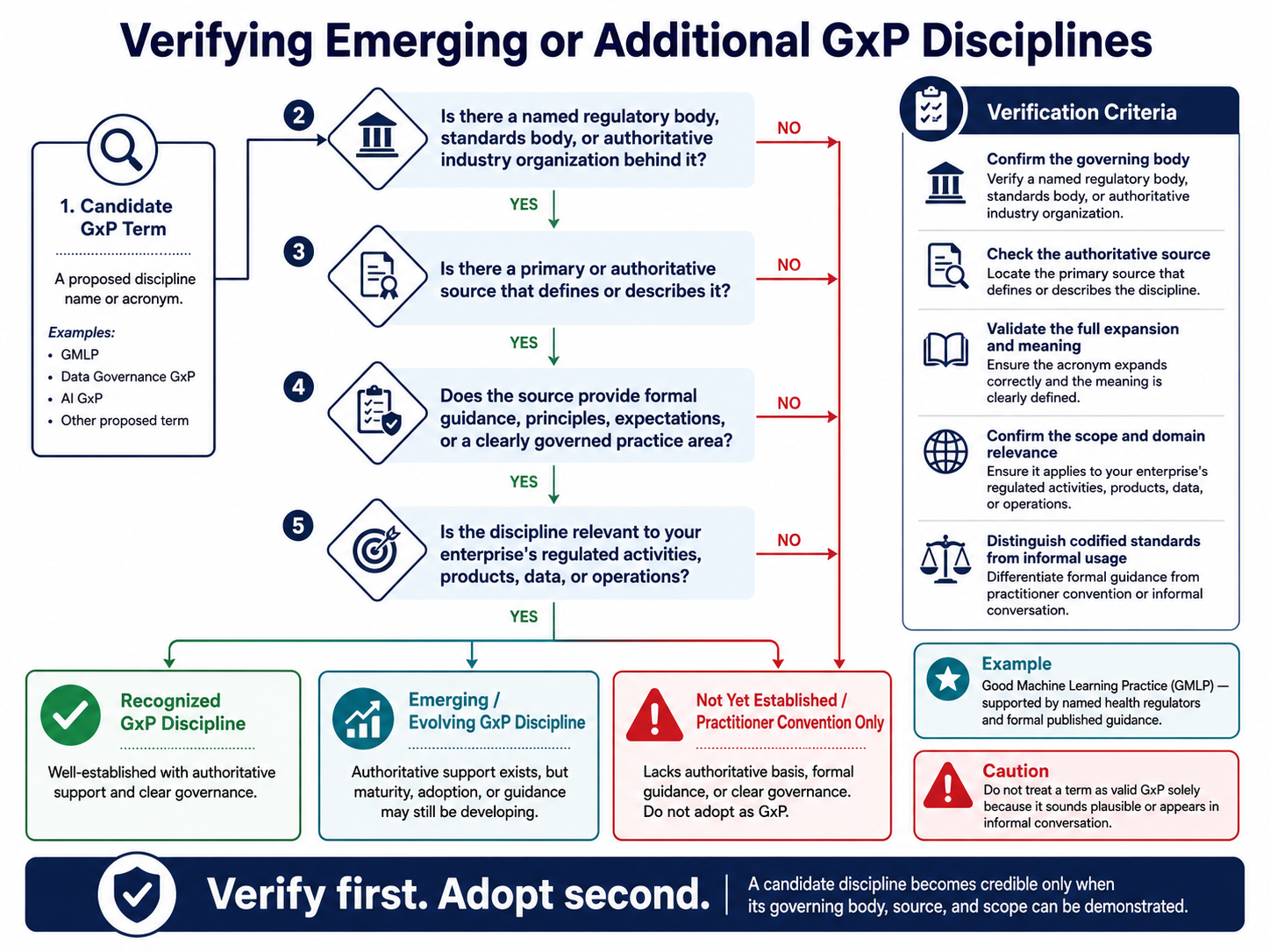
The Complete List of GxP Types and Acronyms documents twenty-one disciplines — the most commonly recognized forms of GxP, as this Framework’s Overview states from the outset. It is a foundation, not a finished, permanent list. GxP disciplines continue to emerge as technology, regulation, and industry practice evolve, and this chapter gives a repeatable method for evaluating whether a candidate discipline belongs in your organization’s compliance program, rather than leaving that judgment to guesswork.
The method mirrors exactly what produced the Complete List itself. Verify a candidate discipline’s full name, regulatory body, and scope directly against primary sources — a named regulator’s or standards body’s own published guidance — rather than accepting a secondary source, industry blog post, or AI-generated summary uncritically. This Framework’s own drafting process is worth learning from directly: several acronyms that appeared plausible in initial research turned out, on verification, not to correspond to any real, codified standard — “GCRP,” “GIMP,” and “GCDR” among them, alongside a use of “GMLP” in the Manufacturing domain for laboratory batch-release testing that didn’t hold up under scrutiny either.
That final example is worth dwelling on, because the same three letters — GMLP — turn out to have a second, genuinely real meaning entirely outside this Framework’s original scope. Good Machine Learning Practice (GMLP) was jointly issued by the FDA, Health Canada, and the UK’s Medicines and Healthcare products Regulatory Agency in October 2021, establishing ten guiding principles for developing, deploying, and monitoring AI- and machine-learning-enabled medical devices throughout their lifecycle. All three regulatory bodies have continued actively expanding GMLP since — publishing additional joint guidance on model transparency in 2024 and predetermined change control plans for managing model updates after deployment. This is exactly what this chapter is looking for: multiple named regulatory bodies, dedicated published guidance under a consistent name, and explicit acknowledgment from the issuing bodies that the standard is still maturing as the underlying technology evolves. It also illustrates, directly from this Framework’s own drafting experience, why verification has to happen acronym by acronym and context by context — the same letters can be a fabrication in one domain and a genuinely emerging discipline in another.
Not every candidate you encounter will be industry-wide the way GMLP is becoming. Some GxP-adjacent disciplines are specific to a subsector this Framework doesn’t primarily cover — food safety, cosmetics, veterinary medicine, or other regulated industries with their own “Good X Practice” conventions. These can be fully real and codified within their own subsector without belonging in a pharmaceutical- and life-sciences-centric catalog like this one. If your enterprise operates in one of these adjacent industries, apply this chapter’s verification method against that subsector’s own regulatory bodies directly, rather than assuming this Framework’s catalog is the complete universe of GxP.
Finally, apply the same discipline established in “GxP in Cross-Functional Operations and Business Governance” here: not every real governance concern deserves its own “Good X Practice” acronym. If a candidate discipline you’re evaluating doesn’t have a named regulatory or standards body behind it, resist the temptation to formalize it as one anyway — note it as a practitioner convention, the way this Framework treats Good Experimental Practice and Good Auditing Practice, rather than inventing false authority.
With ownership assigned to each applicable discipline in “Assign Ownership and Governance for Each GxP Discipline” and this method for identifying additional or emerging disciplines now in hand, your enterprise’s GxP compliance scope is as complete as this Framework can help you make it. The next chapter, “Map IT Applications, Data, and Access to GxP Compliance Scope,” is where that scope becomes concrete — translated into the actual applications, data, and access controls IT is accountable for.
Best Practice: Advance Maturity Deliberately for Identifying Emerging GxP Disciplines
At the Crawl stage, awareness of new or emerging GxP disciplines typically happens by chance — a team member encounters a new acronym in a vendor conversation or trade publication and flags it informally, with no systematic process behind the discovery.
At the Walk stage, organizations build a periodic regulatory horizon-scanning activity into their Quality or Compliance calendar — a defined, scheduled review of major regulatory bodies’ recent publications, rather than relying on chance encounters.
At the Run stage, regulatory intelligence is a dedicated function or subscribed service systematically monitoring publications from every regulatory body relevant to the enterprise’s operations, with new candidate disciplines evaluated against this chapter’s verification method as a routine, defined workflow rather than an occasional special project.
Best Practice
Verify any candidate discipline against primary sources before treating it as real — apply the same standard this Framework applied to its own drafting, where several plausible-looking acronyms didn’t survive scrutiny. Build a light, scheduled habit of scanning the regulatory bodies already named throughout this Framework’s Complete List for new guidance, since emerging disciplines are far more likely to originate from a body already on your radar than from an entirely new source.
Benefit(s)
A repeatable verification method protects your organization from two opposite failure modes: missing a genuinely new discipline until an auditor raises it, and wasting compliance effort formalizing a practice that was never a real, codified standard to begin with. Watching Good Machine Learning Practice mature in real time also gives an enterprise a head start — organizations that track GMLP’s guiding principles now, while the standard is still forming, are positioned to shape their AI/ML development practices proactively rather than retrofitting compliance after the standard fully solidifies.
How to cite this page
When referencing this page in academic work, internal standards, or external publications, include the page title, IF4IT as author and publisher (The International Foundation for Information Technology (IF4IT), LLC), the URL, and your access date.
Example (informal web citation):
The International Foundation for Information Technology (IF4IT), LLC. Identify Additional or Emerging Forms of GxP Relevant to Your Enterprise | GxP Compliance Framework. https://if4it.org/best-practices/gxp-compliance-framework/identify-additional-or-emerging-forms-of-gxp-relevant-to-your-enterprise/ (accessed 2026-10-22).
See About Us for content governance and site-wide citation guidance.
Copyright for The International Foundation for Information Technology (IF4IT), LLC: 2008 - Present
Legal Disclaimers