Map IT Applications, Data, and Access to GxP Compliance Scope - GxP Compliance Framework
Map IT Applications, Data, and Access to GxP Compliance Scope
(Chapter 17 of GxP Compliance Framework)
Executive Summary: Chapter Overview
IF4ITThe Bottom Line
Core Concepts
| Concept | Definition & Strategic Role |
|---|---|
| GxP-Relevant Application | An application whose function directly creates, stores, processes, or transmits evidence a GxP discipline depends on — an EDC system for GCDMP, a LIMS for GCLP, an electronic batch record system for GMP — regardless of which business function operates it. |
| GxP-Scoped Data and Information | Data or information whose accuracy, completeness, and integrity a specific GxP discipline depends on for compliance — batch records, audit trails, clinical trial data, adverse event reports — as distinct from data an enterprise holds that has no GxP relevance. |
| GxP Access Governance | The practice of granting, reviewing, and revoking system and data access specifically calibrated to GxP’s Attributable and Traceable requirements — every action must be traceable to a specific, authorized individual, never a shared or overly broad role. |
| Governed View, Not a Silo | The IF4IT principle that GxP application and data scope is a governed lens applied across the existing Application Portfolio and Enterprise Model, not a separate inventory built and maintained in isolation. |
Quick Q&A
Question: If Compliance or Quality functions own most GxP disciplines, why does IT need its own chapter in this Framework?
Question: Should an enterprise build a separate inventory just for GxP-relevant applications and data?
Question: What's the connection between GxP access governance and the ALCOA+ principles covered earlier in this Framework?
Read More Below
Overview
With ownership assigned to each applicable discipline in “Assign Ownership and Governance for Each GxP Discipline,” and any additional or emerging disciplines relevant to your operations identified in “Identify Additional or Emerging Forms of GxP Relevant to Your Enterprise,” your enterprise’s GxP compliance scope is as complete as this Framework can help make it. This chapter is where that scope becomes concrete and actionable for IT specifically.
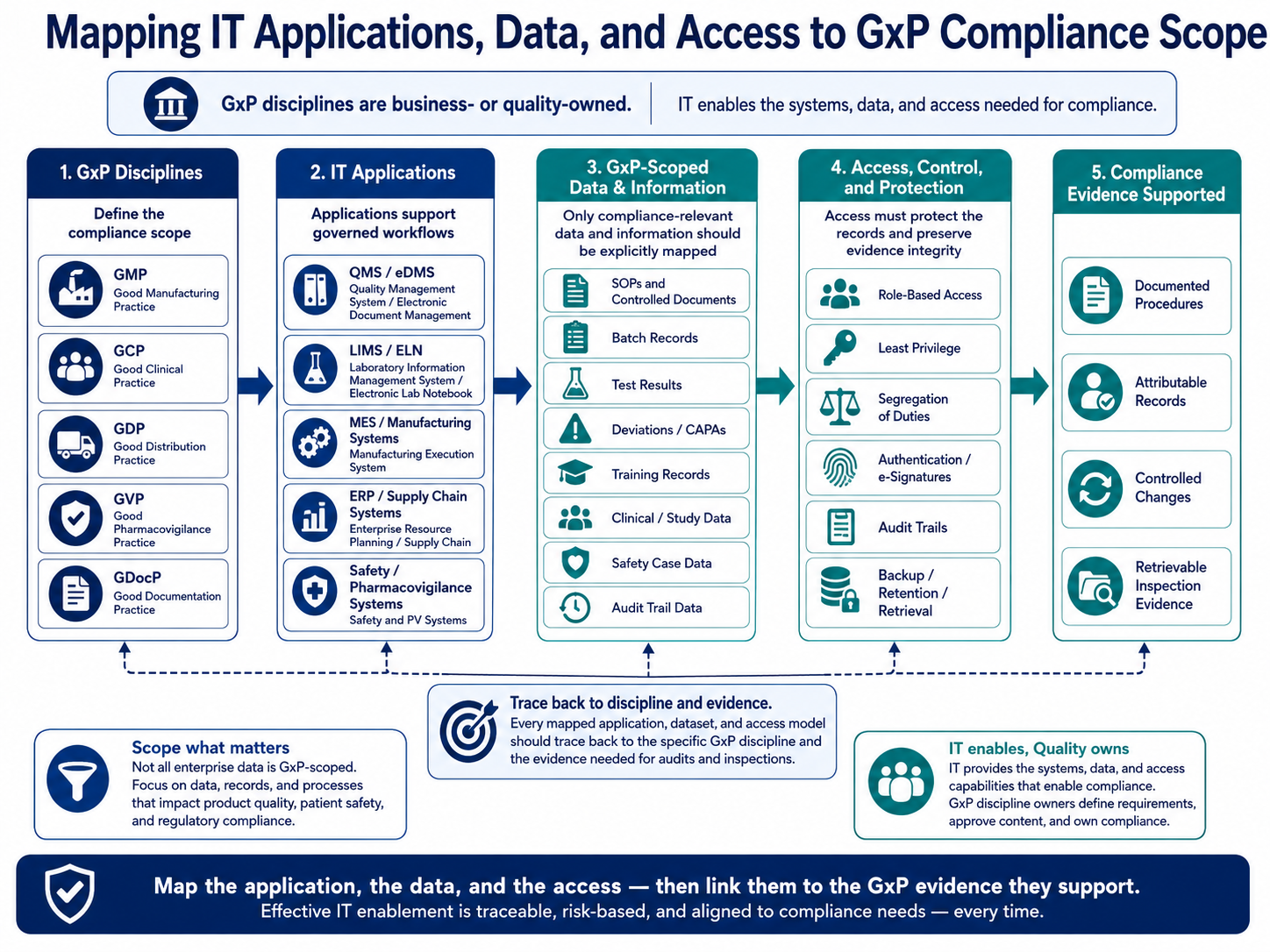
Every domain chapter in this Framework, and the ownership assignments in the Complete List, point in the same direction: most GxP disciplines are owned by Compliance, Quality, and specific business functions — not IT. That’s correct, and it’s not a reason for IT leaders to treat this Framework as someone else’s problem. IT carries direct responsibility for the applications, data, and access controls that create and maintain the evidence every GxP discipline’s compliance actually depends on, even when IT holds none of the regulatory accountability itself. A Quality function cannot demonstrate Good Clinical Data Management Practice compliance without a validated Electronic Data Capture system IT built and maintains. A Compliance function cannot demonstrate Good Documentation Practice’s ALCOA+ requirements without the documentation infrastructure, audit-trail logging, and access controls IT operates. This chapter is for the IT leaders, managers, and practitioners enabling that work — giving them three concrete things to understand and inventory.
The first is application scope: understanding which applications in the enterprise’s portfolio support which GxP disciplines. An Electronic Data Capture system supports Good Clinical Data Management Practice. A Laboratory Information Management System supports Good Clinical Laboratory Practice and Good Manufacturing Practice’s quality control testing. An electronic batch record system, a document management system enforcing GDocP’s ALCOA+ rules, a pharmacovigilance case-processing system supporting GVP — each is a GxP-relevant application whether or not the team that built or maintains it thinks of it that way. This is not a call to build a new, separate inventory. Consistent with this Framework’s standing IT Management principle, GxP application scope is a governed view layered onto the enterprise’s existing Application Portfolio, not a parallel structure maintained in isolation — tag the applications already in your portfolio with the GxP disciplines they support, rather than duplicating the underlying inventory.
This application-scope work connects directly to three other governed disciplines across IF4IT. This tagging approach follows the same federation-over-duplication discipline IF4IT’s Enterprise Inventory Management Best Practices document establishes for every Noun Type inventory across the enterprise. Building and maintaining those applications to a standard that can withstand GAMP-based validation is itself governed by IF4IT’s Systems Development Lifecycle (SDLC) Best Practices document — the disciplined, phase-based approach to designing, building, testing, and maintaining software that GxP-relevant systems depend on just as much as any other enterprise application. And the specific quality attributes GAMP validation demands — data integrity, auditability, availability, security — are exactly what IF4IT’s Non-Functional Requirements (NFRs) Framework for Software Systems formalizes as a discipline in its own right; treating GxP’s technical requirements as a specialized set of NFRs, rather than a separate compliance exercise bolted onto development, keeps validation demands visible throughout the SDLC rather than surfacing only at the end.
The second is data and information scope: understanding what data and information each applicable GxP discipline actually puts in scope. Good Manufacturing Practice puts batch records, deviation reports, and cleaning validation data in scope. Good Clinical Practice puts informed consent records, protocol deviations, and case report form data in scope. Good Pharmacovigilance Practice puts adverse event reports in scope. This scoping directly determines which systems’ data falls under the Data Integrity and ALCOA+ requirements covered earlier in this Framework — data outside GxP scope doesn’t carry the same ALCOA+ obligations, and conflating the two either overburdens systems that don’t need this rigor or, more dangerously, under-protects data that does. As with application scope, this is a tagging exercise rather than a new inventory: mark the relevant records as GxP-scoped within IF4IT’s Data and Information Inventory and Attributes document — the enterprise’s master reference for every data and information type it holds — rather than maintaining a separate, GxP-specific data catalog.
The third is roles and access: understanding who is granted access to GxP-relevant applications and data, and why. This connects directly to the Data Integrity chapter’s Attributable principle — every action on GxP-relevant data must be traceable to a specific, authorized individual, which is structurally impossible without disciplined access governance. Shared logins, overly broad roles, and access rights that outlive an employee’s actual need for them all directly undermine Attributability, no matter how well-designed the underlying application is. IT’s role here is not to decide who should have access — that’s a business and Compliance decision — but to design, implement, and maintain the access controls that make the business’s access decisions enforceable and auditable.
Together, applications, data, and access are what creating and maintaining GxP evidence, reports, and records actually depends on operationally. This is precisely why IT organizations, even without direct GxP compliance accountability themselves, remain directly responsible for enabling and supporting the businesses that do.
Best Practice: Advance Maturity Deliberately for Mapping IT to GxP Compliance Scope
At the Crawl stage, GxP relevance for applications, data, and access is typically known only informally — a few people on the IT team know “that system matters for GMP” without any documented record connecting a specific application, dataset, or access policy to the GxP disciplines it supports.
At the Walk stage, organizations maintain a documented tagging layer on their existing Application Portfolio, marking each GxP-relevant application with the specific discipline(s) it supports, and apply role-based access control aligned to GxP requirements, reviewed on a defined schedule.
At the Run stage, GxP relevance is tracked as a first-class, governed attribute within the enterprise’s Application Portfolio Management and Enterprise Model tooling — automatically surfacing which applications, data domains, and access policies map to which GxP disciplines, with access reviews and attestations integrated directly into the broader GRC system introduced in “Assign Ownership and Governance for Each GxP Discipline.”
Best Practice
Treat GxP relevance as an attribute you tag onto existing Application Portfolio and Enterprise Model records, never as a reason to stand up a separate, disconnected inventory — a second system of record for the same applications creates exactly the kind of governance drift this Framework’s Cross-Functional Operations chapter warns against. When granting access to any GxP-relevant application or dataset, default to the most restrictive role that still lets someone do their job, and treat every grant as something that will eventually need to be reviewed, justified, and revoked — not as a permanent state.
Benefit(s)
A governed, tagged view of GxP-relevant applications, data, and access gives IT a defensible answer when Compliance or an auditor asks “which systems matter here” — instead of reconstructing that answer under audit pressure, it’s already documented. It also directly strengthens the Attributable and Traceable principles this entire Framework is built around, since disciplined access governance is a prerequisite for both, not an optional security nicety layered on top. And treating GxP scope as a governed view rather than a separate inventory keeps IT’s own portfolio management practice consistent with itself, avoiding the maintenance burden and drift risk of parallel, disconnected systems of record.
How to cite this page
When referencing this page in academic work, internal standards, or external publications, include the page title, IF4IT as author and publisher (The International Foundation for Information Technology (IF4IT), LLC), the URL, and your access date.
Example (informal web citation):
The International Foundation for Information Technology (IF4IT), LLC. Map IT Applications, Data, and Access to GxP Compliance Scope | GxP Compliance Framework. https://if4it.org/best-practices/gxp-compliance-framework/map-it-applications-data-and-access-to-gxp-compliance-scope/ (accessed 2026-10-22).
See About Us for content governance and site-wide citation guidance.
Copyright for The International Foundation for Information Technology (IF4IT), LLC: 2008 - Present
Legal Disclaimers