Traceability and Audit Trails Across GxP Disciplines - GxP Compliance Framework
Traceability and Audit Trails Across GxP Disciplines
(Chapter 6 of GxP Compliance Framework)
Executive Summary: Chapter Overview
IF4ITThe Bottom Line
Core Concepts
| Concept | Definition & Strategic Role |
|---|---|
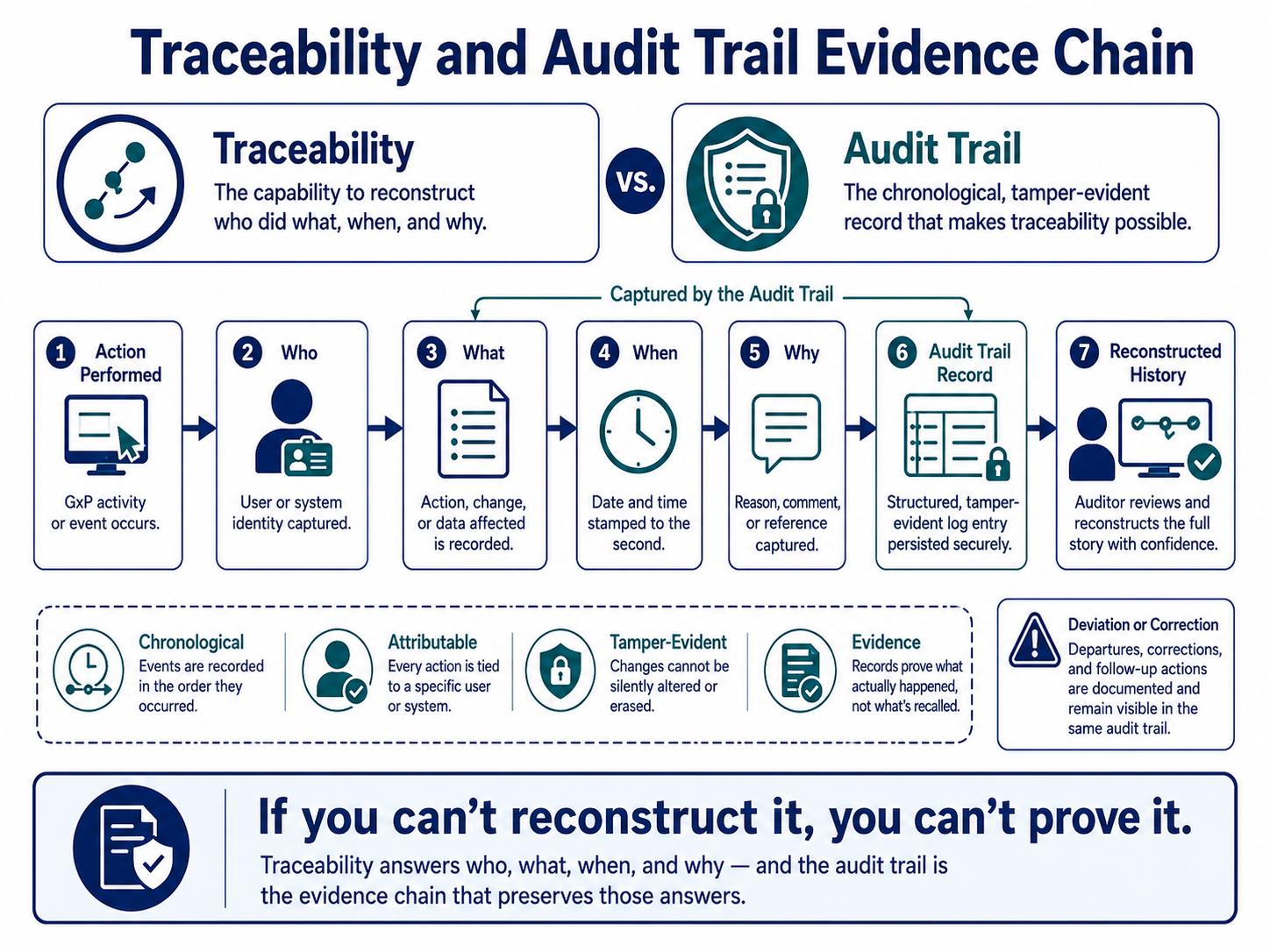
| Traceability | The ability to trace any GxP-relevant batch, sample, test result, software edit, or decision back to who performed it, when, and why it was performed or changed. |
| Audit Trail | The tamper-evident, chronological record — paper or electronic — that makes traceability provable, capturing who did what, when, and why for every GxP-relevant action. |
| Chain of Custody | The unbroken, documented record of who possessed and physically handled a sample or specimen at every point between collection, transport, testing, and final disposition. |
| Tamper-Evidence | The property of a genuine audit trail that any alteration, deletion, or backdating attempt leaves a visible, permanent trace rather than silently overwriting the original record. |
Quick Q&A
Question: What's the difference between traceability and an audit trail?
Question: Can a corrected paper record still satisfy GxP traceability requirements?
Read More Below
Overview
If Standard Operating Procedures establish what is supposed to happen, traceability and audit trails establish proof of what actually did happen — and who made it happen. Traceability is GxP’s requirement that every batch, sample, test result, software edit, and decision be traceable back to who performed it, when, and why. An audit trail is the mechanism that makes that traceability real: a chronological, tamper-evident record — paper or electronic — of every GxP-relevant action.
This chapter builds directly on the previous one, “Standard Operating Procedures (SOPs): The Documented-Process Foundation of GxP.” An SOP describes the correct procedure; the audit trail is the evidence that the SOP was actually followed, on that batch, at that time, by that person. When actual practice departs from an SOP, that departure is itself required to be captured as a formally documented Deviation — and the audit trail is what makes it possible to identify that a departure occurred at all.
Traceability and audit trails also lay the groundwork for the next chapter, “Data Integrity and the ALCOA+ Principles in GxP.” Two of ALCOA+’s core requirements — that data be Attributable and Contemporaneous — are, in practice, traceability and audit trail requirements applied specifically to data. Understanding traceability first makes those principles far more intuitive when we get there.
Audit trails take two broad forms, and the defining property is the same for both: any alteration must be visible, never silent. Paper-based audit trails rely on disciplined manual practice — original entries stay legible even when corrected, never obscured, whited out, or erased, with every correction initialed, dated, and briefly explained. Electronic audit trails rely instead on system design: the system itself must automatically and immutably log every creation, modification, and deletion of a GxP-relevant record, capturing who made the change, when, and why. In the United States, this is formally codified for electronic records and signatures under 21 CFR Part 11; equivalent standards exist in other jurisdictions.
A related but distinct concept is chain of custody — the unbroken record of who physically possessed and handled a sample or specimen, from initial collection through transport, testing, and final disposition. Chain of custody matters most in domains covered later in this Framework, particularly Clinical Development and Manufacturing, where a broken custody record can invalidate an otherwise sound test result.
Best Practice: Advance Maturity Deliberately for Traceability and Audit Trails
Traceability tooling scales meaningfully with enterprise maturity, and organizations should advance deliberately rather than skip stages or over-invest before they’re ready.
At the Crawl stage, traceability typically depends on paper logbooks and manual sign-off sheets, with corrections handled by hand per the initial-date-explain convention. This is a legitimate starting point, but reconstructing a complete history for any single record is labor-intensive and vulnerable to gaps — a missed initial or an unlogged action can break the chain without anyone noticing until an audit.
At the Walk stage, organizations move to semi-electronic systems — structured electronic forms or a document management system with basic version history — that automatically capture some create/modify actions but may not yet cover every GxP-relevant system consistently or meet full electronic-signature regulatory standards.
At the Run stage, traceability runs through validated computerized systems with system-generated, tamper-evident electronic audit trails compliant with 21 CFR Part 11 or the equivalent regional standard — automatically capturing every create, modify, and delete action with user ID, timestamp, and reason for change. At this stage, audit trail review becomes a routine, scheduled quality activity in its own right, and audit trail data can be analyzed systematically for risk signals such as unusual after-hours edits.
Organizations should know which stage they are currently operating at and have a deliberate plan for advancing, rather than assuming paper-based Crawl-stage traceability is sufficient indefinitely simply because it has not yet caused a problem.
Best Practice
Design every GxP-relevant system and process so an auditor could reconstruct the complete history of any single record — who created it, who touched it, when, and why — without needing to interview anyone. Never allow overwrite-in-place edits on GxP records; every change must append a new, attributed entry rather than replace the original. Apply this discipline to electronic systems as rigorously as paper — 21 CFR Part 11 compliance, or the equivalent regional standard, is not optional wherever electronic records substitute for paper GxP records.
Benefit(s)
A robust audit trail turns “trust us” into “verify it yourself” — the record speaks for itself during inspection instead of requiring staff to reconstruct events from memory, which is inherently unreliable. It also directly enables root-cause investigation when something goes wrong: a complete traceability chain is what allows an organization to isolate exactly where and when a deviation, error, or falsification occurred, rather than guessing. Finally, tamper-evident audit trails protect the organization’s own staff — an accurate, unbroken record is the best defense against unfounded allegations of misconduct.
How to cite this page
When referencing this page in academic work, internal standards, or external publications, include the page title, IF4IT as author and publisher (The International Foundation for Information Technology (IF4IT), LLC), the URL, and your access date.
Example (informal web citation):
The International Foundation for Information Technology (IF4IT), LLC. Traceability and Audit Trails Across GxP Disciplines | GxP Compliance Framework. https://if4it.org/best-practices/gxp-compliance-framework/traceability-and-audit-trails-across-gxp-disciplines/ (accessed 2026-10-22).
See About Us for content governance and site-wide citation guidance.
Copyright for The International Foundation for Information Technology (IF4IT), LLC: 2008 - Present
Legal Disclaimers