The IF4IT Enterprise Model and Modeling Best Practices
Executive Summary: Document Overview
IF4ITThe Bottom Line
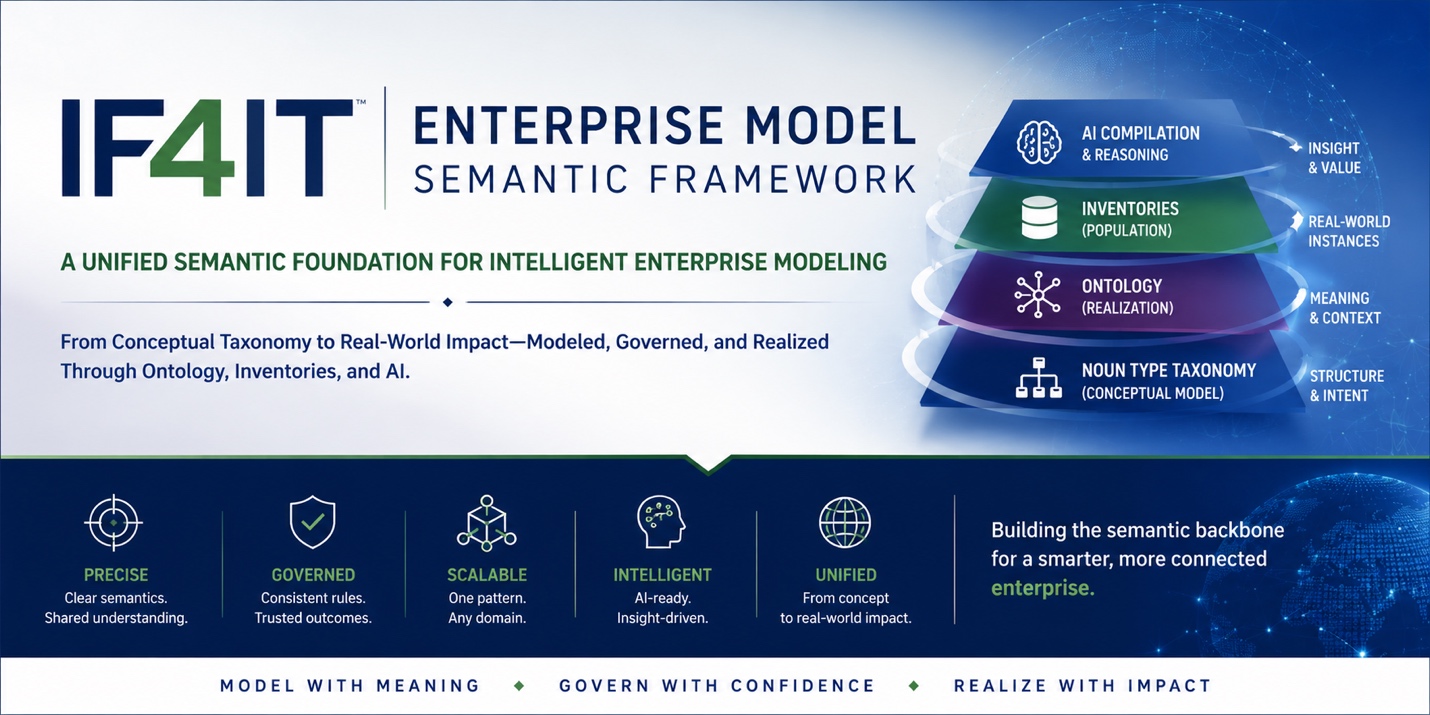
The IF4IT Enterprise Model and Modeling Best Practices explains how enterprises can design, govern, and use an AI-consumable semantic Enterprise Model that represents what the enterprise has, how those things relate, and what those relationships mean. It positions the Enterprise Model as a living, governed foundation for enterprise understanding, graph compilation, AI-assisted reasoning, visualizations, reporting, dashboards, generated applications, decision support, and durable knowledge management.
Core Pillars & Document Modules
| Document Pillar / Focus Area | Strategic Business Outcome & Intent |
|---|---|
| Enterprise Model as Semantic Model | Defines the enterprise through governed Taxonomy, Ontology, inventories, semantic identifiers, semantic relationships, attributes, and rules so humans and AI can reason over enterprise knowledge with shared meaning. |
| AI as Graph Compiler | Shows how AI and deterministic compilers can read IF4IT Enterprise Model source artifacts and compile them into in-memory or external data and knowledge graphs for analysis and downstream use. |
| AI as Graph Runtime | Explains how AI can traverse, query, compare, visualize, reason over, report from, and generate applications from compiled enterprise graphs. |
| Governance and Operating Discipline | Establishes the ownership, validation, refresh, inventory, ontology, and lifecycle practices needed to keep the Enterprise Model accurate, useful, scalable, and trustworthy. |
Quick Q&A (Macro Executive Reference)
Question: What is the IF4IT Enterprise Model?
Answer: It is a governed, queryable semantic representation of an enterprise that combines Taxonomy, Ontology, inventories, semantic identifiers, relationships, attributes, and rules so humans and AI systems can understand and reason over enterprise facts.
Question: Why does the Enterprise Model matter in the age of AI?
Answer: AI needs more than fragmented records and diagrams. It needs governed concepts, stable identifiers, meaningful relationships, authoritative inventories, and interpretation rules so it can produce useful, explainable, and trustworthy outputs rather than fluent answers from weak enterprise knowledge.
Question: How does this document connect modeling practice to operational value?
Answer: It shows how model source content can be compiled into data and knowledge graphs and then operated on through AI runtimes, external graph systems, generated applications, visualizations, reports, dashboards, and decision-support artifacts.
Read Full Table of Contents Below
Table of Contents
Overview and Glossary
Foundations of the IF4IT Enterprise Model
- Understand the IF4IT Enterprise Model and Modeling Concepts
- Recognize the Empirical Foundation
- Key IF4IT Enterprise Model Component 1 — the Taxonomy
- Key IF4IT Enterprise Model Component 2 — the Ontology
- Key IF4IT Enterprise Model Component 3 — the Inventories
- Use AI as the Graph Compiler and Runtime
- IF4IT Enterprise Model Scalability Within and Across Domain Spaces
Governing and Measuring an Enterprise Model
Building and Leveraging an IF4IT-compliant Enterprise Model
Copyright for The International Foundation for Information Technology (IF4IT), LLC: 2008 - Present