Govern Your Enterprise Model - The IF4IT Enterprise Model and Modeling Best Practices
Govern Your Enterprise Model
(Chapter 10 of The IF4IT Enterprise Model and Modeling Best Practices)
Executive Summary: Chapter Overview
IF4ITThe Bottom Line
Core Concepts
| Concept | Definition & Strategic Role |
|---|---|
| Model Governance | The discipline that keeps Taxonomy, Ontology, inventories, identifiers, relationships, rules, and outputs trustworthy over time. |
| Human-in-the-Loop Review | The control pattern that ensures AI-suggested changes, inferred relationships, and generated outputs remain accountable to qualified owners. |
| Lifecycle Management | The process of adding, changing, retiring, and validating Noun Types, inventories, rules, and relationships as enterprise reality changes. |
Quick Q&A
Question: Why can’t the Enterprise Model be left unmanaged after it is built?
Question: What role should AI play in governance?
Read More Below
Overview
This section explains how any IF4IT-compliant Enterprise Model you generate for your own enterprise becomes a governed enterprise capability rather than a modeling exercise. The EM you generate is valuable only when the enterprise can trust its Taxonomy, Ontology, inventories, relationships, rules, and AI-runtime outputs. That trust requires accountable ownership, explicit decision rights, defined stewardship, change control, and a recurring operating cadence.
Governance Closes the Model Improvement Loop
The Enterprise Model does not improve only during initial design, implementation, or periodic refresh. It improves continuously as the Taxonomy, Ontology, Inventories, AI compilation process, AI runtime utilization, and human governance process expose new improvement opportunities.
The governance function is what closes the model improvement loop. As AI compiles the graph and humans and AI use the graph, the model may reveal missing Noun Types, weak definitions, unclear relationship rules, stale inventory records, duplicate Noun Instances, poor classifications, missing evidence, weak prompts, incomplete traversals, confusing visualizations, or runtime outputs that require better source grounding.
These discoveries should not automatically become authoritative model content. They should become governed improvement candidates.
Human governance decides whether each candidate should be approved, rejected, revised, deferred, routed to another owner, escalated, or converted into a backlog item for later improvement. This preserves accountability while still allowing the EM to improve rapidly through use.
The governing principle is simple: AI may discover, suggest, compile, traverse, explain, and generate but it is accountable humans who must decide what becomes trusted, authoritative, and operationally binding.
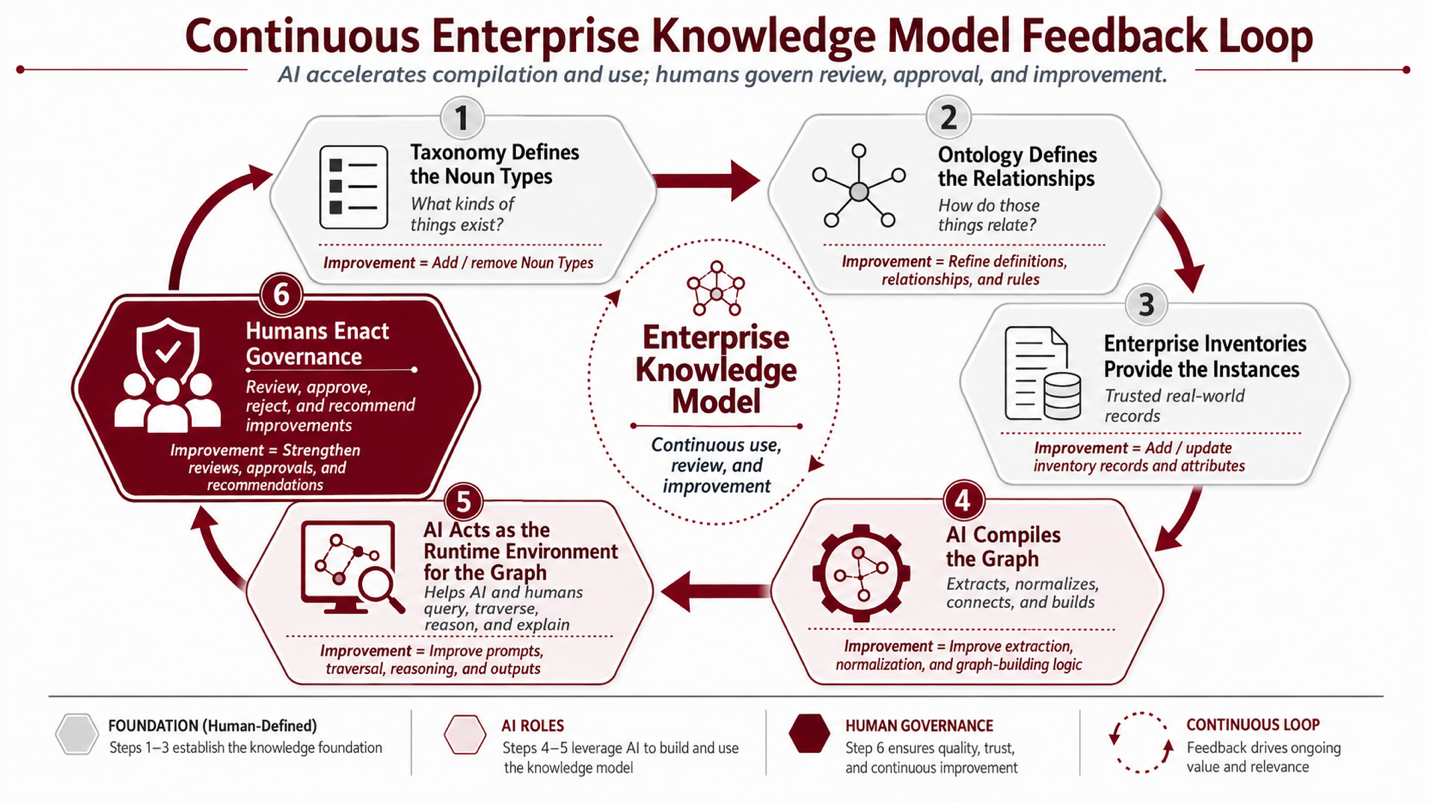
The loop begins when the Taxonomy defines the Noun Types, continues as the Ontology defines their relationships and rules, is populated by Enterprise Inventories, is compiled by AI into a working graph, and is used by AI and humans through runtime interactions. Human governance closes the loop by deciding which discoveries and recommendations should improve the Taxonomy, Ontology, inventories, graph compilation logic, runtime behavior, or governance rules.
Governance Roles and Accountabilities
The following roles establish a practical starting operating model. A small enterprise may combine several roles in one person or team; a larger enterprise may assign them to separate accountable owners. The important discipline is not organizational complexity. The important discipline is that every major part of the EM has a named owner and a clear path for approving change.
| Role | Primary Accountability | Typical Decision Rights | Loop Accountability / Improvement Focus |
|---|---|---|---|
| Enterprise Model Owner | Owns the EM as an enterprise capability and is accountable for its overall coherence, usefulness, and adoption. | Approves model scope, priority use cases, governance cadence, and escalation of cross-domain conflicts. | Owns the overall model improvement loop and ensures that Taxonomy, Ontology, inventories, graph compilation, runtime use, and governance decisions remain coherent and aligned to priority enterprise use cases. |
| Taxonomy Owner | Owns the lightweight Taxonomy of Noun Types and the discipline for quickly registering, naming, specializing, deprecating, or retiring Noun Types. | Approves lightweight Taxonomy changes, naming conventions, source-inventory pointers, specialization decisions, and alignment to the Inventory of Inventories. | Reviews feedback that suggests new, duplicate, ambiguous, specialized, deprecated, retired, merged, split, or renamed Noun Types. |
| Ontology Owner | Owns definitions, attribute interpretation, relationship types, reified relationships, natural-language rules, and model-level semantic integration. | Approves ontology entries, relationship semantics, rule changes, attribute mappings, and semantic interpretation standards. | Reviews feedback that suggests better definitions, aliases, attributes, relationship semantics, reification rules, natural-language rules, or interpretation guidance. |
| Inventory Owner | Owns one governed inventory as the realized population of a Noun Type, including its source data, core attributes, quality practices, and update cadence. There needs to be a clear owner for every inventory and it is common for one person to own multiple inventories. | Approves inventory content standards, fit-for-purpose governance rigor, source authority, update cadence, data quality expectations, and accepted improvements. | Accepts, rejects, or routes AI-suggested inventory improvements such as missing records, duplicate records, stale records, missing attributes, weak classifications, or source-data corrections. |
| Inventory Steward | Maintains day-to-day inventory quality, resolves defects, and supports population, update, and validation activities. | Recommends corrections, identifies stale or missing records, and manages routine quality remediation. | Performs day-to-day triage and remediation for approved inventory-quality improvements and prepares issues that require Inventory Owner review. |
| AI Runtime Owner (a.k.a. Tool Owner) | Owns the AI runtime patterns that compile, traverse, query, summarize, visualize, or generate outputs from the EM. | Approves runtime access, prompt and workflow patterns, output validation requirements, and operational controls. | Improves prompts, runtime workflows, graph-access patterns, visualization behavior, evidence display, confidence display, role-specific outputs, and runtime controls. |
| Enterprise Model Governance Board (Optional and for more advanced modeling enterprises) | Provides cross-functional oversight when model changes affect multiple domains, inventories, owners, or decision processes. | Approves major scope changes, resolves ownership conflicts, prioritizes remediation, and governs enterprise adoption. | Resolves cross-domain improvement conflicts and approves high-impact changes that affect multiple Noun Types, inventories, owners, runtime outputs, or decision processes. |
Each role participates in the improvement loop differently. Some roles govern conceptual structure, some govern semantic meaning, some govern source inventories, some govern runtime behavior, and some resolve cross-domain conflicts. The improvement loop works only when suggestions are routed to the role with the authority to decide whether the suggested change should become governed model content, source inventory content, runtime behavior, or backlog work.
Operating Cadence and Change Control
The governance cadence should be lightweight enough to sustain and formal enough to protect trust. Routine inventory corrections, source-data updates, core inventory attributes, and inventory-specific quality controls should normally remain with the federated Inventory Owner. The Taxonomy of Noun Types should remain deliberately lightweight: when a useful inventory exists and can be strapped into the model, the Enterprise Model Owner or Taxonomy Owner should be able to register the Noun Type quickly, identify the correlating source inventory, and make it available for model use. More significant changes to enterprise-wide semantics, relationship rules, reified relationship patterns, or cross-inventory interpretation should move through an appropriate review path. It is recommended that the EM’s governance should also include a maintained audit or decision log so future readers can understand why modeling choices were made.
| Governance Activity | Typical Cadence | Purpose |
|---|---|---|
| Continuous feedback capture | Continuous or event-driven | Capture AI compiler feedback, AI runtime feedback, modeler feedback, Inventory Owner feedback, stakeholder feedback, and audit feedback as candidate improvement signals. |
| Inventory quality review | Weekly or biweekly for priority inventories | Identify stale, missing, duplicate, ambiguous, weakly classified, or low-quality records before they weaken model trust. |
| AI compiler review | Weekly, biweekly, or per major ingestion cycle | Review extraction quality, mapping quality, identity resolution, normalization logic, source traceability, confidence patterns, and graph-building defects. |
| AI runtime review | Per pilot, release, or material decision use case | Confirm that AI-generated outputs, visualizations, traversals, dashboards, summaries, and explanations are grounded in governed model content before promotion or publication. |
| Taxonomy and Ontology review | Monthly or as change volume requires | Approve structural model changes, Noun Type changes, relationship semantics, reification patterns, natural-language rules, and prevention of uncontrolled specialization or semantic drift. |
| Cross-domain issue review | Monthly or triggered by unresolved conflicts | Resolve ownership, definition, relationship, source-authority, stakeholder-impact, and evidence disputes that cross inventory or domain boundaries. |
| Governance disposition review | Monthly or as backlog volume requires | Review unresolved AI-suggested improvements, deferred recommendations, escalated issues, and recommendations that require owner or governance-board action. |
| Executive value review | Quarterly | Confirm that the EM continues to support priority business, governance, architecture, risk, compliance, operational, and AI use cases. |
| Major release or refresh gate | Per major model release, shared runtime deployment, or authoritative-model promotion | Approve promotion from exploratory or working-graph content into authoritative model structures, governed inventories, shared runtime environments, or published outputs. |
The cadence should support the improvement loop without turning every change into a heavyweight approval event. Routine inventory corrections should remain close to the Inventory Owner and stewarding process. Structural model changes, relationship semantics, runtime-output behavior, evidence requirements, cross-domain mappings, and authoritative promotions should follow stronger review paths. The objective is to preserve trust while allowing the EM to improve through use.
The governance objective is to make the EM trustworthy enough to be used. Governance does not mean every change requires executive approval. It means each kind of change has the right owner, the right review path, and the right evidence behind it.
Sources of Model Improvement Feedback
Improvement opportunities may emerge from many parts of the IF4IT EM operating pattern. Governance should recognize these feedback sources so that suggestions are routed to the right owner and disposition path.
| Feedback Source | Examples |
|---|---|
| AI compiler feedback | Missing nodes, weak source mappings, duplicate records, low-confidence identity resolution, ambiguous Noun Type classification, poor normalization, or failed graph construction. |
| AI runtime feedback | Poor answers, incomplete traversals, weak explanations, missing evidence, confusing visualizations, inappropriate dashboard output, or unclear decision-support artifacts. |
| Modeler feedback | Better Noun Type definitions, missing relationship rules, reification candidates, semantic identifier improvements, attribute-mapping improvements, or graph-quality defects. |
| Inventory Owner feedback | Source-data corrections, stale records, missing attributes, duplicate Noun Instances, ownership gaps, update-cadence gaps, or source-authority issues. |
| Stakeholder feedback | Missing views, misunderstood outputs, decision-support gaps, unclear explanations, missing context, role-inappropriate outputs, or practical usability issues. |
| Governance, risk, compliance, or audit feedback | Evidence gaps, approval gaps, unresolved ownership, weak traceability, confidence issues, control gaps, policy conflicts, or compliance-readiness defects. |
Feedback should be treated as an input to governance, not as automatic truth. Each feedback signal should be classified, routed, reviewed, and either acted on or rejected through an appropriate disposition path.
Lightweight Noun Type Registration and Inventory Integration
START SIMPLE: Crawl, Walk, Run. This is deliberate.

The EM should make enterprise knowledge easy to connect before requiring that knowledge to be perfected. A new Noun Type does not need a fully mature ontology entry, a perfectly governed inventory, or a redesigned source schema before it can become useful. If the enterprise has some representable inventory that can be pointed to, loaded, and interpreted, the model owner should be able to register the Noun Type, identify the correlating inventory source, and let AI or another compiler begin using it in the next model compilation cycle.
This is a deliberate distinction between Taxonomy governance and inventory governance. The Taxonomy of Noun Types is intended to be lightweight and simple. Inventory governance is fit-for-purpose and federated. A Contracts Inventory may require legal, procurement, audit, and retention controls. A Business Capabilities Inventory may require much lighter stewardship. The EM does not impose one governance weight across all inventories; it provides a semantic integration layer that allows differently governed inventories to participate in the broader model.
The Enterprise Model Owner governs how the Noun Type is registered, how the source inventory is made visible to the model, and how ontology rules help AI interpret the source. The Inventory Owner governs the inventory itself: its data, core attributes, quality, source authority, and update cadence. The model should add semantic context where useful, not seize ownership of federated source data. The Inventory Owner should realize the importance of improving the inventory to improve the Enterprise Model that is the enterprise knowledge graph.
| Lifecycle State | Meaning | Primary Owner |
|---|---|---|
| Candidate | A useful inventory or inventory-like source has been identified as a possible addition to the EM. | Enterprise Model Owner, Taxonomy Owner, or sponsoring practitioner |
| Registered | A Noun Type has been added to the Taxonomy / ontology rule set with a basic name, definition, source pointer, and known owner or contact. | Enterprise Model Owner / Taxonomy Owner |
| Loadable | The correlating inventory can be ingested in its current format, such as CSV, Excel, JSON, API output, database export, system report, or structured document content. | Modeler, Inventory Owner, or technical steward |
| Connected | The inventory participates in the EM through semantic identifiers, source metadata, relationship hints, attribute mappings, or ontology rules. | Modeler / Ontology Owner with Inventory Owner input |
| Enriched | AI, modelers, stewards, and Inventory Owners improve definitions, attribute mappings, relationship hints, inferred relationships, quality notes, and model-level semantics over time. | Modeler and Inventory Owner |
| Governed | The Noun Type and its source inventory integration have stable ownership, source authority, refresh expectations, and fit-for-purpose controls. | Inventory Owner and Enterprise Model Owner |
| Deprecated | The Noun Type remains visible for legacy interpretation but should not be used for new model expansion. | Enterprise Model Owner / Taxonomy Owner |
| Retired | The Noun Type is no longer active in the model, while historical references and lineage are preserved where needed. | Enterprise Model Owner / Taxonomy Owner |
The improvement loop should also be allowed to create Taxonomy change candidates. Runtime use, graph compilation, stakeholder questions, and inventory analysis may reveal that a Noun Type is missing, duplicated, ambiguous, overly broad, too narrow, or ready for specialization. These observations should be routed to the Taxonomy Owner or Enterprise Model Owner for review. Approved changes should update the Taxonomy and then trigger any needed Ontology, inventory, rule, mapping, compiler, or runtime adjustments.
Governance Boundaries for Noun Types and Inventories
The lifecycle is intentionally asymmetric. Registering a Noun Type should be easy; governing the inventory behind it should be as light or as heavy as the enterprise requires. The boundary prevents the EM from becoming a central data-control bureaucracy while still preserving enterprise-wide semantic coherence.
| Concern | Primary Accountability | Governance Implication |
|---|---|---|
| Taxonomy of Noun Types | Enterprise Model Owner / Taxonomy Owner (Recommended: Enterprise Architecture of Software Engineering) | Keep simple, lightweight, and easy to extend when useful inventories are discovered. |
| Ontology rule entry | Ontology Owner / Modeler | Define enough meaning, source context, and interpretive guidance for AI to ingest and reason over the inventory. |
| Inventory source content | Inventory Owner | Maintain the data, source authority, update cadence, quality controls, and inventory-specific governance rigor. |
| Core inventory attributes | Inventory Owner | Start with the attributes the source inventory already uses; do not require a universal IF4IT schema before onboarding. |
| Model-enabling attributes | Modeler with Inventory Owner input | Add or map only what is useful for semantic interpretation, such as semantic identifiers, normalized names, relationship hints, and source metadata. |
| AI-suggested changes | AI proposes; accountable humans decide | Treat AI recommendations as advisory until accepted by the Inventory Owner, modeler, or appropriate steward. |
The feedback loop does not collapse governance boundaries. A modeler or AI runtime may discover that an inventory record appears stale, duplicated, incomplete, or misclassified, but the source Inventory Owner remains accountable for deciding whether the source inventory should change. Likewise, an Inventory Owner may identify a useful source attribute, relationship candidate, or classification concern, but the Ontology Owner or Enterprise Model Owner remains accountable for deciding whether and how that concept should become part of the governed model semantics. The loop accelerates discovery; it does not erase accountability.
Start with Source Attributes and Improve Through Use
Key Tenets:
Start Simple: Get fundamental and usable Noun Types integrated, up, published, and running as quickly as possible.
Hook Your Audience: Get the model up, running, and in use by leadership and other day-to-day stakeholders as quickly as possible. This includes not just using the model to tell you things via natural language text but also using it to generate highly interactive visualizations, reports, dashboards, and more.
Rapidly Evolve: Your use and their use will quickly help guide you in the directions of model evolution and improvements.
The attributes of an inventory should start with those identified by the Inventory Owner. In many cases, the source inventory already contains the attributes its owner needs to manage the underlying domain. The EM should be able to leverage those attributes as-is, even if their names, formats, or completeness are not ideal from a model perspective. They can be changed/improved in the future.
If the source inventory has few or no useful attributes beyond basic identity, the modeler can look to IF4IT reference material to see whether recommended attributes exist for that Noun Type. IF4IT may provide recommended attribute sets for some Noun Types but not all; developing full attribute guidance for every possible Noun Type is itself a large and evolving body of work. Recommended IF4IT attributes should therefore be treated as guidance, not as a precondition for model participation.
After the inventory is ingested and used by model consumers, the modeler and Inventory Owner can work together to identify new attributes, improve existing attributes, or add a simple attribute mapping layer. Such a mapping layer can translate source field names into model-friendly names without forcing the source inventory to be redesigned. For example, a source field named app_nm can be mapped to Application Name; ownr_id can be mapped to Business Owner; vend can be mapped to Vendor. This is easy for AI to interpret and easy for a modeler to maintain. Note: Such mappings can be part of your Ontology Attribute specifications and rules.
| Attribute Source or Layer | Purpose | Governance Treatment |
|---|---|---|
| Source attributes from the Inventory Owner | Use the fields the inventory already has for its operational purpose. | Owned and governed by the Inventory Owner. |
| IF4IT-recommended attributes | Provide optional guidance where IF4IT has developed recommended attributes for a Noun Type. | Adopt selectively; do not require before onboarding. |
| Semantic identifiers | Provide stable, human-meaningful identity for Noun Instances. | May be generated or mapped by the modeler with Inventory Owner review. |
| Attribute mapping layer | Translate source field names or values into model-friendly names or interpretations. | Owned collaboratively by the modeler and Inventory Owner. |
| AI-suggested attribute improvements | Identify missing, ambiguous, duplicate, weak, or high-value attributes after ingestion and use. | Advisory until accepted by the accountable owner or steward. |
Use AI to Ingest First and Enrich Progressively
A critical difference between an IF4IT-compliant EM and many Architecture Modeling Tool (AMT) approaches is that an IF4IT-compliant EM can begin with existing inventories in practical formats — with no complex, time-consuming, and expensive ETL. AI often does not require the inventory to be remodeled into a rigid tool-specific schema before it can begin using it and making it valuable to the enterprise. Given CSV files, Excel spreadsheets, JSON files, exports, reports, APIs, or structured documents, a modeler can be up and running in minutes-to-hours, and AI can often infer what it is looking at, identify candidate entities, interpret columns and values, and apply ontology rules to infer relationships, mappings, and possible reified semantic relationships.
The modeler should still provide whatever context is available: owner, source pointer, format, refresh cadence, known fields, identifier conventions, data sensitivity, known relationship hints, and quality notes. The EM is format-tolerant, but not context-free. The more context the modeler provides, the more reliable and repeatable AI ingestion and graph compilation become.
| Step | Activity | Result |
|---|---|---|
| 1. Identify inventory | Find a useful source inventory or inventory-like artifact. | Candidate Noun Type and source inventory are known. |
| 2. Register Noun Type | Add the Noun Type to the Taxonomy / ontology rule set and point to the source. | The inventory becomes visible to the EM. |
| 3. Load source | Allow AI or another compiler to ingest the source in its available format. | The source becomes available for interpretation and compilation. |
| 4. Apply ontology rules | Use definitions, rules, identifiers, and relationship hints to interpret the inventory. | AI can infer mappings, relationships, gaps, and candidate reifications. |
| 5. Review suggestions | Modeler and Inventory Owner review AI-suggested improvements. | Useful changes are accepted; weak or incorrect suggestions are rejected. |
| 6. Enrich model | Update attribute mappings, semantic identifiers, rules, or relationship guidance as needed. | The inventory becomes more useful without requiring heavy upfront remodeling. |
Ingestion-First Modeling vs. Schema-First Tooling
This ingestion-first posture is one of the IF4IT EM’s most important and powerful differentiators. Many Architecture Modeling Tools are schema-first: the entity type, attributes, relationships, and views often must be configured or modeled inside the tool before the information becomes broadly useful. An IF4IT-compliant EM is ingestion-first and enrichment-after-use: it can leverage the inventories the enterprise already has, then progressively add semantic identifiers, mappings, ontology rules, relationship guidance, and governance discipline as value is proven.
The point is not that AMTs are wrong. AMTs are valuable when an enterprise wants a controlled modeling environment with a defined metamodel, curated element types, standardized views, and governed diagrams or reports, all for a constrained and limited data set. The IF4IT EM addresses a different problem: making existing enterprise inventories semantically consumable, across a broad and complex range of Noun Types that are mostly not easily, quickly or affordably modeled in and handled by such AMTs or conventional relational modeling methodologies. They do this with AI, without first forcing those inventories into a tool-specific schema with complex, expensive, and time-consuming ETL. This gives the modeler and his/her stakeholders the ability to ingest, look at what they have, and then make practical decisions about how to improve any aspect of the model and the inventories.
Use Human-in-the-Loop Control for AI-Suggested Improvements
AI can accelerate the improvement of the EM, but it should not silently convert suggestions into governed truth. AI may infer relationships, propose reified semantic relationships, recommend attribute mappings, identify duplicate or stale inventory records, suggest new rules, improve semantic identifiers, normalize values, generate dashboards, or identify gaps in source inventories. These suggestions are valuable because they reveal improvement opportunities quickly. They are not, by themselves, authoritative changes.
Human-in-the-loop control is the discipline that decides what happens to those suggestions. The EM should distinguish model-layer improvements from inventory-layer improvements. Model-layer improvements can normally be reviewed and applied by the modeler, Enterprise Model Owner, Taxonomy Owner, or Ontology Steward through model governance. Inventory-layer improvements must be fed back to the federated Inventory Owner, with affected stakeholders considered, because source inventory changes may affect operational processes, legal obligations, financial reporting, compliance posture, security controls, audit evidence, or business ownership outside the model itself.
Human-in-the-loop control is also the mechanism by which the EM improves through use. AI-suggested improvements should be treated as improvement candidates that may affect one or more model layers: the Taxonomy, the Ontology, source inventories, source-to-model mappings, semantic relationships, reified relationships, compiler behavior, runtime behavior, natural-language rules, evidence requirements, or trust levels. Human review determines which layer is affected, which owner has authority, which stakeholders may be impacted, and what disposition is appropriate.
The governing principle is simple: AI may suggest, infer, map, normalize, enrich, or generate but it is accountable humans who decide what becomes governed model truth or source inventory truth.
Classify AI suggestions before acting on them
The first human decision is classification. A recommendation may belong in the model layer, the source inventory, or a mapping layer between the two. Classifying the suggestion first protects federated ownership while still allowing the EM to improve quickly.
| AI-suggested improvement area | Examples of what AI may suggest | Primary human disposition path |
|---|---|---|
| Model-layer improvements | Better ontology definitions, semantic relationship rules, source-to-model mappings, Noun Type specialization, semantic identifier rules, or reified semantic relationship patterns. | Modeler, Enterprise Model Owner, Taxonomy Owner, or Ontology Steward reviews and applies through model governance. |
| Inventory-layer improvements | Data corrections, missing values, duplicate records, inconsistent statuses, missing owners, attribute additions, quality issues, or update-cadence improvements. | Modeler packages the recommendation and works with the federated Inventory Owner, who decides whether and how to change the source inventory. |
| Cross-boundary improvements | Attribute mappings, relationship hints, derived attributes, normalized names, linkage fields, confidence notes, or source metadata that help the inventory participate in the model. | Modeler and Inventory Owner decide whether the improvement belongs in the source inventory, model mapping layer, ontology/rule layer, or some combination. |
| Generated constructs | Candidate reified semantic relationships, inferred mappings, proposed rules, generated views, dashboards, reports, or graph traversals. | Modeler reviews model-level constructs; affected Inventory Owners and stakeholders review constructs that depend on or change their source data. |
AI-suggested improvements should also be classified by the model layer they affect. This helps route each suggestion to the correct owner and prevents all AI feedback from being treated as the same kind of governance issue.
| Model Layer Affected | Examples of AI-Suggested Improvements | Primary Disposition Owner |
|---|---|---|
| Taxonomy | New Noun Type, duplicate Noun Type, retired Noun Type, renamed Noun Type, merged Noun Types, split Noun Type, or specialized child Noun Type. | Taxonomy Owner / Enterprise Model Owner |
| Ontology | Improved definition, synonym, alias, attribute interpretation, relationship rule, reification rule, natural-language rule, or semantic interpretation guidance. | Ontology Owner / Enterprise Model Owner |
| Inventory | Missing record, stale record, duplicate record, missing attribute, weak classification, invalid status, missing owner, or source-data correction. | Inventory Owner, supported by Inventory Steward |
| Mapping layer | Source-to-model attribute mapping, normalized field name, linkage field, crosswalk, derived attribute, semantic identifier rule, or confidence note. | Modeler + Inventory Owner |
| Relationship layer | Candidate relationship, weak relationship, incorrect relationship, missing relationship, relationship direction issue, or proposed reified relationship. | Ontology Owner / Enterprise Model Owner / affected Inventory Owners |
| AI compiler behavior | Extraction rule, classification logic, identity-resolution pattern, normalization logic, graph-building rule, source traceability, or confidence scoring. | AI Runtime Owner + Ontology Owner / Modeler |
| AI runtime behavior | Prompt pattern, traversal workflow, explanation quality, dashboard behavior, visualization design, evidence display, role-specific output, or generated report behavior. | AI Runtime Owner + Enterprise Model Owner |
| Evidence and trust layer | Missing evidence, weak provenance, low confidence, unclear review status, missing approval, or insufficient auditability. | Governance Lead / Enterprise Model Owner / affected owner |
Classifying the affected model layer prevents improvement candidates from being reviewed by the wrong owner. A stale inventory record, a weak ontology rule, a poor runtime answer, and a missing Noun Type may all surface during the same AI interaction, but they require different owners and different disposition paths.
Use a lightweight HITL disposition workflow
The HITL workflow should be lightweight enough that useful AI recommendations are not buried, but disciplined enough that AI output does not become trusted content merely because it is plausible. The following workflow is a practical starting point.
This section addresses governance disposition: who reviews, owns, accepts, rejects, or routes AI-suggested improvements. Its intent is to help better understand topics such as evidence, provenance, confidence, review criteria, trustworthiness, and promotion readiness.
| Step | Disposition State | Purpose |
|---|---|---|
| 1 | Suggested | AI, a modeler, a stakeholder, a runtime user, or a governance reviewer identifies a possible improvement, inference, mapping, correction, rule, relationship, runtime issue, evidence gap, or generated construct. |
| 2 | Classified | The suggestion is classified by affected layer: Taxonomy, Ontology, inventory, mapping, relationship, AI compiler behavior, AI runtime behavior, evidence, trust level, or cross-boundary issue. |
| 3 | Routed | The suggestion is routed to the accountable owner, such as the Taxonomy Owner, Ontology Owner, Inventory Owner, AI Runtime Owner, Enterprise Model Owner, or governance board. |
| 4 | Reviewed | The accountable human reviewer checks evidence, source context, semantic fit, ownership, stakeholder impact, downstream consequences, trust level, and promotion readiness. |
| 5 | Dispositioned | The reviewer approves, rejects, revises, defers, routes, escalates, or converts the suggestion into a formal improvement recommendation or backlog item. |
| 6 | Promoted or Fed Back | Approved model-layer changes are promoted into governed model content. Inventory-layer recommendations are fed back to the Inventory Owner and affected stakeholders. Runtime or compiler changes are assigned to the runtime or modeling backlog. |
| 7 | Recompiled / Reused | The updated model, mapping, rule, inventory content, compiler behavior, or runtime pattern is included in the next ingestion, compilation, reporting, runtime, or release cycle. |
| 8 | Logged | Material decisions, rationales, reviewers, sources, evidence, and approval status are captured where needed for traceability, auditability, rollback, and future learning. |
The workflow should remain lightweight enough to preserve the speed advantage of AI-assisted modeling. However, the workflow must also prevent plausible AI output from becoming trusted model content without appropriate ownership, review, evidence, and approval.
| Disposition Outcome | Meaning |
|---|---|
| Approve | Promote the suggestion into authoritative model content, governed inventory content, approved mapping logic, runtime behavior, or formal rule content. |
| Reject | Decline the suggestion and capture the reason where useful for future learning or auditability. |
| Revise | Send the suggestion back for additional source context, better wording, stronger evidence, improved mapping, or narrower scope. |
| Defer | Hold the suggestion for later review, dependency resolution, evidence collection, owner availability, or release planning. |
| Route | Send the suggestion to the correct owner, steward, stakeholder, or governance forum. |
| Escalate | Send cross-domain, high-impact, disputed, sensitive, or policy-significant suggestions to a governance board or executive owner. |
| Recommend Improvement | Convert the observation into a backlog item for Taxonomy, Ontology, inventory, mapping, compiler, runtime, rule, evidence, or trust-level improvement. |
| Promotion Criterion | Governance Question |
| —- | —- |
| Source evidence | What source supports the suggested change? |
| Owner approval | Which owner is authorized to approve it? |
| Affected stakeholders | Who may be impacted by the change? |
| Confidence level | How confident is the AI, modeler, reviewer, or owner in the suggestion? |
| Model impact | Does it affect Taxonomy, Ontology, inventory content, mappings, relationships, compiler behavior, runtime behavior, rules, evidence, or trust levels? |
| Reversibility | Can the change be rolled back if wrong? |
| Auditability | Can the decision, source, reviewer, rationale, and disposition be preserved? |
| Operational effect | Will dashboards, reports, traversals, generated outputs, decisions, integrations, controls, or downstream consumers change? |
| Security and sensitivity | Does the change expose sensitive data, change access expectations, alter role-specific outputs, or affect controlled information? |
| Release timing | Should the change be applied immediately, included in the next refresh cycle, or held for a major release gate? |
Not every suggestion requires the same level of evidence or approval. Low-risk model improvements may be handled by the modeler or relevant owner. High-impact changes, cross-domain semantic changes, inventory-source changes, sensitive outputs, or runtime behavior changes should follow stronger promotion criteria.
Respect ownership boundaries and affected stakeholders
Inventory-layer changes deserve special care because the inventory usually exists for reasons beyond the EM. A Contracts Inventory may be governed by Legal, Procurement, Finance, Vendor Management, and Audit. A Business Capabilities Inventory may be governed by Business Architecture, Strategy, or Portfolio Management. A data-sensitivity attribute may involve Security, Privacy, Compliance, and Data Governance. The modeler may identify the improvement opportunity, but the Inventory Owner decides how or whether to change the source inventory, with affected stakeholders considered as appropriate.
| Improvement type | Accountable disposition owner | Typical stakeholder considerations |
|---|---|---|
| Inventory data correction | Inventory Owner | Operational owners, audit, compliance, security, business users, or source-system owners affected by the data. |
| Source attribute change | Inventory Owner | Teams that maintain, report on, or consume the inventory. |
| Source-to-model attribute mapping | Modeler + Inventory Owner | Model consumers, reporting users, AI-runtime users, and downstream consumers relying on the mapped name. |
| Semantic identifier rule | Modeler + Inventory Owner | Consumers needing stable identity, traceability, and repeatable graph compilation. |
| Ontology definition or relationship rule | Ontology Steward / Enterprise Model Owner | Affected Inventory Owners, architects, data stewards, governance forums, and model consumers. |
| Reified semantic relationship proposal | Enterprise Model Owner / Ontology Steward + affected owners | Owners of all inventories represented by the proposed reified construct. |
| Natural-language rule | Ontology Steward / governance owner | Any group whose model interpretation, AI output, report, or dashboard may change because of the rule. |
This boundary preserves the federated nature of enterprise inventories while still allowing the EM to become smarter through use. The modeler can improve model semantics directly. The modeler and Inventory Owner can improve mappings collaboratively. The Inventory Owner governs source data and source attributes. AI remains an accelerator of discovery and recommendation, not a replacement for accountability.
| Dimension | IF4IT EM | Schema-First AMT Pattern |
|---|---|---|
| Starting point | Existing inventories and source artifacts as they are. | Tool-defined metamodel, element types, attributes, and relationship structure. |
| Onboarding requirement | Register the Noun Type, point to the source inventory, provide helpful context, and ingest. | Configure or map content into the tool schema before broad use. |
| Attribute treatment | Start with source attributes; add mappings and semantic enhancements progressively. | Fit attributes into the tool’s supported attribute model or custom configuration. |
| Relationship treatment | AI can infer candidate relationships and reified semantic relationships from content and ontology rules. | Relationships are usually explicitly modeled, imported, or constrained by the tool metamodel. |
| Time-to-use | Fast: connect, ingest, reason, then improve. | Slower: configure, model, normalize, import, then analyze. |
| Ownership posture | Federated inventory ownership with central semantic integration. | Often centralized around the modeling tool or architecture practice. |
The continuous improvement loop should make ownership boundaries more visible, not less visible. When AI or model usage exposes a defect, ambiguity, or improvement opportunity, the modeler should identify whether the issue belongs to the model layer, source inventory layer, mapping layer, compiler layer, runtime layer, rule layer, or evidence layer. The issue should then be routed to the accountable owner. This preserves federated accountability while allowing the EM to improve from every compilation cycle, runtime interaction, stakeholder question, and governance review.
Use Natural-Language Rules as Operational Interpretation Guidance
Natural-language rules are governed operational instructions that help AI and other runtimes interpret the EM. They are not casual notes. They describe how Noun Types should be recognized, how inventories should be read, how attributes should be interpreted, how candidate relationships should be inferred, how reified semantic relationships should be generated or reviewed, and how suggested improvements should be routed through human review.
The value of natural-language rules is that they make the EM operational without requiring every instruction to be encoded immediately as software, formal logic, graph constraints, or a tool-specific metamodel. Rules can start lightweight, mature through use, and become more formal where risk, auditability, repeatability, or scale require stronger controls.
The following section helps better understand common enterprise modeling rule categories.
Representative Rule Categories
The following table exists to help highlight common rule categories and why they’re important to AI.
| Rule Category | What the Rule Helps AI Do | Representative Example |
|---|---|---|
| Noun Type interpretation | Recognize preferred names, singular and plural forms, synonyms, and related language for a Noun Type. | Applications may be represented with the singular form Application, the plural form Applications, and synonyms such as Apps or Systems. |
| Inventory ingestion | Understand how a source inventory should be read, what it represents, and what context helps interpret it. | A Contracts Inventory may be read to identify candidate contractual deliverables that could become records in a related inventory. |
| Attribute interpretation | Use source attributes, including narrative attributes, to infer meaning or suggest mappings. | An Application Description may help suggest candidate mappings between Applications and Capabilities. |
| Attribute mapping and normalization | Map source field names or values to model-friendly names without forcing changes to the source inventory. | A source-owned field can be interpreted through a model-friendly attribute name when the mapping is documented. |
| Semantic identifier generation | Generate stable, human-meaningful identifiers when source records lack reliable identifiers. | A semantic identifier may be derived from available source values such as name, domain, environment, or source context. |
| Relationship inference | Infer candidate relationships between Noun Instances using attributes, narrative content, source references, and ontology guidance. | Fields or descriptions in one inventory may suggest links to Technologies, Capabilities, Vendors, Contracts, or other Noun Types. |
| Reification guidance | Determine when a relationship should be represented as a first-class meaning-bearing construct. | A reified relationship should preserve enough subject, predicate, and object semantics to make the resulting construct explainable. |
| Data normalization, fuzzy matching, and remediation | Identify dirty, inconsistent, duplicate, incomplete, stale, or ambiguous data and propose candidate fixes. | Similar names, inconsistent codes, missing owners, or duplicate-looking records can be flagged for human review. |
| HITL, sensitivity, and output handling | Route suggestions to the right human reviewer and constrain outputs where ownership, sensitivity, or stakeholder impact matters. | Inventory-layer changes should be routed to the Inventory Owner and affected stakeholders; sensitive content should remain subject to access and use constraints. |
| Feedback classification | Classify whether an improvement signal affects Taxonomy, Ontology, inventory content, mappings, relationships, compiler behavior, runtime behavior, rules, evidence, or trust levels. | If AI detects a missing concept that appears repeatedly across inventories and stakeholder questions, classify it as a candidate Taxonomy improvement rather than an inventory defect. |
| Disposition routing | Route AI-suggested improvements to the correct accountable owner or governance forum. | Inventory-layer changes should route to the Inventory Owner; relationship semantics should route to the Ontology Owner; high-impact cross-domain conflicts should route to the governance board. |
| Promotion readiness | Determine whether an AI-suggested improvement has enough source evidence, owner approval, confidence, traceability, and stakeholder review to become authoritative. | A candidate relationship should not be promoted if it lacks source evidence, owner approval, or an acceptable confidence level. |
| Runtime-output improvement | Identify when a poor answer, weak visualization, missing evidence trail, or confusing explanation should become a runtime-improvement backlog item. | If runtime users repeatedly ask follow-up questions because a dashboard lacks evidence context, create a runtime-improvement recommendation. |
Govern Rules as Model Content
Natural-language rules can be authored by modelers, ontology stewards, inventory owners, or other subject-matter experts. AI may also suggest rules after observing how inventories are ingested and used. However, rules that affect governed interpretation, inference, remediation, or downstream outputs should be reviewed and accepted by accountable humans before they become part of the governed IF4IT EM.
| Governance Concern | Recommended Treatment |
|---|---|
| Ownership | Assign each rule, or each rule set, to the appropriate model, ontology, or inventory owner. |
| Scope | State whether the rule applies to one Noun Type, one inventory, one relationship pattern, or the broader model. |
| Evidence | Where practical, tie the rule to source examples, stakeholder intent, or known model behavior. |
| Review | Use human review before promoting AI-suggested rules into governed model content. |
| Change control | Track meaningful rule changes because they can alter AI inference, mappings, reifications, reports, and dashboards. |
| Deterministic controls | When stronger enforcement is needed, supplement natural-language rules with validation logic, data-quality checks, policy engines, graph constraints, or other technical controls. |
The practical discipline is to keep rules accessible enough for business and architecture practitioners to author and understand, while governing them seriously enough that AI-driven interpretation remains explainable, reviewable, and trustworthy.
Govern Feedback as Model Content
Feedback about the EM should itself be treated as model-improvement content. Feedback may come from AI compilation, AI runtime use, modeler review, Inventory Owner review, stakeholder use, governance review, audit review, or operational incidents.
At minimum, material feedback should capture:
| Feedback Attribute | Purpose |
|---|---|
| Feedback source | Identifies whether the feedback came from AI compilation, AI runtime use, modeler review, stakeholder use, Inventory Owner review, governance review, audit review, or operational incidents. |
| Affected model layer | Identifies whether the feedback affects Taxonomy, Ontology, inventory content, mappings, relationships, compiler behavior, runtime behavior, rules, evidence, or trust levels. |
| Description | Explains the issue, opportunity, gap, defect, or recommendation. |
| Source evidence | Links the feedback to the source record, runtime output, stakeholder question, audit finding, model artifact, or operational event that triggered it. |
| Proposed disposition | Captures the recommended action, such as approve, reject, revise, defer, route, escalate, or recommend improvement. |
| Accountable owner | Identifies who is responsible for reviewing and deciding the disposition. |
| Review status | Tracks whether the feedback is suggested, classified, routed, reviewed, approved, rejected, revised, deferred, escalated, promoted, closed, or converted into backlog work. |
| Decision rationale | Captures why the disposition decision was made. |
| Follow-up action | Identifies any required change to the Taxonomy, Ontology, inventory, mapping, relationship, rule, compiler behavior, runtime behavior, evidence, trust level, or governance process. |
Treating feedback as model content helps the EM improve without losing accountability. It also creates the evidence trail needed to understand why the model changed over time.
Use Separate Environments to Isolate and Govern Model Quality Levels
As described earlier, it is highly recommended to set up and use different isolated environments to control model quality level development, testing, and utilization. Consider at least one layer of user acceptance testing between development and production end users…
- A Model Development Environment,
2. A Model Testing Environment, and
- A Model Production Runtime Environment.

The continuous improvement loop should not promote every AI-generated or user-suggested change directly into a shared enterprise runtime. Candidate improvements should move through appropriate environments or quality levels. Exploratory suggestions may remain in a private modeler workspace. Reviewed suggestions may move into a shared test or stewardship environment. Approved changes may be promoted into the authoritative model or shared enterprise runtime. This protects the integrity of the model while preserving the speed of AI-assisted discovery.
Such a model mimics common software development patterns, where developers work in a highly volatile environment to develop a future model that is one level advanced of testers (e.g., V1.3, user acceptance testers (manual and automated) can test in an isolated environment that is not constantly being changed by developers and that represents the next intended version release (e.g., V1.2), and production users are working with the last deployed version (e.g., V1.0).
Consider that tools like AI often generate incorrect results until the data they’re trained on is accurate and fully tested. Having a separate and dedicated testing environment can help increase your enterprise’s odds for better outcomes.
Closing Perspective
Governance is not a blocking layer placed after AI does its work. Governance is the mechanism that turns AI-assisted discovery into trusted model improvement.
Each approved improvement should strengthen one or more parts of the EM: the Taxonomy, the Ontology, the inventories, the semantic relationships, the reified relationships, the natural-language rules, the graph compilation process, the runtime experience, the evidence trail, or the trust levels that make the model safe to use.
AI can help discover improvement opportunities quickly. It can compile the graph, traverse the graph, summarize the graph, visualize the graph, identify gaps, and generate outputs from the graph. Humans remain accountable for deciding what becomes trusted, authoritative, and operationally binding.
The governance goal is therefore not to slow the EM’s evolution down. The governance goal is to make the model safe enough, trustworthy enough, and useful enough to improve continuously.
How to cite this page
When referencing this page in academic work, internal standards, or external publications, include the page title, IF4IT as author and publisher (The International Foundation for Information Technology (IF4IT), LLC), the URL, and your access date.
Example (informal web citation):
The International Foundation for Information Technology (IF4IT), LLC. Govern Your Enterprise Model | The IF4IT Enterprise Model and Modeling Best Practices. https://if4it.org/best-practices/if4it-enterprise-model-and-modeling-best-practices/govern-your-enterprise-model/ (accessed 2026-09-11).
See About Us for content governance and site-wide citation guidance.
Copyright for The International Foundation for Information Technology (IF4IT), LLC: 2008 - Present
Legal Disclaimers