The IF4IT Enterprise Model and Modeling Best Practices - IF4IT Enterprise Model Scalability Across Domain Spaces
The IF4IT Enterprise Model and Modeling Best Practices
Chapter 9. IF4IT Enterprise Model Scalability Across Domain Spaces
Overview
This section helps explain how the IF4IT Enterprise Model scales across domain spaces. It builds on the section that explains the Taxonomy, by moving from the foundational Taxonomy concept to the broader scalability pattern that makes the IF4IT EM adaptable to enterprise, industry, functional, product, operational, and problem-specific domains. The IF4IT EM can begin with a small set of Noun Types and grow to support larger, richer, and more specialized domain spaces as the modeler’s purpose, available inventories, and enterprise maturity evolve.
Use the Noun Type Taxonomy to Define the Model’s Domain Space
The Taxonomy of Noun Types is a conceptual model of the domain space. For the purposes of this document, the starting domain space is a generic enterprise domain that can be expanded, narrowed, or specialized for industry-specific, functional, operational, product, or problem-specific domains. It identifies the kinds of things the IF4IT EM recognizes, such as Applications, Capabilities, Vendors, and Contracts in a generic enterprise domain; it can scale to include Claims, Members, and Reimbursements in an insurance domain; it can scale to include Targets, Chemicals, Drugs and Trials in a pharmaceutical or life sciences domain; or it can scale to include any other Noun Types appropriate to the modeled domain. However, the Taxonomy alone does not fully operationalize those concepts. Each Noun Type must be realized in the Ontology, where it is registered, defined, described, governed, related to other Noun Types, associated with rules, and linked to a homogeneous inventory set of Noun Instances.
Apply the Domain-Space Controller Pattern
The Taxonomy and the broader Ontology can be understood as a repeatable domain-space controller pattern.
The Taxonomy establishes the conceptual model of the domain space by adding the Noun Types that exist in the modeled domain.
The Ontology realizes that conceptual model by defining and expanding each Noun Type through meaning, attributes, relationships, rules, interpretation guidance, governance expectations, and model behavior.
Each Noun Type is then linked to a homogeneous inventory set containing instances of that type.
When the pattern is repeated across the selected Noun Domain Space, tools like AI can ingest the Taxonomy, Ontology, rules, and inventories, generate or work with a data or knowledge graph, infer relationships, suggest reified semantic relationships, and produce structures that can be used directly by AI or loaded into other systems.
The Taxonomy defines the domain space. The Ontology operationalizes it. The inventories instantiate it. AI compiles and reasons over it.
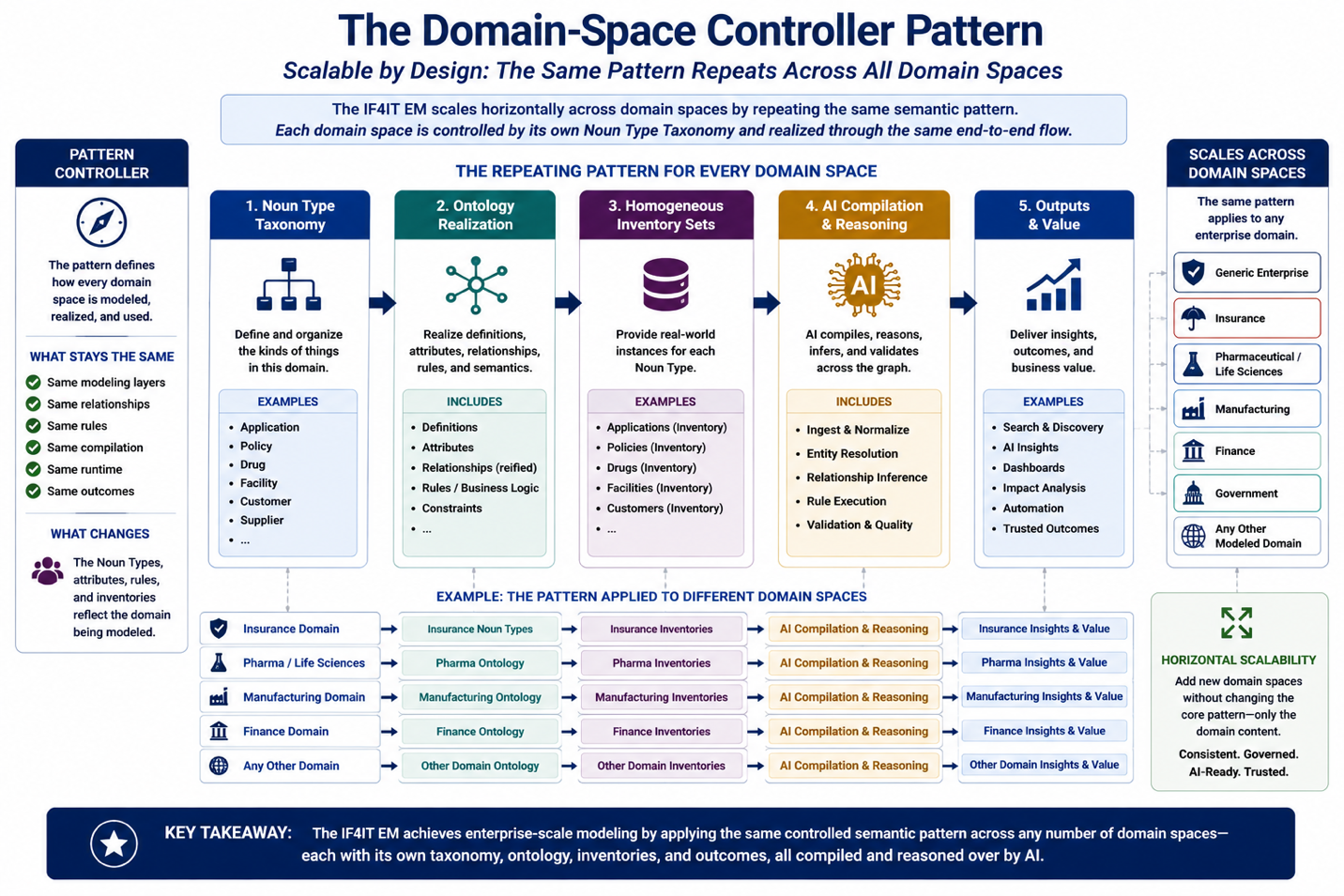
Figure: The IF4IT EM Domain-Space Controller Pattern can be used to scale across domain spaces by repeating the same semantic pattern: define the Noun Type Taxonomy, realize it through the Ontology, instantiate it with homogeneous inventory sets, and allow AI to compile, reason over, and generate value from the resulting model.
Scale from Small Models to Large Models
The Noun Type Taxonomy can be as small or as large as the modeler’s purpose requires. A focused model may begin with only a handful of Noun Types needed to answer a specific question, support a specific dashboard, or analyze a specific domain. A broader enterprise model may expand to include dozens or hundreds of Noun Types across business, technology, data, risk, finance, operations, products, and industry-specific domains. The important point is that the Taxonomy defines the domain space being modeled; it does not need to represent every possible enterprise concept before the IF4IT EM can become useful.
Keep in mind that you can use the Ontology to control what Noun Types are ingested into your model or left out; like an On/Off switch.
Extend Across Industry and Functional Domains
For an insurance domain, the Taxonomy might include Noun Types such as Insurance Products, Members, Policies, Claims, Providers, Adjudication Decisions, Reimbursements, Coverage Rules, Benefits, Networks, and Appeals. For a pharmaceutical or life-sciences domain, it might include Noun Types such as Targets, Compounds, Formulations, Drugs, Clinical Trials, Protocols, Adverse Events, Sites, Investigators, Cohorts, Indications, and Regulatory Submissions. Other domains can define their own Noun Types the same way.
The IF4IT Domain-Space Controller Pattern makes the steps to integrate (or turn off) Noun Types simple and highly repeatable.
Keep Advanced Scalability Practical
At far more advanced levels of scale, the IF4IT Enterprise Model can support Taxonomies of Taxonomies and Ontologies of Ontologies. A large enterprise may maintain multiple related domain taxonomies for Business Capabilities, Applications, Data & Information Types, Products, Services, Risks, Controls, Vendors, Customers, Geographies, Operating-Model Constructs, and industry-specific concepts. Likewise, it may maintain related ontology layers or sub-ontologies that define meanings, attributes, relationships, rules, and interpretation guidance for different domain spaces.
However, this document intentionally keeps the pattern simple for practical enterprise modeling: define the Noun Types that matter, describe and govern them through the Ontology, link them to coherent inventories of instances, and allow AI to compile and reason over the resulting model. Modelers should not begin by trying to build a Taxonomy of Taxonomies or an Ontology of Ontologies until they have mastered the IF4IT Domain-Space Controller Pattern and concepts like Inventory Splitting (i.e., breaking inventories into separate and more specific Noun Types. They should, instead, start with the Noun Types and inventories needed for the problem at hand, then scale the structure only when the enterprise’s domain complexity justifies it.
Copyright for the International Foundation for Information Technology (IF4IT): 2008 - Present
Legal Disclaimers