Key IF4IT Enterprise Model Component 1 — the Taxonomy - The IF4IT Enterprise Model and Modeling Best Practices
Key IF4IT Enterprise Model Component 1 — the Taxonomy
(Chapter 5 of The IF4IT Enterprise Model and Modeling Best Practices)
Executive Summary: Chapter Overview
IF4ITThe Bottom Line
Core Concepts
| Concept | Definition & Strategic Role |
|---|---|
| Noun Type Taxonomy | The structured list of governed thing-types the enterprise chooses to model, such as Applications, Vendors, Contracts, Risks, or domain-specific entities. |
| Domain Space | The scope of what the model recognizes, which may be generic, industry-specific, functional, operational, product-specific, or problem-specific. |
| Taxonomy Depth | The use of parent-child specialization among Noun Types when finer-grained governance or analysis is needed. |
Quick Q&A
Question: Why does the Taxonomy come first?
Question: Can the Taxonomy vary by domain?
Read More Below
Overview
An IF4IT-compliant Enterprise Model starts with a Taxonomy of Noun Types. The Taxonomy defines the kinds of things the model recognizes, organizes, relates, governs, populates, and makes available for AI to reason over.
The Taxonomy is not the full model by itself. It is the conceptual starting point for the model. It establishes the domain space by identifying the Noun Types that matter to the enterprise, domain, function, product, operating model, or problem space being modeled.
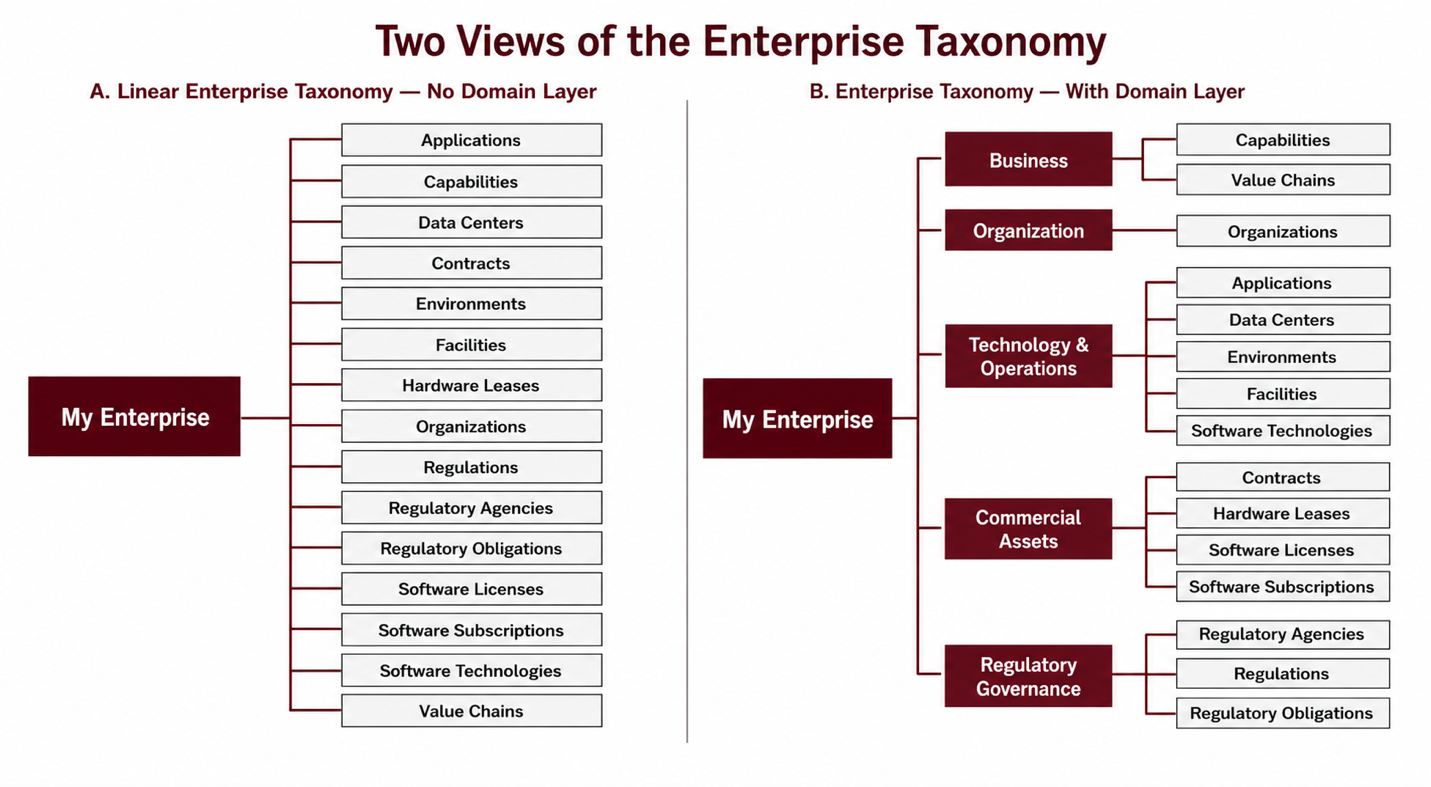
For the purposes of this document, the starting domain space is a generic enterprise domain that can be expanded, narrowed, or specialized for industry-specific, functional, operational, product, or problem-specific domains. A generic enterprise Taxonomy may include Noun Types such as Applications, Capabilities, Technologies, Vendors, Contracts, Data Stores, Integrations, Risks, Controls, Policies, Projects, Products, Services, Processes, Organizations, and Roles. A domain-specific Taxonomy may include other Noun Types that are natural to a target domain, such as Claims, Members, Policies, Providers, and Reimbursements in insurance, or Drugs, Trials, Protocols, Indications, and Adverse Events in pharmaceutical or life sciences contexts.
The Taxonomy defines what the model can recognize. The Ontology defines what those recognized things mean and how they behave. Inventories provide the real instances. AI turns the combined structure into usable enterprise intelligence.
The Taxonomy defines the domain space
The Taxonomy of Noun Types acts as the domain-space definition construct for the Enterprise Model. It answers a foundational question: “What kinds of things does this model recognize?”
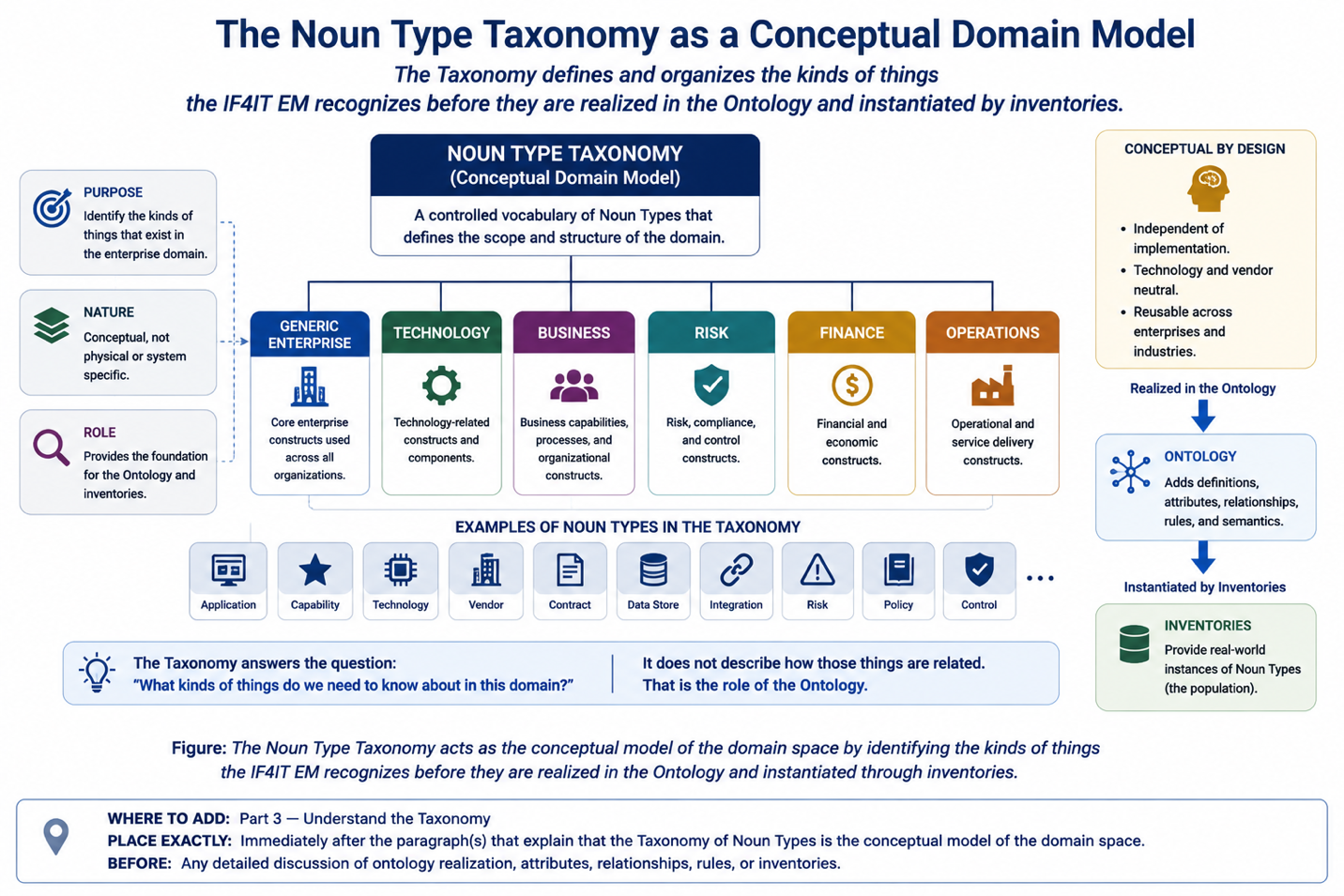
A model that recognizes Applications, Capabilities, Technologies, Vendors, Contracts, and Risks defines a different domain space than a model that recognizes Claims, Members, Providers, Benefits, Policies, and Reimbursements. A model that recognizes Drugs, Targets, Compounds, Clinical Trials, Protocols, and Adverse Events defines yet another domain space.
The Noun Type Taxonomy establishes the conceptual boundaries of the model. It tells the modeler, the Ontology, the Inventory sources, and AI which kinds of things are in scope.
| Domain Space | Example Noun Types | |
|---|---|---|
| Generic enterprise domain | Applications, Capabilities, Technologies, Vendors, Contracts, Data Stores, Integrations, Risks, Controls, Policies | |
| Insurance domain | Insurance Products, Policies, Members, Claims, Providers, Benefits, Coverage Rules, Adjudication Decisions, Reimbursements, Appeals | |
| Pharmaceutical / life sciences domain | Targets, Compounds, Formulations, Drugs, Clinical Trials, Protocols, Investigators, Sites, Cohorts, Indications, Adverse Events, Regulatory Submissions | |
| Manufacturing domain | Products, Parts, Suppliers, Plants, Machines, Work Orders, Quality Events, Shipments, Bills of Material | |
| Legal / contract domain | Parties, Agreements, Clauses, Obligations, Deliverables, Milestones, Amendments, Notices, Disputes | |
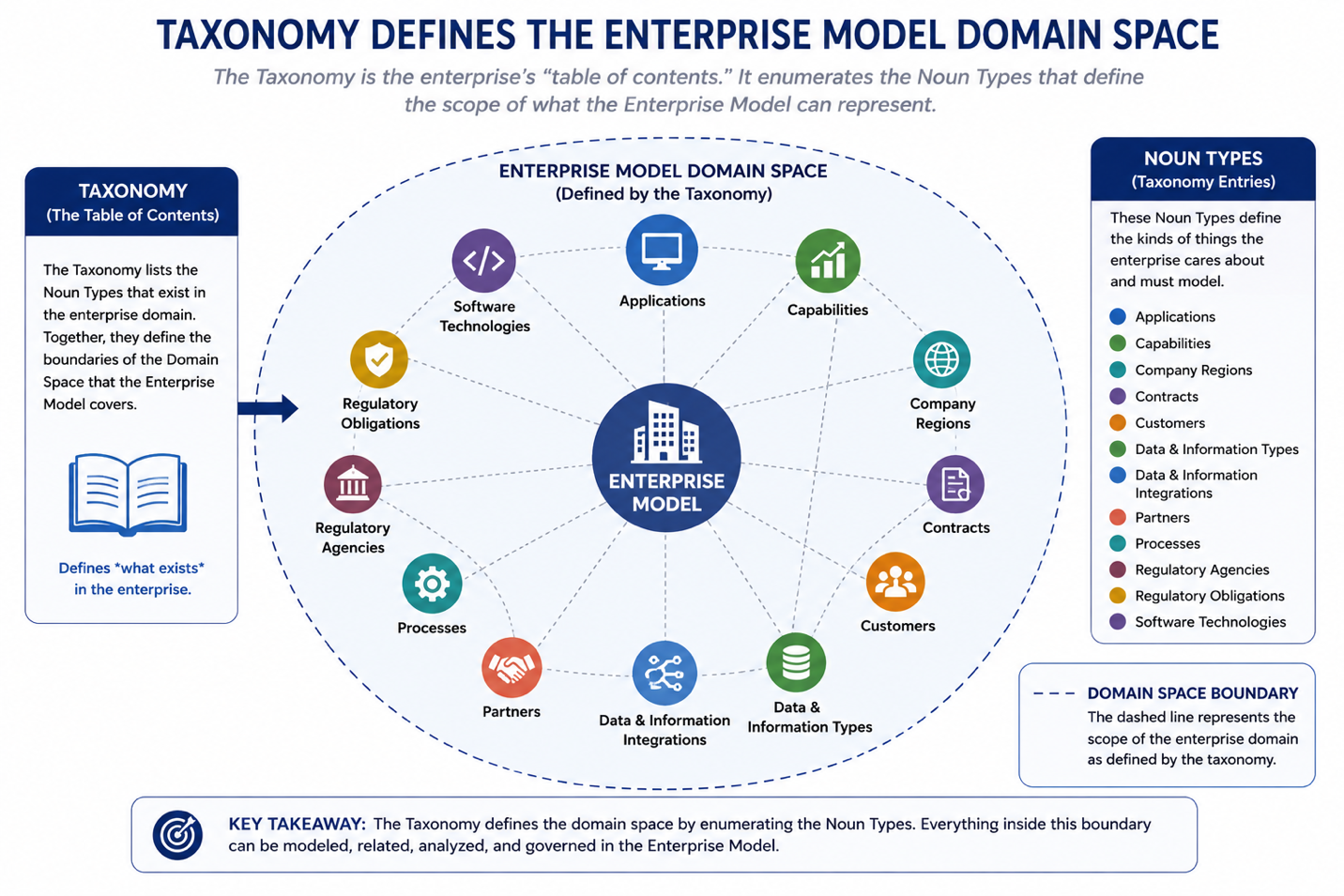
The important point is that the Taxonomy does not need to represent every possible enterprise concept before the EM becomes useful. It should reflect the modeler’s purpose, the domain being modeled, the inventories available, and the questions the enterprise wants the model to help answer.
Examples of common Enterprise Noun Types can be found in the section titled “Inventory Types” of the IF4IT Enterprise Inventory Management and Best Practices document, which links to documents that help better define some of the individual Noun Types.
The Taxonomy is a conceptual model
The Taxonomy of Noun Types is a conceptual model of the domain space. It identifies and organizes the kinds of things the EM recognizes before those things are fully defined, described, governed, related, and populated.
However, the Taxonomy alone does not fully operationalize those concepts. A Noun Type in the Taxonomy is not enough by itself. Each Noun Type must be realized in the Ontology, where it is registered, defined, described, governed, related to other Noun Types, associated with rules, and linked to a homogeneous inventory set of Noun Instances.
| Construct | Role |
|---|---|
| Taxonomy of Noun Types | Defines the conceptual domain space by identifying the kinds of things the model recognizes. |
| Ontology | Realizes and operationalizes those Noun Types by defining their meaning, attributes, relationships, rules, governance, and inventory linkages. |
| Inventory | Provides real-world Noun Instances for each Noun Type. |
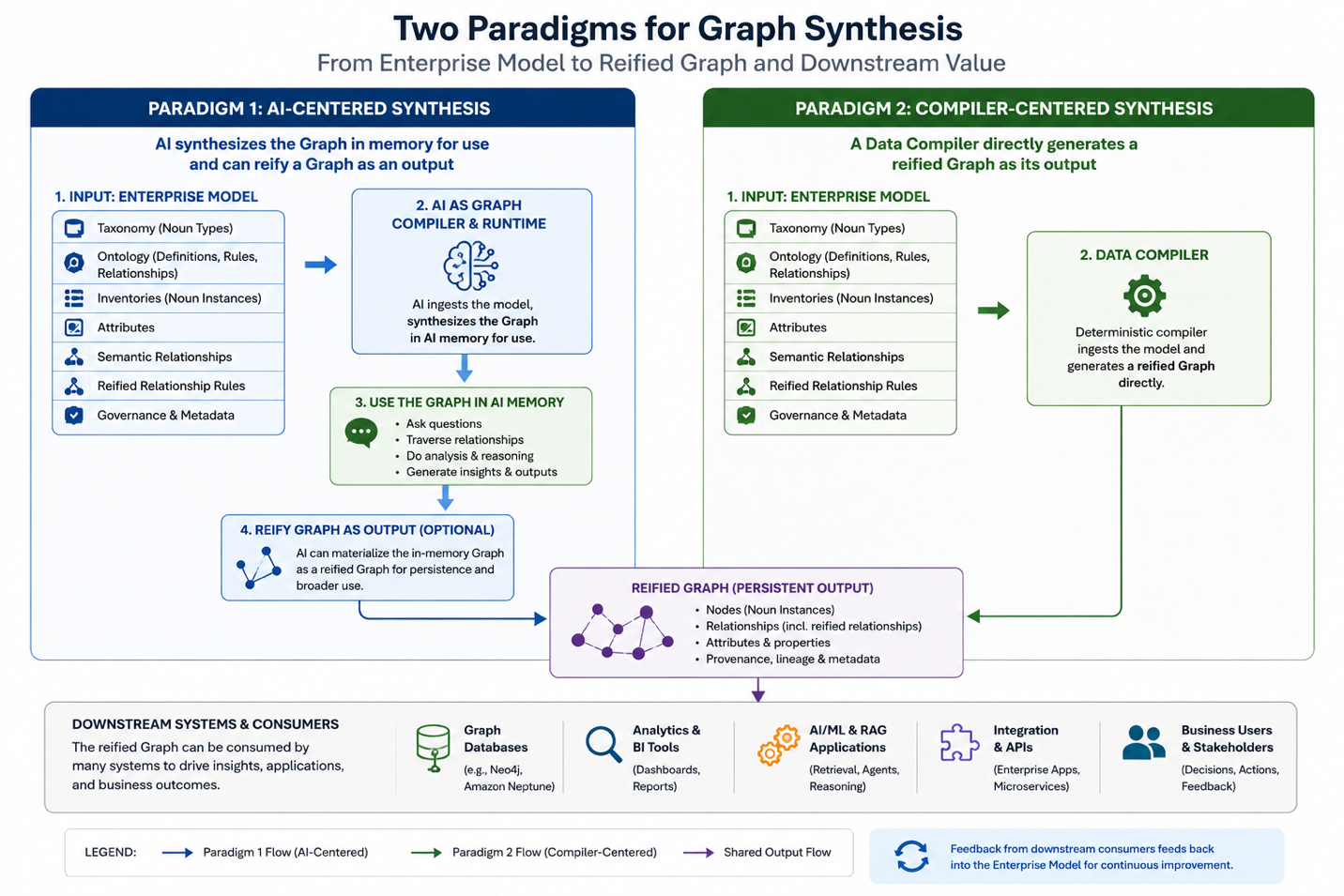
| AI / Graph Compiler | Ingests the Taxonomy, Ontology, rules, and Inventories to compile, reason over, and use the model. |
This distinction matters because the Taxonomy should remain lightweight and easy to extend. The Taxonomy names and organizes the kinds of things that matter. The Ontology carries the deeper explanation, operational meaning, relationship logic, rules, and model behavior.
Noun Types are realized in the Ontology
Each Noun Type in the Taxonomy should be realized in the Ontology (the Ontology is explained further in this document). Realization means that the Noun Type is not merely named; it is made operationally meaningful.
To realize a Noun Type in the Ontology, the modeler should define enough information for people, systems, and AI to understand what the Noun Type means and how it should be used.
| Ontology Realization Area | What It Defines |
|---|---|
| Name and forms | Singular form, plural form, aliases, abbreviations, and synonyms. |
| Meaning | What the Noun Type represents and what it does not represent. |
| Attributes | The properties, characteristics, or descriptive fields expected for Noun Instances of that type. |
| Relationships | How the Noun Type can relate to other Noun Types. |
| Rules | Natural-language or formal rules that guide interpretation, mapping, inference, validation, and use. |
| Governance | Ownership, review expectations, sensitivity, trust posture, and change-control expectations. |
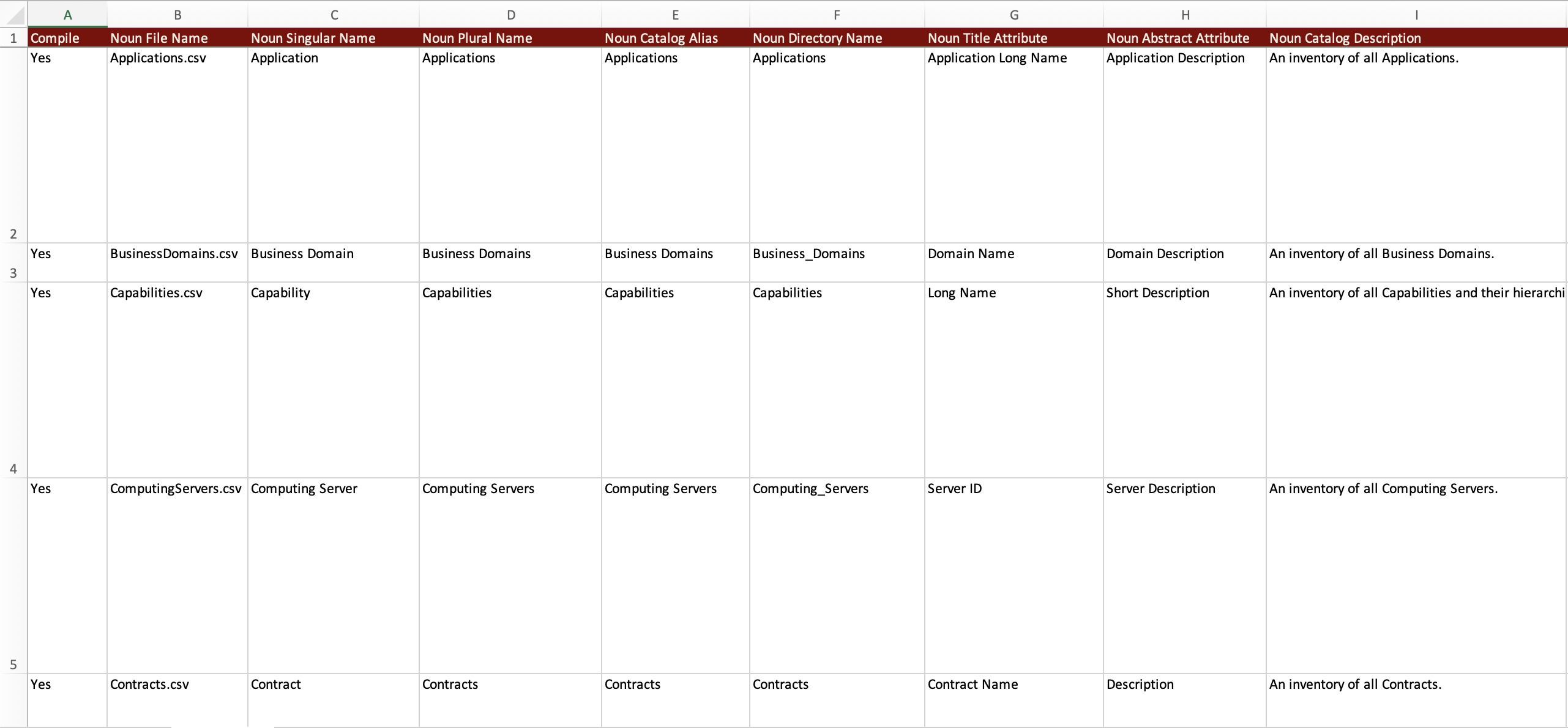
| Inventory linkage | The inventory, list, catalog, register, repository, file, system export, or other source that provides instances. |
For example, the Noun Type Application may be added to the Taxonomy, but it becomes useful when the Ontology explains what counts as an Application, what attributes are commonly useful, what synonyms may be used, what inventory provides Application instances, and what relationships may exist to Capabilities, Technologies, Vendors, Contracts, Data Stores, Integrations, Risks, or Controls.
In this sense, the Taxonomy names the domain. The Ontology explains and controls it.
The Taxonomy should remain lightweight
The Noun Type Taxonomy should be governed, but it should not become a bureaucratic bottleneck. Adding a new Noun Type should be relatively lightweight when the modeler can identify a meaningful kind of thing, explain why it matters, point to an available inventory or source of instances, and provide enough Ontology guidance for AI to begin interpreting it.
This is one of the important differences between the IF4IT Enterprise Modeling approach and rigid schema-first modeling approaches that are common in most Architecture Modeling Tool (AMT) and relational schema modeling approaches, which require users to first design and define a fixed and often difficult to change metamodel and/or data model.
| Rigid Schema-First Approach | IF4IT EM Taxonomy Approach |
|---|---|
| Requires a complete entity schema before useful modeling can begin. | Allows a Noun Type to be registered and improved progressively. |
| Requires all attributes and relationships to be modeled up front. | Allows available inventory attributes to be used first and enhanced over time. |
| Often depends on tool-specific metamodel configuration. | Keeps the conceptual Taxonomy lightweight and portable. |
| Can slow expansion into new domains. | Allows new Noun Types to be added as domain questions and inventories emerge. |
| Encourages heavy central design before use. | Encourages progressive enrichment through use, evidence, and feedback. |
The goal is not to create an uncontrolled list of terms. The goal is to maintain a controlled but lightweight Taxonomy that allows the model to grow as the enterprise discovers new questions, integrates new inventories, and expands into new domain spaces.
The Taxonomy enables model scalability
The Taxonomy is one of the main mechanisms that allows any IF4IT-compliant EM to scale, and it can scale to address both depth and diversity. It defines the scope of the model by listing in-scope Noun Types. A model can start small with a few high-value Noun Types, then grow into a broader enterprise model or a specialized industry model.
For example, an Enterprise Model might evolve as follows:
Phase 1 of model development could include Applications and Capabilities, with rules to generate semantic relationships that map/correlate Applications to Capabilities.
Phase 2 of model development could expand this to include Value Streams, where rules are used to generate semantic relationships that map/correlate Capabilities to value streams — creating an indirect correlation of Applications to Value Streams via two degrees of separation.
Phase 3 of model development could further expand the model to include Software Technologies and their mappings/correlations to Applications.
Phase 4 of model development could include Data Stores and their mappings to Applications.
Etc.
The above highlights natural vertical scaling of the Taxonomy by starting with Applications and Capabilities, then adding Value Streams, then adding Software Technologies, and then adding Data Stores. Each phase of the above example expands the baseline Taxonomy (i.e., the model’s scope).
The model Taxonomy could also have been expanded to include Noun Types that are industry specific, as an IT organization in one industry will need to leverage Noun Types that are not or may not be relevant to another industry.
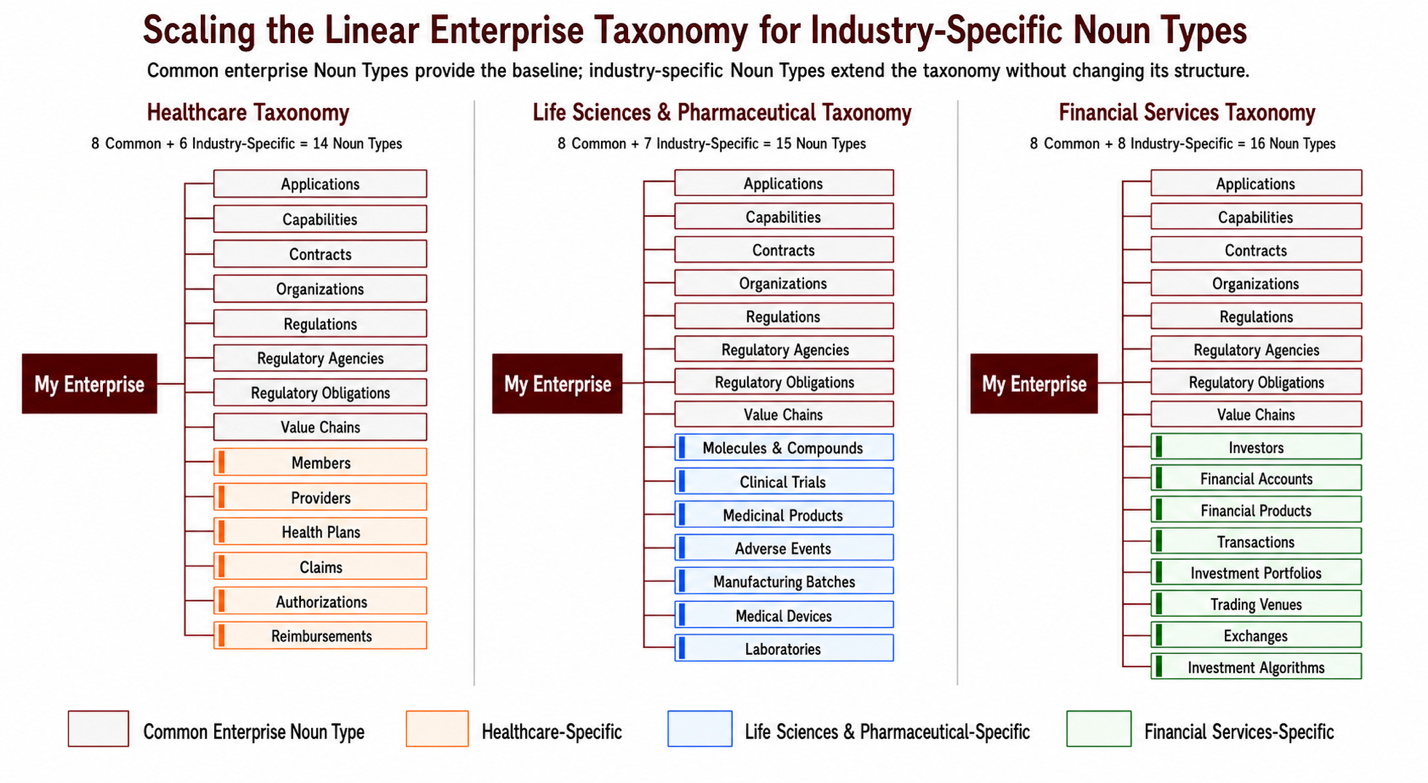
A focused model might begin with Applications, Capabilities, Vendors, and Contracts. A broader enterprise model might add Technologies, Data Stores, Integrations, Risks, Controls, Projects, Products, Services, Processes, Organizations, and Roles. An industry-specific model might add Claims, Members, Providers, Policies, and Benefits for insurance, or Drugs, Trials, Protocols, Indications, and Adverse Events for pharmaceutical and life sciences domains.
| Scale Pattern | Example |
|---|---|
| Small focused model | Applications, Capabilities, Vendors, Contracts |
| Enterprise management model | Applications, Technologies, Integrations, Data Stores, Risks, Controls, Projects, Services |
| Insurance domain model | Insurance Products, Policies, Members, Claims, Providers, Benefits, Reimbursements, Appeals |
| Pharmaceutical / life sciences model | Targets, Compounds, Drugs, Trials, Protocols, Adverse Events, Regulatory Submissions |
| Advanced enterprise model | Multiple related taxonomies and ontology layers across business, technology, product, data, risk, legal, operational, and industry domains |
At more advanced levels, the IF4IT EM can scale toward Taxonomies of Taxonomies and Ontologies of Ontologies. However, for practical enterprise modeling, the starting pattern should remain simple: define the Noun Types that matter, realize them in the Ontology, link them to coherent inventories, and allow AI to compile and reason over the resulting model.
As an enterprise builds its own Enterprise Model(s), the modeler(s) will start to see and understand natural opportunities to implement more complex and advanced modeling concepts.
For example, Software Technologies may become too broad and may need to be broken down into separate inventories of different Software Technology Types (e.g., SaaS Software Technologies, Vendor Installable Software Technologies, Open Source Software Technologies, etc.), such that the more detailed individual Noun Types are still correlated to the more general categorization of Software Technologies. A query of the broader context can easily bring up a joined view of the more specific contexts; without the specific attributes of each of course.
Use Multiple Model Instances for Model Scaling
Another option for model scalability is the implementation of separate Model Instances. Because the model is decoupled from the tool(s), it is canonical and can therefore be deployed to and realized in separate different technology instances for various reasons. For example, an enterprise can deploy, build, and publish the same model to different environments or locations, creating different standalone instances for development, testing, and production use, or an enterprise can deploy the same canonical model to separate regions in distinct and localized agent implementations so as to act as local caches that reduce latency for end users in those regions.
The Taxonomy helps AI understand what exists
AI needs semantic orientation. It needs to understand what kinds of things exist in the modeled domain before it can interpret inventories, infer mappings, generate relationships, identify gaps, compare graphs, or produce useful outputs.
The Taxonomy gives AI a controlled set of recognized Noun Types. The Ontology then provides the deeper meaning, attributes, relationships, rules, and interpretation guidance. Inventories provide the instances. Together, these inputs allow AI to move beyond generic text interpretation and toward grounded enterprise reasoning.
| AI Need | How the Taxonomy Helps |
|---|---|
| Know what kinds of things exist | Provides recognized Noun Types. |
| Distinguish similar concepts | Separates different Noun Types, such as Application, Technology, Data Store, Vendor, and Contract. |
| Interpret inventory sources | Helps AI understand what a source list, file, table, export, or repository represents. |
| Infer relationships | Provides the type-level context needed to infer candidate relationships across inventories. |
| Generate graph structures | Helps AI create nodes, edges, reified relationships, and graph views. |
| Support reasoning | Gives AI a controlled conceptual frame for answering questions and generating insights. |
The Taxonomy does not make AI correct by itself. It gives AI a better semantic starting point. Trust still depends on Ontology quality, inventory quality, rules, evidence, validation, confidence, governance, and human review.
Best Practice
Maintain the Noun Type Taxonomy as a lightweight, governed, extensible conceptual model of the domain space.
The Taxonomy should define the kinds of things the EM recognizes, but it should not try to carry all operational meaning by itself. Each Noun Type should be realized in the Ontology, linked to a coherent inventory or inventory-like source where possible, and improved progressively as the model is used.
The best Taxonomies are neither uncontrolled word lists nor rigid metamodels. They are governed conceptual structures that help the enterprise define what it wants to understand, connect, govern, analyze, and make available for AI reasoning.
Implementation Guidance
When creating or evolving the EM Taxonomy, modelers should:
| Step | Guidance |
|---|---|
| 1. Define the modeling purpose | Identify the questions, decisions, analyses, dashboards, governance concerns, or AI use cases the model should support. |
| 2. Identify candidate Noun Types | List the kinds of things that matter to the selected domain space. |
| 3. Start with high-value Noun Types | Begin with the Noun Types that are most useful, most available, or most connected to immediate value. |
| 4. Confirm inventory reality | Prefer Noun Types that can be tied to an available inventory, list, catalog, register, repository, system export, or other source of instances. |
| 5. Register each Noun Type in the Ontology | Define the Noun Type’s name, meaning, aliases, attributes, relationships, rules, governance, and inventory linkage. |
| 6. Keep registration lightweight | Add enough structure to start; do not wait for perfect attributes and relationships. |
| 7. Use natural-language rules | Help AI understand how to interpret, map, relate, validate, or improve the Noun Type and its inventory. |
| 8. Review usage and feedback | Improve the Taxonomy as AI, modelers, Inventory Owners, and stakeholders use the model. |
| 9. Govern change | Prevent duplicates, ambiguity, conflicting terms, and uncontrolled expansion while avoiding excessive bureaucracy. |
| 10. Scale intentionally | Expand the Taxonomy when new domains, questions, inventories, or decisions justify it. |
Benefits
A well-managed Taxonomy creates several benefits for the EM.
| Benefit | Explanation |
|---|---|
| Clear domain scope | The Taxonomy makes explicit what kinds of things are included in the model. |
| Shared vocabulary | Stakeholders, modelers, systems, inventories, and AI can work from a common set of Noun Types. |
| Faster modeling | Modelers can start with a small number of useful Noun Types and expand over time. |
| Better AI interpretation | AI receives a clearer conceptual frame for interpreting inventories and generating graph structures. |
| Stronger inventory integration | Each Noun Type can be associated with one or more coherent sources of Noun Instances. |
| Improved governance | Noun Type registration helps prevent uncontrolled term sprawl and conceptual ambiguity. |
| Domain scalability | The model can expand from generic enterprise concepts into industry-specific or problem-specific domain spaces. |
| Lower modeling friction | The Taxonomy can remain lightweight while deeper meaning is carried in the Ontology and inventories. |
Common Mistakes
| Mistake | Why It Is a Problem | Better Pattern |
|---|---|---|
| Treating the Taxonomy as the full model | The Taxonomy names concepts but does not fully define meaning, behavior, rules, relationships, or instances. | Realize each Noun Type in the Ontology and instantiate it through inventories. |
| Over-engineering the Taxonomy too early | Heavy upfront design slows adoption and delays value. | Start with high-value Noun Types and expand progressively. |
| Adding Noun Types with no inventory reality | A Noun Type without instances may remain abstract and hard to use. | Prefer Noun Types that can be linked to actual inventories or planned sources. |
| Allowing duplicate or ambiguous Noun Types | Duplicate terms create confusion and weaken AI interpretation. | Govern Noun Type registration and maintain clear definitions and aliases. |
| Confusing source terms with governed Noun Types | Source systems may use inconsistent or local terminology. | Map source terms to governed Noun Types through the Ontology and rules layer. |
| Making the Taxonomy too tool-specific | Tool-specific structures reduce portability and architectural independence. | Keep the Taxonomy conceptual and portable; realize implementation detail separately. |
| Blocking new Noun Types with heavy governance | Excessive governance prevents the model from adapting to new domains. | Use lightweight registration, review, and progressive enrichment. |
Closing Perspective
The Taxonomy is where the EM defines what it can recognize. It is the conceptual model of the domain space and the starting point for model scalability.
A strong Taxonomy does not need to be large. It needs to be useful, clear, governed, extensible, and connected to inventory reality. As the model matures, the Taxonomy can expand into new domains, deeper enterprise concerns, and more specialized Noun Types.
The implementation pattern remains simple:
Define the Noun Type.
Realize it in the Ontology.
Link it to a coherent Inventory.
Populate the model with Noun Instances (if not already done so).
Let AI (or some other tool) compile, connect, and render the model.
Let AI (or some other tool) traverse, analyze, reason, and recommend.
Let accountable humans govern what becomes trusted model truth.
How to cite this page
When referencing this page in academic work, internal standards, or external publications, include the page title, IF4IT as author and publisher (The International Foundation for Information Technology (IF4IT), LLC), the URL, and your access date.
Example (informal web citation):
The International Foundation for Information Technology (IF4IT), LLC. Key IF4IT Enterprise Model Component 1 — the Taxonomy | The IF4IT Enterprise Model and Modeling Best Practices. https://if4it.org/best-practices/if4it-enterprise-model-and-modeling-best-practices/key-if4it-enterprise-model-component-1-the-taxonomy/ (accessed 2026-09-11).
See About Us for content governance and site-wide citation guidance.
Copyright for The International Foundation for Information Technology (IF4IT), LLC: 2008 - Present
Legal Disclaimers