Key IF4IT Enterprise Model Component 3 — the Inventories - The IF4IT Enterprise Model and Modeling Best Practices
Key IF4IT Enterprise Model Component 3 — the Inventories
(Chapter 7 of The IF4IT Enterprise Model and Modeling Best Practices)
Executive Summary: Chapter Overview
IF4ITThe Bottom Line
Core Concepts
| Concept | Definition & Strategic Role |
|---|---|
| Inventory | The populated set of instances for one Noun Type, such as the actual applications, vendors, technologies, or contracts the enterprise governs. |
| Inventory Owner | The accountable role responsible for the quality, currency, structure, and governance of an inventory. |
| Semantic Identifier | A stable, human-meaningful identifier that helps preserve identity and meaning across refresh cycles, systems, and AI processing. |
Quick Q&A
Question: What makes inventories different from the Taxonomy and Ontology?
Question: Why do inventories need governance?
Read More Below
Overview
Enterprise Inventories are the realized data population layer of the Enterprise Model. Where the Noun Type Taxonomy defines the kinds of things the model recognizes, and the Ontology defines how those things are understood, governed, related, interpreted, and used, Inventories provide the actual Noun Instances the model works with.
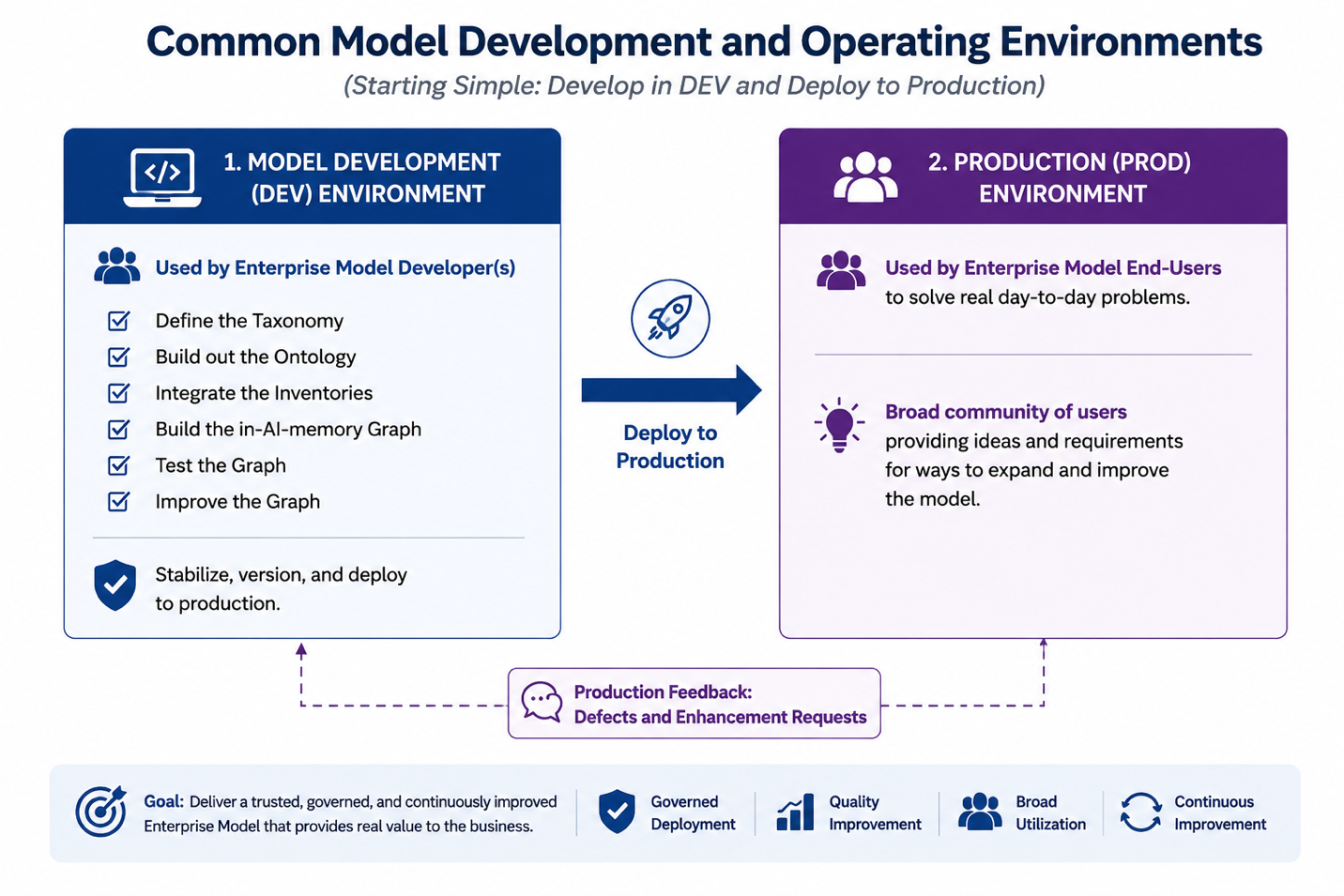
An Applications Inventory provides Application instances. A Vendors Inventory provides Vendor instances. A Contracts Inventory provides Contract instances. A Claims Inventory provides Claim instances. A Drugs Inventory provides Drug instances. Each Inventory grounds a Noun Type in real enterprise data, turning the EM from a conceptual model into a usable semantic representation of the enterprise.
Without Inventories, the EM remains mostly conceptual. With Inventories, the model becomes populated with real-world enterprise facts that AI can ingest, connect, validate, reason over, and use to generate trusted outputs.
Inventories instantiate Noun Types
A Noun Type defines a kind of thing. An Inventory provides the population (i.e., the “set”) of actual things for that Noun Type. This distinction is critical.
| IT EM Construct | Role |
|---|---|
| Noun Type Taxonomy | Defines the kinds of things the model recognizes. |
| Ontology | Defines, governs, relates, and interprets those things. |
| Inventory | Provides the real-world instances of those things. |
| Noun Instance | Represents on actual “real” thing within an inventory. |
| AI / Graph Compiler | Ingests the Taxonomy, Ontology, rules, and Inventories to synthesize/generate/compile and reason over the graph. |
For example, the Noun Type Application may be realized through an Applications Inventory that contains actual Application instances such as a claims platform, billing system, CRM, data warehouse, or producer portal. The Noun Type Vendor may be realized through a Vendors Inventory. The Noun Type Contract may be realized through a Contracts Inventory. The same pattern applies to industry-specific Noun Types such as but no limited to Claim, Member, Policy, (for Insurance domain) or Drug, Trial, Protocol, Adverse Event (for Life Sciences/Pharmaceutical domain).
In this sense, Inventories answer the question: “What actual things exist for this Noun Type?”
The Ontology describes Inventories and provides rules for how to work with them
While the Taxonomy helps set the scope for what Inventories will be needed for and integrated into the EM, the Ontology describes each and provides things like rules for what the modeling tool can or cannot do with the inventories and their corresponding data.
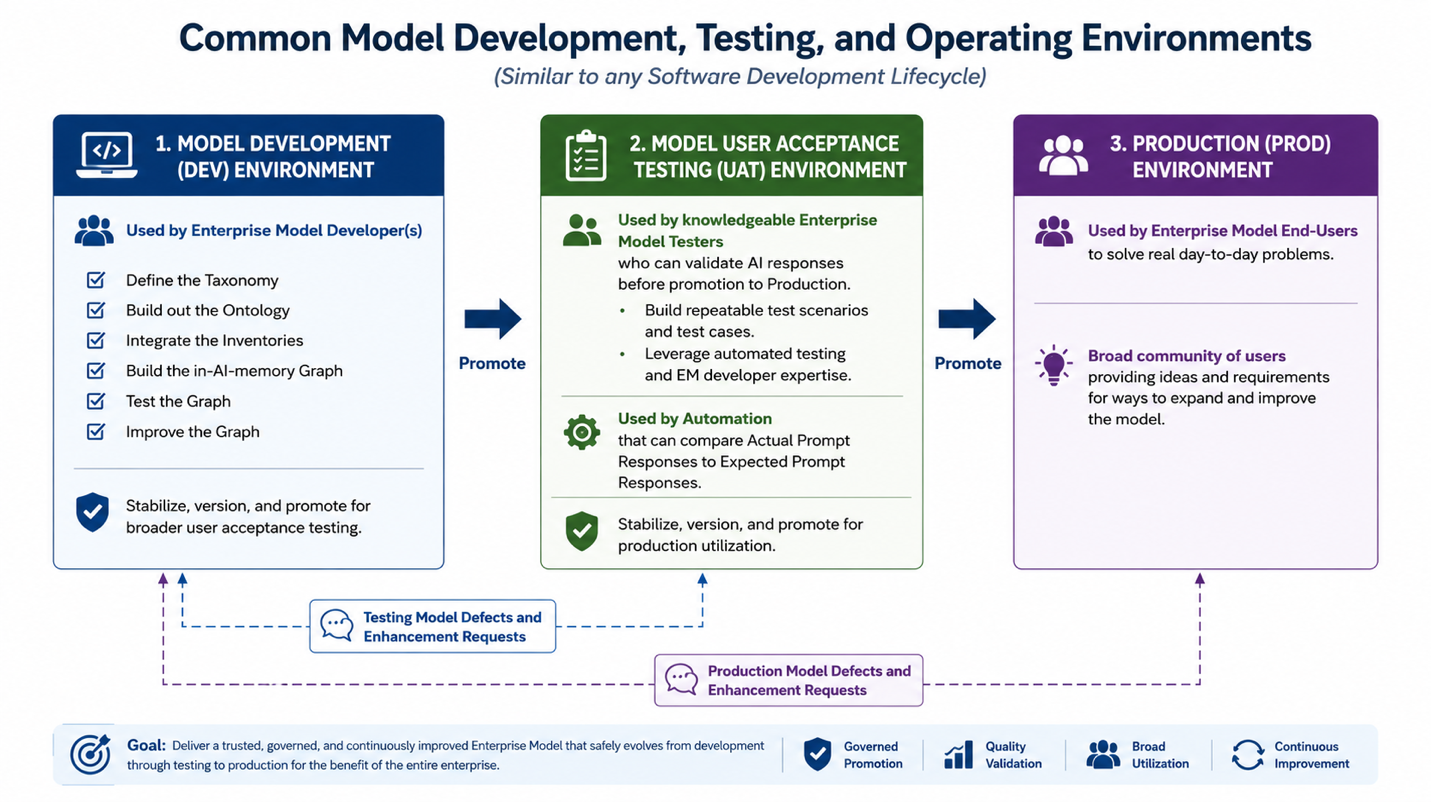
Inventories connect the conceptual model to the real enterprise
Inventories are important because they connect semantic structure to real enterprise evidence. They are the bridge between what the model says the enterprise cares about and what actually exists inside the enterprise.
| Inventory Function | Why It Matters |
|---|---|
| Populate Noun Types | Each Inventory provides actual Noun Instances for one or more Noun Types. |
| Ground the model in evidence | Inventories prevent the model from being purely theoretical or diagrammatic. |
| Enable graph generation | Inventory records can become graph nodes, attributes, relationship candidates, and evidence sources. |
| Support AI reasoning | AI can reason over real enterprise facts rather than abstract labels alone. |
| Preserve federated ownership | Inventory Owners can remain accountable for their own source inventories while the modeler integrates them semantically. |
| Allow progressive adoption | Modelers can begin with existing files, spreadsheets, exports, databases, repositories, or platforms. |
| Create business value | Connected Inventories enable impact analysis, gap analysis, dashboards, semantic search, risk analysis, governance views, and decision support. |
This reinforces the foundations for the IF4IT EM’s core operating principles:
The Taxonomy names the things and defines model scope.
The Ontology explains and controls the things.
The Inventories provide the actual things. AI connects and reasons over the things.
Ownership of Inventories may be federated
Inventories do not need to be owned, governed, or maintained by a single central modeling team. In many enterprises, important Inventories are federated across business, technology, data, risk, finance, legal, operations, product, and industry-domain teams.
The Enterprise Model should respect this ownership reality. The modeler does not need to take over every Inventory. Instead, the modeler should identify the relevant Inventory, associate it with the correct Noun Type, understand its available attributes, document its source and ownership, and use Ontology rules to help AI interpret and integrate it into the broader model.
A note about combining data: For some enterprises, it may become a confidentiality risk when certain Noun Type data sets are combined and published to the broader enterprise via the EM. For example, Contracts about Intellectual Properties might surface confidential information that might not be appropriate to share with the broader enterprise. Modelers should work with inventory owners and leaderships to ensure that inventories brought into the EM are appropriate and allowable for doing so. However, it should be noted that different version of EMs can be designed and built for different stakeholder audiences. For example, an EM without such confidential data could be built and deployed for the broader enterprise, while an EM with such confidential data could be built and deployed only for executive leadership.
IMPORTANT POINT — Multiple Model Instances: This previous example highlights the important point that, unlike traditional monolithic, single-model solutions — as is common with most Architecture Modeling Tools (AMTs), the IF4IT Enterprise Model and Modeling Best Practices document presents paradigms and best practices, such as separating the model data and definition from the tool, that allow an enterprise to design, build and deploy as many custom-tailored versions of a model (i.e., Model Instances) as might be needed by the enterprise to satisfy the needs of its stakeholders. A single-model, fixed-schema, monolithic, expensive solution, such as what is common in most AMTs, cannot achieve multiple Model Instances as it only supports one instance of a model at any given point in time. To make this point stronger, consider that automation can be leveraged to build and deploy many different or customized permutations of Model Instances. Tools like AMTs simply cannot compete with this, at least not yet.
| Area | Primary Accountability |
|---|---|
| Inventory content | Inventory Owner |
| Inventory attributes and source data quality | Inventory Owner, with support from modelers and stakeholders |
| Noun Type registration | Model Owner / Ontology Steward |
| Ontology rules and relationship semantics | Model Owner / Ontology Steward |
| Model-layer mappings and inferred relationships | Model Owner, with human-in-the-loop validation |
| Recommended changes to source Inventories | Inventory Owner, informed by modeler, AI, and stakeholder feedback |
This separation of accountability matters. The EM can use and connect Inventories without pretending that every Inventory belongs to the model owner. Source Inventories remain accountable to their owners. The model integrates, interprets, maps, reasons over, and recommends improvements to those Inventories through governed semantic patterns.
Ownership Recommendation: For inventories that have no clear ownership, especially those that have “logical” instances, such as but not limited to Applications, Capabilities, Value Chains, etc., consider having an organization like Architecture (Enterprise or Business Architecture) or Software Engineering own and maintain them, as these are logically in the same area the Enterprise Model will most likely be created, maintained and owned in.
Inventories can often be used as-is
The EM does not require every Inventory to be redesigned before it can become useful. A modeler can often begin with the attributes, labels, identifiers, and formats already provided by the Inventory Owner.
An Inventory may exist as a spreadsheet, CSV file, JSON file, database table, SaaS export, CMDB extract, portfolio-management record set, contract repository, document collection, ticketing-system export, or other source collection. The Inventory does not need to be perfect, complete, or modeled in a rigid Architecture Modeling Tool before it can provide value.
The Ontology and rules layer can help AI interpret the Inventory as-is by explaining what the Inventory represents, how its attributes should be understood, how source names map to preferred model names, how semantic identifiers should be generated, how dirty or fuzzy data should be handled, and what relationships should be inferred or recommended.
| As-Is Inventory Capability | Explanation |
|---|---|
| Source attribute interpretation | AI can use Ontology rules to understand source attributes and map them to model meaning. |
| Semantic identifier generation | AI can help generate stable identifiers when source identifiers are absent, inconsistent, or ambiguous. |
| Attribute mapping | The modeler can maintain a simple mapping layer from source attribute names to preferred model names. |
| Relationship inference | AI can infer candidate relationships between Inventory records and other Noun Instances. |
| Data quality feedback | AI can identify duplicates, gaps, stale records, inconsistencies, and weak descriptions. |
| Progressive enrichment | The model can improve over time as modelers, Inventory Owners, and stakeholders review usage and feedback. |
This is one of the practical differences between and IF4IT-compliant EM and schema-first modeling approaches. A rigid metamodel or Architecture Modeling Tool often requires the entity type, attributes, and relationships to be modeled before meaningful use can begin. The IF4IT EM allows modelers to start with what exists, connect it semantically, and improve it progressively and iteratively.
Inventories become graph evidence
When Inventories are ingested into the EM, they can become evidence for a generated Knowledge Graph or Data Graph. Inventory records may become graph nodes. Inventory attributes may become node properties. Source references may become provenance. Descriptions may become semantic context. Identifiers may become entity-resolution anchors. Rules may guide relationship inference. Reviewed relationships may become governed graph edges or reified semantic relationships.
This allows AI to reason over the enterprise in a grounded way.
For example, an Applications Inventory may identify an Application. A Capabilities Inventory may identify a Business Capability. A Contracts Inventory may identify a Contract. A Vendors Inventory may identify a Vendor. Through Ontology rules, AI may infer that the Application supports the Business Capability, depends on the Vendor, is governed by the Contract, and is exposed to risks or obligations associated with that Vendor or Contract.
These relationships should not automatically become governed truth. They may begin as candidate relationships, inferred relationships, or AI-suggested improvements. Human review, evidence, confidence, provenance, and governance determine what is promoted into the trusted model.
Inventory improvement remains accountable
AI can help improve Inventories, but it should not silently overwrite source Inventories or bypass accountable Inventory Owners.
AI may identify that records are incomplete, inconsistent, duplicated, stale, weakly described, poorly classified, or missing useful attributes. It may recommend better descriptions, new attributes, improved mappings, semantic identifiers, relationship candidates, classification changes, or data-quality corrections. However, improvements to source Inventory data must be reviewed through the appropriate governance path.
| Improvement Type | Review Path |
|---|---|
| Model-layer mapping improvement | Model Owner / Ontology Steward review |
| Candidate relationship or reified relationship | Model governance and human-in-the-loop review |
| Source Inventory data correction | Inventory Owner review |
| New or changed source attribute | Inventory Owner and affected stakeholders |
| New Noun Type or Inventory linkage | Model Owner / Ontology Steward with relevant Inventory Owner input |
| Sensitive or regulated data treatment | Inventory Owner, security, privacy, legal, compliance, and governance stakeholders as needed |
This keeps the EM practical and trustworthy. AI can propose improvements. Modelers can evaluate model-layer implications. Inventory Owners can decide what changes should be made to their source Inventories. Stakeholders can participate where the change affects business meaning, compliance, risk, reporting, or operational use.
Best Practice
Use Inventories to ground the EM in real enterprise data while preserving clear ownership boundaries.
A modeler should identify the Inventory or Inventory-like source that populates each Noun Type, understand who owns it, document how it is sourced, preserve or map its useful attributes, and use the Ontology to guide AI interpretation and integration. The goal is not to centralize every Inventory into one tool. The goal is to make distributed enterprise knowledge semantically usable, governable, and AI-consumable.
Implementation Guidance
When integrating an Inventory into the EM, modelers should:
| Step | Guidance |
|---|---|
| 1. Identify the Noun Type | Determine which Noun Type the Inventory populates. |
| 2. Identify the Inventory Owner | Determine who owns, governs, and maintains the source Inventory. |
| 3. Locate the source | Record where the Inventory lives, such as a file, repository, database, SaaS platform, or system export. |
| 4. Assess available attributes | Start with the attributes already maintained by the Inventory Owner. |
| 5. Map source attributes where useful | Create lightweight mappings from source names to preferred model names if needed. |
| 6. Define interpretation rules | Add natural-language rules that help AI understand the Inventory, its attributes, and its expected relationships. |
| 7. Generate or validate identifiers | Use existing identifiers where reliable; generate semantic identifiers where needed. |
| 8. Ingest and connect | Allow AI to ingest the Inventory and infer candidate relationships. |
| 9. Review AI-suggested improvements | Use human-in-the-loop review before promoting suggestions into model truth or source-inventory truth. |
| 10. Improve progressively | Work with Inventory Owners and stakeholders to improve Inventory quality over time. |
Benefits
Treating Enterprise Inventories as the realized population layer creates several benefits:
| Benefit | Explanation |
|---|---|
| Faster start | Modelers can begin with existing Inventories instead of waiting for perfect source systems. |
| Lower friction | Federated Inventory Owners do not need to surrender ownership to a central model team. |
| Better grounding | The model is populated with real enterprise data, not just conceptual diagrams. |
| Improved AI reasoning | AI can reason over actual Noun Instances, attributes, relationships, rules, and evidence. |
| Progressive quality improvement | AI can help identify Inventory improvement opportunities as the model is used. |
| Greater adaptability | New Inventories can be added as new Noun Types, domains, or questions emerge. |
| Stronger governance | Source ownership, model ownership, and AI-generated recommendations can be clearly separated. |
Common Mistakes
| Mistake | Why It Is a Problem | Better Pattern |
|---|---|---|
| Waiting for perfect Inventories | Delays value and reinforces analysis paralysis. | Start with available Inventories and improve progressively. |
| Centralizing ownership unnecessarily | Creates resistance and may weaken accountability. | Preserve federated Inventory ownership while integrating semantically. |
| Treating Inventory records as automatically trusted | Source data may be incomplete, stale, duplicated, or inconsistent. | Use provenance, review, confidence, and governance. |
| Forcing every Inventory into one schema too early | Recreates rigid metamodel friction. | Use lightweight mapping and Ontology rules. |
| Allowing AI to update source Inventories without review | Bypasses accountable owners and stakeholders. | Route Inventory changes through Inventory Owner review. |
| Confusing model truth with source truth | Inferred model relationships and source records have different governance paths. | Distinguish model-layer improvements from source-inventory improvements. |
Closing Perspective
Enterprise Inventories are where any EM becomes real. They populate the model with actual enterprise things, connect conceptual Noun Types to operational evidence, and give AI the factual substrate it needs to reason over the enterprise.
The strongest implementation pattern is simple:
Define the Noun Type. Realize it in the Ontology. Link it to a coherent Inventory. Ingest the Noun Instances that are part of that Inventory. Let AI propose connections and improvements (in addition to any connections you’ve already provided). Let accountable humans decide what becomes trusted model truth or source-inventory truth.
How to cite this page
When referencing this page in academic work, internal standards, or external publications, include the page title, IF4IT as author and publisher (The International Foundation for Information Technology (IF4IT), LLC), the URL, and your access date.
Example (informal web citation):
The International Foundation for Information Technology (IF4IT), LLC. Key IF4IT Enterprise Model Component 3 — the Inventories | The IF4IT Enterprise Model and Modeling Best Practices. https://if4it.org/best-practices/if4it-enterprise-model-and-modeling-best-practices/key-if4it-enterprise-model-component-3-the-inventories/ (accessed 2026-10-05).
See About Us for content governance and site-wide citation guidance.
Copyright for The International Foundation for Information Technology (IF4IT), LLC: 2008 - Present
Legal Disclaimers