Overview - The IF4IT Enterprise Model and Modeling Best Practices
Overview
(Chapter 1 of The IF4IT Enterprise Model and Modeling Best Practices)
Executive Summary: Chapter Overview
IF4ITThe Bottom Line
Core Concepts
| Concept | Definition & Strategic Role |
|---|---|
| Enterprise Model (EM) | A governed, queryable semantic representation of the enterprise that captures what the enterprise has, how those things relate, and what those relationships mean. |
| Semantic Model | The meaning-bearing source structure that allows humans and AI systems to reason across enterprise facts rather than isolated records or static diagrams. |
| AI-Consumable Enterprise Knowledge | Governed identifiers, relationships, attributes, inventories, and rules that allow AI to compile, traverse, analyze, and generate outputs from the model. |
Quick Q&A
Question: What problem does the IF4IT Enterprise Model solve?
Question: Why is AI important to the Enterprise Model?
Read More Below
What is an Enterprise Model?

An Enterprise Model (EM) is the combined set of all things, in the form of data and information, that matter to an enterprise. Think of it as one comprehensive database of everything that matters to the enterprise, at any point in time, for any specific reason.
The words “that matter to an enterprise” are important because they highlight the reality that different enterprises in different industries, and often even in the same industries, care about both common and different data and information types and values.
Enterprise Models exist to facilitate things such as (but not limited to): query/response (e.g., learning), analysis, comparison, inference & reasoning, decision making.
To date and for various reasons, most EMs have been extremely difficult to realize and have existed more as theoretical concepts rather than as realized living systems. AI rapidly is changing this.
NOTE: The IF4IT organization prefers and defers to a Data Graph (a.k.a. Knowledge Graph) representation for an Enterprise Model that is composed of two fundamental concepts: semantically identified and described Nodes and semantic Relationships, as experience shows that other forms are highly limited for such complex and vast representations.

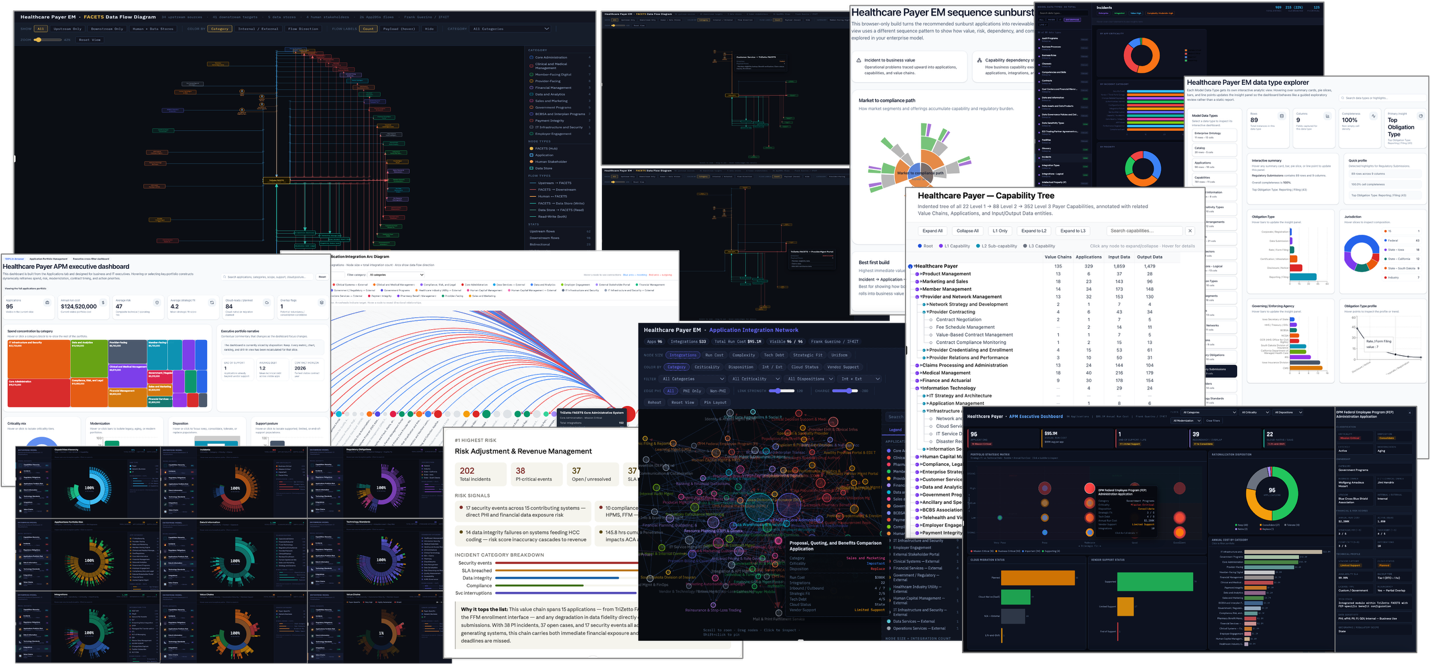
Once an Enterprise Model is realized, it can be used to create different knowledge constructs that help enterprise stakeholders (i.e., people) explore, learn, and make decisions. The model can also further be used by other systems that might rely on or facilitate such data.
About This Document
This document covers the concepts required to help successfully design, build, deploy, and maintain Enterprise Models that must accommodate:
Scale: Think global enterprises that consist of hundreds-of-thousands of employees and consultants.
Complexity: Think “commonalities” and “differences/variations” between industries, regions, offerings, etc.
Constant Change: Think new and constantly changing products, services, customers, regulations, workforce, organizational structures, and much more.
Usability &Value: Think easy traversal, exploration, transparency, analysis, reasoning, and decision making.
At the heart of an Enterprise Model is a vast and ever-changing data graph (a.k.a. knowledge graph) that can scale to require millions of nodes and tens of millions of meaningful relationships between them.
The IF4IT has developed a repeatable means for designing, defining, and realizing such a graph using patterns and constructs, coupled with AI, to address concepts and gaps that other design practices and tools & technologies simply could not easily accommodate.
The IF4IT Enterprise Model and Modeling Best Practices document is a foundational publication of the International Foundation for Information Technology (IF4IT). It sits alongside the companion IF4IT Enterprise Inventory Management Best Practices document (EIM), which treats the discipline of enterprise inventory practice in depth and governs the Inventory of Inventories as a foundational artifact. The two documents are designed to be read together, but neither requires the other as a strict prerequisite — a reader who arrives at this document without prior EIM knowledge will find the vocabulary they need taught in place; a reader who wants the deeper treatment of inventory practice can turn to EIM at any time.
Relationship to the Enterprise Inventory Management Document
This document and the companion IF4IT Enterprise Inventory Management Best Practices document address different but closely related disciplines. EIM explains how to establish and govern the inventories an enterprise depends on. The IF4IT EM document explains how those inventories become part of a semantic, AI-consumable representation of the enterprise.
| Dimension | Enterprise Inventory Management (EIM) | IF4IT Enterprise Model (IF4IT EM) |
|---|---|---|
| Primary concern | How the enterprise defines, owns, populates, maintains, and governs inventories. | How inventories, taxonomy, ontology, relationships, rules, and AI runtime behavior form a semantic model of the enterprise. |
| Primary artifact | Governed inventories, including the Inventory of Inventories. | A governed Semantic Model realized through Taxonomy, Ontology, inventories, and compiled data and knowledge graphs. |
| Core question | What inventories does the enterprise need, and how are they kept authoritative and current? | How does the enterprise represent itself so humans and AI can reason across it? |
| AI relevance | Provides trusted inventory data that AI can use. | Provides the semantic substrate AI can compile, traverse, query, visualize, and reason over. |
The Problem This Document is Trying to Solve
Most enterprises do not lack systems, data, tools, or diagrams. They lack a governed semantic representation of themselves and their enterprise facts that can be trusted across organizational, technological, and data boundaries. Applications, technologies, vendors, capabilities, contracts, risks, policies, and ownership records usually exist somewhere, but they are fragmented across departments, functions, systems, spreadsheets, documents, and local vocabularies. The result is an enterprise that can operate day to day but cannot reliably explain itself; or that desperately scrambles when asked to explain itself, such as during audits.
In earlier eras, that weakness was costly but often survivable. Humans compensated by reconciling spreadsheets, conducting interviews, tracing dependencies manually, and rebuilding context for each audit, roadmap, outage, investment decision, or transformation effort. The cost showed up as delay, rework, disagreement, inconsistent decisions, and stale snapshots.
AI raises the stakes. An AI system asked to reason across the enterprise needs more than isolated records. It needs governed concepts, stable identifiers, authoritative inventories, meaningful relationships, rich attributes, and rules that tell it how to interpret what it is reading. Without that substrate, AI will not necessarily stop. It may produce fluent, confident answers from partial, stale, or contradictory enterprise knowledge. However, with such a substrate, the enterprise works at a rapid pace that is consistent across its many facets (e.g., departments, regions, facilities, etc.).
This document addresses this problem by defining the enterprise as a governed Semantic Model:
a Taxonomy that names the kinds of things the enterprise governs,
an Ontology that defines what those things mean and how they relate,
and inventories that realize the model with actual enterprise instances.
The Enterprise Model a reader builds for his or her own enterprise using the IF4IT EM is not merely documentation about the enterprise. It is the structured, governed source content from which AI and non-AI runtimes can compile graphs, generate views, answer questions, perform analysis, reason over, and produce decision-support artifacts. It also enables and empowers AI agents, which many enterprises have already started sprinting towards.
The IF4IT EM documents concepts that are not limited to a fixed list of enterprise or technology concepts. It commonly starts with Noun Types that are natural to many enterprises (a.k.a. Enterprise Noun Types), as are described further in this document, but the same pattern can scale to any domain space a modeler can define, which is covered later.
This document exists to make the models the reader will design and build and the modeling discipline for doing so understandable, governable, and executable. It explains what an IF4IT-compliant Enterprise Model is, what it is composed of, why it differs from tool-bound modeling approaches, how its empirical foundation has been tested, how AI can compile and operate on it, and what practices enterprises must follow to build, govern, and use it responsibly for their own models.
| Enterprise Problem | Why It Matters | IF4IT EM Response |
|---|---|---|
| Fragmented enterprise knowledge | Each function maintains a partial view of the enterprise, so cross-functional questions produce reconciliation work instead of answers. | Connect governed inventories through a shared Taxonomy, Ontology, and relationship model. |
| Tool-bound or diagram-only modeling | Models become trapped in a specific tool, view, or diagram rather than serving as reusable enterprise knowledge. | Treat the EM as tool-independent source content that can generate many views and outputs. |
| Ungoverned or stale inventories | AI and human decision-makers can reason from records that are incomplete, out of date, or locally defined. | Require ownership, semantic identifiers, attributes, relationships, rules, and maintenance discipline. |
| AI without an enterprise substrate | AI can produce confident, fluent answers that sound correct but rest on weak or contradictory enterprise data. | Provide AI with governed semantic content it can compile into data and knowledge graphs. |
| Repeated one-off analysis | Audits, impact assessments, roadmaps, and strategy questions repeatedly rebuild the same context. | Use the EM as reusable governed source content for on-demand graph compilation and runtime analysis. |
This is intended to be a living document. It publishes what is known now and is expected to evolve as IF4IT’s understanding deepens.
Readers may read the document sequentially or move to the sections most relevant to their immediate needs. Each section is written to be substantively self-contained: a reader arriving at a section from a search engine or from a cross-reference finds enough context to understand that section without first reading the section before it. However published pages offer links for how to navigate to previous and following sections, as well as for getting to the master table of contents.
How to cite this page
When referencing this page in academic work, internal standards, or external publications, include the page title, IF4IT as author and publisher (The International Foundation for Information Technology (IF4IT), LLC), the URL, and your access date.
Example (informal web citation):
The International Foundation for Information Technology (IF4IT), LLC. The IF4IT Enterprise Model and Modeling Best Practices. https://if4it.org/best-practices/if4it-enterprise-model-and-modeling-best-practices/overview/ (accessed 2026-09-11).
See About Us for content governance and site-wide citation guidance.
Copyright for The International Foundation for Information Technology (IF4IT), LLC: 2008 - Present
Legal Disclaimers