IT Operating Environments Best Practices
Executive Summary: Document Overview
IF4ITThe Bottom Line
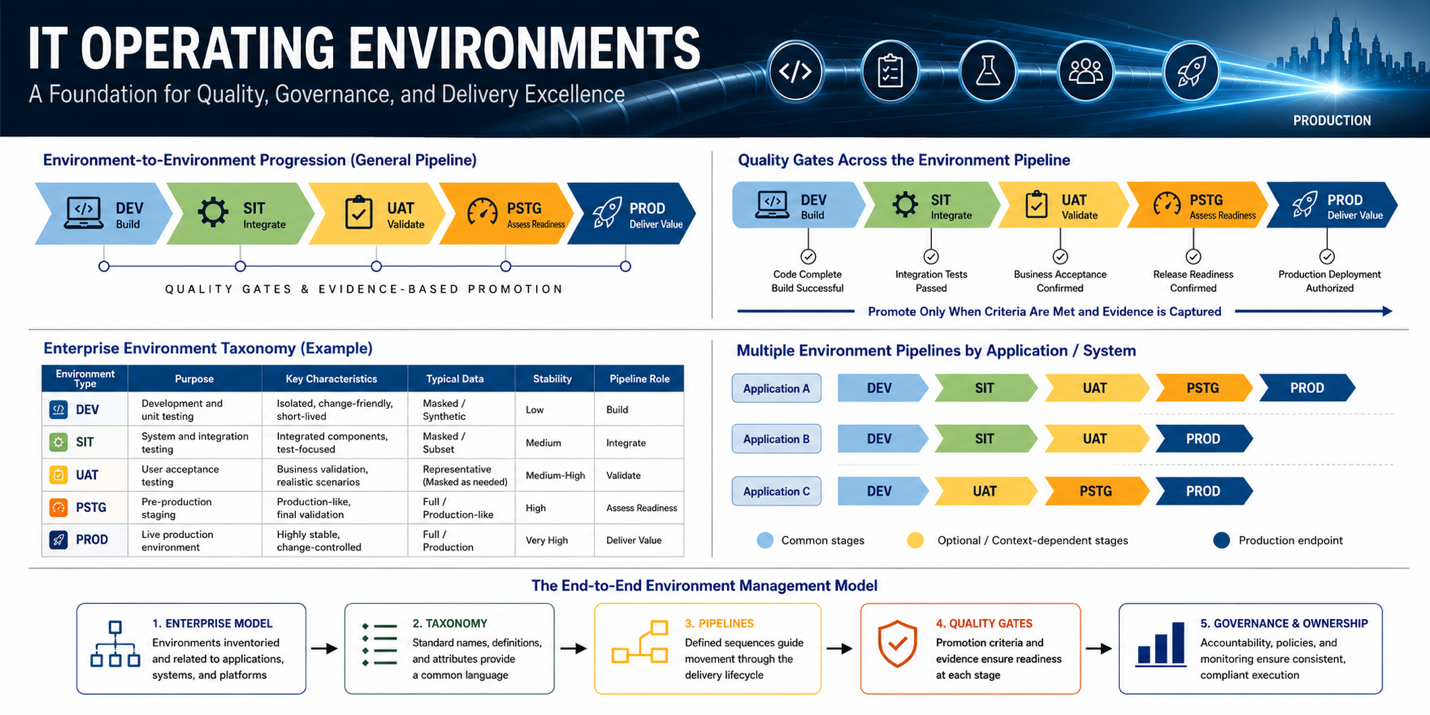
IT operating environments are not incidental technical spaces; they are governed enterprise control points that determine how reliably, securely, and cost-effectively solutions move from research and development into production operation. Effective Environment Management requires consistent Environment Types, known Environment Instances, defined ownership, governed access, controlled data movement, lifecycle discipline, automation, cost governance, and evidence-based promotion decisions. This document provides a full operating model for establishing, governing, operating, optimizing, and continuously improving environment pipelines so every Environment Instance is purposeful, accountable, secure, auditable, and aligned to business need.
Core Pillars & Document Modules
| Document Pillar / Focus Area | Strategic Business Outcome & Intent |
|---|---|
| Environment Taxonomy and Pipeline Governance | Establishes a common vocabulary and lifecycle model for Research, Development, Engineering, SIT, UAT, Education and Training, Production Staging, and Production environments so teams can govern environment journeys consistently without forcing every solution through the same physical path. |
| Ownership, Inventory, and Enterprise Model Integration | Treats Environment Instances, Environment Assets, relationships, stakeholders, access, data, cost, and lifecycle state as governed enterprise data so leaders can understand dependency, risk, accountability, and operational impact. |
| Security, Data, and Evidence Controls | Defines the access, segregation, sensitive-data, promotion, validation, and audit evidence practices required to protect environments and ensure that changes advance only through controlled, reviewable decisions. |
| Automation, Operations, Cost, and Continuous Improvement | Connects provisioning, deployment, configuration, observability, resilience, FinOps, metrics, retirement, and improvement practices so environments remain reliable, efficient, repeatable, and aligned to enterprise standards. |
Quick Q&A (Macro Executive Reference)
Question: Why should IT operating environments be governed as enterprise assets rather than treated as local technical conveniences?
Answer: Because environment decisions determine where applications run, what data they use, who can access them, how changes are validated, what risks are accepted, and what costs are incurred. When environments are not governed as enterprise assets, organizations lose visibility into quality, security, compliance, cost, and operational readiness across the delivery pipeline.
Question: What does this document help organizations standardize?
Answer: It helps organizations standardize Environment Types, Environment Instances, environment naming, ownership, inventory attributes, lifecycle states, access models, data controls, promotion rules, validation evidence, automation practices, operational expectations, cost guardrails, metrics, and continuous-improvement practices across the full IT operating environment landscape.
Question: How is the document organized for practical use?
Answer: The document is organized as a flow of guidance areas rather than a fixed set of counted domains. It begins with foundational environment concepts and taxonomy, then moves through governance, ownership, inventory management, lifecycle control, delivery and release practices, access and security controls, data governance, automation, infrastructure and cost management, metrics, and continuous improvement so the reader can either follow the full model or apply individual practices as needed.
Read Full Table of Contents Below
Table of Contents
Overview and Glossary
Foundation and Strategy
- Define what IT operating environments are and why they matter as a governance discipline
- Define Environment Management as an organizational discipline
- Understand how Environment Management connects to Enterprise Inventory Management, Application Portfolio Management, Enterprise Architecture, and broader governance disciplines
- Build a business case for environment discipline investment
Environment Types, Taxonomy, and Naming
- Establish Environment Types
- Align environments to Systems Development Lifecycle (SDLC) phases
- Establish a standard enterprise environment taxonomy with consistent names, abbreviations, and semantic identifiers
- Map all custom and local environment names to the standard enterprise taxonomy
- Govern environment naming as an enterprise standard - not a local team convention
Environment Ownership and Governance
- Define environment ownership at two levels - the enterprise taxonomy and individual Environment Instances
- Assign a named owner to every Environment Instance
- Establish an enterprise environment governance model connecting to existing governance bodies
- Define environment stewardship roles and responsibilities
Environment Design Models
- Understand the lower environments and upper environments distinction
- Align environment strategy with organizational scale, solution complexity, and risk tolerance
- Document whether each environment is isolated or shared - and govern the implications of each model
- Understand the distinction between isolated and shared environment models
- Make the isolated-vs-shared decision deliberately - document it and govern its implications
- Manage dependency and change coordination complexity in shared environments
- Apply consistent governance standards regardless of whether environments are isolated or shared
Environment Type Definitions and Usage Guidance
- Research (RES) - viability testing and throw-away prototyping before formal development investment
- Development (DEV) - building, unit testing, and module testing initial solutions
- Systems Integration Testing (SIT) - validating external integrations and component interactions
- User Acceptance Testing (UAT) - validating functional expectations with IT and business end users
- Education and Training (EDU/TRN) - preparing administrators and users for deployment
- Govern Penetration Testing as a controlled security validation activity
- Production Staging (PSTG) - final validation in a near-Production configuration
- Production (PROD) - the governed operational environment for live use
Environment Inventory and Enterprise Model Integration
- Maintain an Environments Inventory as a governed, owned enterprise data asset connected to the Enterprise Model
- Register Environment Instances and Environment Assets in appropriate enterprise inventories
- Use environment data to infer and enrich enterprise knowledge of operating locations, facilities, and geographic presence
Environment Request, Provisioning, and Automation
- Manage environment requests through a governed service catalog and intake workflow
- Create environments deliberately - with documented purpose, ownership, and governance
- Document how to construct, reconstruct, and destroy important environments
- Strive to automate environment construction, reconstruction, and destruction
- Govern ephemeral and on-demand environments - treat them as isolated, time-bounded containers for systems, applications, and data that minimize cost by existing only when needed and reduce organizational risk by limiting the time any environment is active and exposed
- Govern the proliferation of sandbox and experimental environments in cloud platforms
- Decommission environments deliberately when they are no longer needed - do not allow them to persist and accumulate cost, configuration drift, and risk
Environment Progression, Promotion, and Release Governance
- Treat the environment pipeline as a quality gate sequence - not a collection of parallel deployments
- Govern solution promotion through environments as a formal, gated process
- Define promotion criteria and required evidence at every environment gate
- Govern performance, resilience, and specialized validation requirements by Environment Instance
- Assign promotion authority at each gate - and require documented approval
- Automate deployments across the environment pipeline to the greatest degree feasible
- Govern deployable assets with versioning, provenance, and bill of materials evidence
- Use controlled release patterns to reduce production deployment risk
- Treat manual deployment as a governance exception requiring documented justification
- Encode environment governance policies as code - automate security controls, compliance checks, and promotion criteria within the CI/CD pipeline
Data and Dependency Governance Across Environments
- Treat data governance across environments as a first-order governance obligation - not a technical detail
- Never move dirty data from lower environments to higher environments without tight, documented controls
- Never replicate or transmit sensitive Production data - including PII, PCI, PHI, and PFI - to lower environments
- Define what data belongs in each environment - and how it should be created, managed, and governed
- Govern environment refresh, reset, and data seeding activities
- Use data masking, anonymization, and synthetic data generation to serve lower environment data needs safely
- Use service virtualization, mocks, and simulators to reduce lower-environment dependency constraints
- Govern data residency and classification across all environment tiers
Configuration, Parity, Observability, and Quality
- Define the required degree of parity between each environment and Production
- Document all known configuration differences between environments - and govern them explicitly
- Use infrastructure-as-code and configuration management tooling to enforce environment consistency
- Test for environment-specific failures - do not assume that success in a lower environment guarantees success in a higher one
- Monitor and observe all governed environments - detect failures, configuration drift, and anomalies proportionate to each environment’s purpose
- Maintain environments to defined quality and currency standards throughout their operational life
- Manage vulnerabilities, patches, and technology currency across all governed environments
Access Controls and Security Governance
- Apply the principle of least privilege to every environment - with access tightening as environments approach Production
- Govern stakeholder access to Environment Instances based on role, purpose, and risk
- Prevent direct modification of production and controlled Environment Assets without strict controls
- Govern Penetration Testing access with heightened controls appropriate to the security-sensitive nature of testing activities
- Review and recertify environment access on a defined cadence for every environment tier
- Treat non-Production environments as security governance obligations - not as ungoverned technical workspaces
- Govern secrets management across all environments - credentials, API keys, certificates, and connection strings must be environment-specific, centrally managed, and never hardcoded
Availability, Resilience, Disaster Recovery, and Continuity
- Define availability and performance SLAs for every environment tier - not only Production
- Right-size SLA commitments to the purpose and user population of each environment
- Communicate environment availability expectations explicitly to all teams that depend on each environment
- Govern environment downtime and maintenance windows in alignment with the teams and processes that depend on them
- Establish mirror environments for Disaster Recovery and Business Continuity Planning where organizationally justified
- Govern mirror environments with the same discipline as their Production counterparts
- Test mirror environment readiness on a defined regular cycle - an untested DR environment is not a DR environment
- Document Recovery Time Objectives and Recovery Point Objectives for every mirrored environment
Infrastructure, Capacity, Cost, and FinOps
- Right-size environment infrastructure proportionate to environment purpose - lower environments do not need Production scale
- Apply FinOps discipline across the full environment stack - not only to Production infrastructure
- Govern environment capacity, consumption, and resource guardrails
- Identify and eliminate idle and orphaned non-Production environments as a recurring cost governance activity
- Connect environment infrastructure cost to application portfolio financial management
Metrics, Reporting, and Continuous Improvement
- Define metrics and KPIs for environment health, governance compliance, and operational quality
- Measure environment parity - track the degree of configuration divergence between environments and Production
- Measure deployment pipeline performance - frequency, lead time, change failure rate, and recovery time
- Report environment health and governance compliance to appropriate leadership levels
- Establish a continuous improvement process for environment governance capability
- Use deployment failure analysis to drive environment governance improvement
- Build a culture of environment discipline across engineering, operations, and governance teams
Copyright for The International Foundation for Information Technology (IF4IT), LLC: 2008 - Present