Align environment strategy with organizational scale, solution complexity, and risk tolerance - IT Operating Environments Best Practices
Align environment strategy with organizational scale, solution complexity, and risk tolerance
(Chapter 17 of IT Operating Environments Best Practices)
Executive Summary: Chapter Overview
IF4ITThe Bottom Line
Core Concepts
| Chapter Focus Area | Practical Governance Intent |
|---|---|
| Align environment strategy with organizational scale, solution co… | Establishes the governance expectation, operating discipline, or decision criteria needed to manage this aspect of IT operating environments consistently. |
| Controls and Accountability | Clarifies the ownership, evidence, access, lifecycle, risk, cost, or compliance practices needed to make the guidance enforceable and auditable. |
Quick Q&A
Question: Why does this chapter matter to Environment Management?
Read More Below
Overview
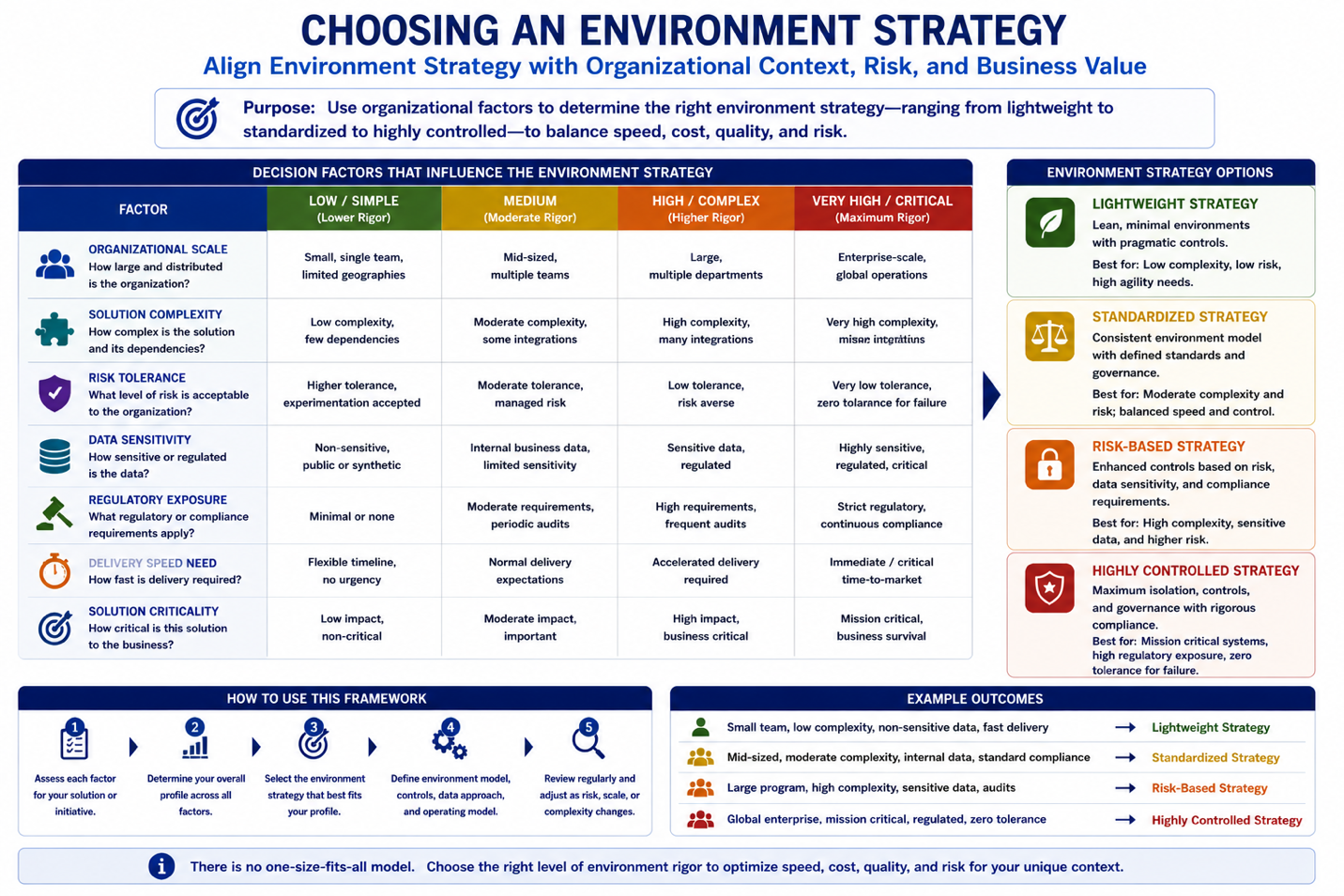
A small organization with a single development team building an internal tool does not require the same environment complexity as a large enterprise delivering customer-facing financial services. An organization with a low risk tolerance for production incidents requires more rigorous gate validation than one whose solutions can tolerate higher post-deployment iteration. A solution with complex external integration dependencies requires SIT environments that a standalone internal tool may not need. Applying a uniform environment strategy regardless of organizational context produces environments that are either inadequate for the risk they are managing or unnecessarily complex for the scale of the solutions they serve.
Best Practice
Define an environment strategy that is calibrated to the organization’s scale, the complexity of the solutions it delivers, and its risk tolerance. For smaller organizations or less complex solutions, a simplified pipeline - DEV, UAT, and PROD, for example - may be entirely adequate. A simple low-risk website, for example, might warrant just DEV & PROD. For larger organizations delivering complex, high-risk solutions, the full eight-environment pipeline with formal gates at every transition is more appropriate. The governing principle is proportionality: the environment strategy should be as simple as the organization’s risk profile allows and as comprehensive as that risk profile requires. Document the rationale for the chosen environment strategy so that it can be revisited and adjusted as organizational scale and risk tolerance evolve.
Benefit(s)
A proportionate environment strategy avoids the twin failure modes of inadequate environment governance and unnecessary complexity. Teams have environments that are fit for purpose rather than environments that are either insufficient or too burdensome to use consistently. The organization’s environment investment is directed to the governance complexity that its risk profile genuinely requires rather than to a one-size-fits-all model that serves no organizational context well.
How to cite this page
When referencing this page in academic work, internal standards, or external publications, include the page title, IF4IT as author and publisher (The International Foundation for Information Technology (IF4IT), LLC), the URL, and your access date.
Example (informal web citation):
The International Foundation for Information Technology (IF4IT), LLC. Align environment strategy with organizational scale, solution complexity, and risk tolerance | IT Operating Environments Best Practices. https://if4it.org/best-practices/it-operating-environments/align-environment-strategy-with-organizational-scale-solution-complexity-and-risk-tolerance/ (accessed 2026-09-20).
See About Us for content governance and site-wide citation guidance.
Copyright for The International Foundation for Information Technology (IF4IT), LLC: 2008 - Present
Legal Disclaimers