Align environments to Systems Development Lifecycle (SDLC) phases - IT Operating Environments Best Practices
Align environments to Systems Development Lifecycle (SDLC) phases
(Chapter 8 of IT Operating Environments Best Practices)
Executive Summary: Chapter Overview
IF4ITThe Bottom Line
Core Concepts
| Chapter Focus Area | Practical Governance Intent |
|---|---|
| Align environments to Systems Development Lifecycle (SDLC) phases | Establishes the governance expectation, operating discipline, or decision criteria needed to manage this aspect of IT operating environments consistently. |
| Controls and Accountability | Clarifies the ownership, evidence, access, lifecycle, risk, cost, or compliance practices needed to make the guidance enforceable and auditable. |
Quick Q&A
Question: Why does this chapter matter to Environment Management?
Read More Below
Overview
Environment Types and Systems Development Lifecycle (SDLC) phases are related, but they are not the same thing. SDLC phases describe the type of work being performed as a solution moves from idea to operation. Environment Types describe the governed technology spaces where work can be safely performed, validated, trained on, staged, deployed, and operated.
This distinction is important because not every SDLC phase requires a dedicated environment. Strategy Setting, Planning, Requirements, and Design usually require analysis, documentation, modeling, decision-making, and governance, but they do not always require a separate technical environment. By contrast, Development, Engineering, Systems Integration Testing, User Acceptance Testing, Education and Training, Production Staging, and Production usually require one or more governed environments to perform, validate, or operate the work safely.
SDLC phases determine what kind of work is being performed. Environment Types determine where that work is safely and appropriately performed.
Best Practice
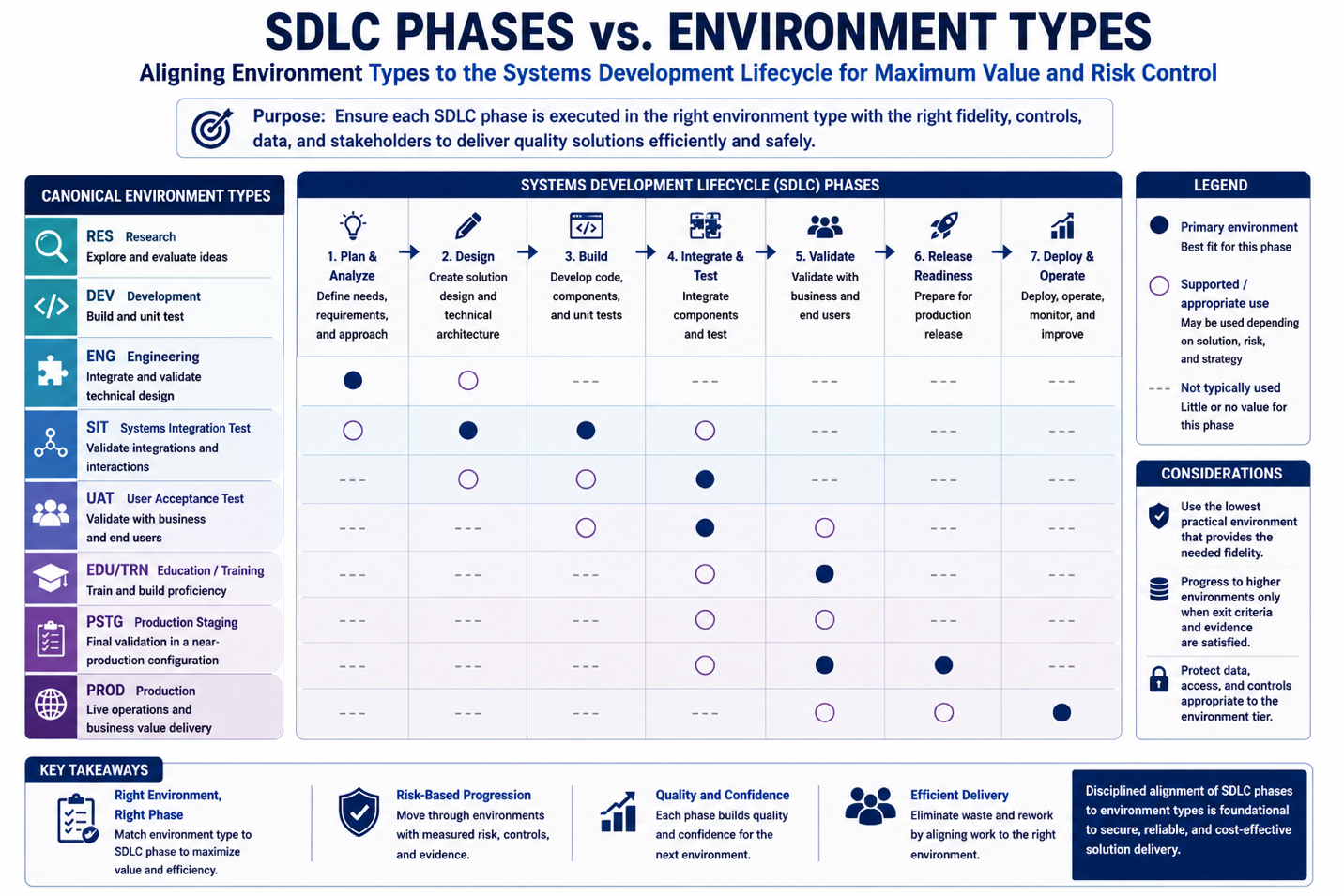
Explicitly map the organization’s standard Environment Types to its standard SDLC phases. This mapping helps business and IT stakeholders understand the general sequencing of work, the role of each Environment Type, the evidence expected at each transition point, and the governance criteria required before a solution advances toward Production.
The mapping should not be interpreted as a rigid one-to-one relationship. Some SDLC phases may not require a dedicated environment. Some Environment Types may support more than one SDLC phase. Some systems may require only a small subset of available Environment Types, while complex or high-risk systems may require a more complete environment path with stronger evidence, validation, and approval controls.
This mapping also supports different delivery methodologies. Waterfall and Agile are not different because one iterates and the other does not. Both delivery approaches iterate. They differ primarily in iteration cadence, control model, documentation burden, evidence expectations, and governance gates. In Waterfall-oriented delivery, SDLC phases often appear as longer, more formal stages with heavier documentation and more explicit approval gates. A solution may fail Systems Integration Testing multiple times and require repeated refinement of requirements, design, development, configuration, or test data before it can advance to User Acceptance Testing. A solution may also fail User Acceptance Testing and require further correction before it is ready for Production.
In Agile-oriented delivery, the same lifecycle concepts exist, but they are often compressed, repeated, or overlapped across sprints, increments, releases, or product roadmap cycles. Requirements, design, development, testing, user validation, and release preparation may occur repeatedly and at higher cadence. Agile delivery does not eliminate the need for governed environments; it increases the need for clear environment purpose, automation, promotion discipline, test evidence, access control, and data governance so that rapid iteration does not become unmanaged change.
Lightweight Agile alone is insufficient for safety-critical, regulated, hardware-dependent, or high-assurance delivery. Iterative engineering can still exist in those domains, but it must be wrapped in stronger architecture governance, formal verification, traceability, validation evidence, regulatory controls, safety cases, release gates, and configuration management.
The following table illustrates a typical alignment between common SDLC phases and standard Environment Types. Organizations should tailor this mapping to their delivery methodology, regulatory obligations, technology architecture, and risk tolerance.
| SDLC Phase | Typical Environment Type Alignment | Governance Guidance |
|---|---|---|
| Strategy Setting | Usually no dedicated environment | Define business intent, investment rationale, strategic fit, governance expectations, risk posture, and success measures. |
| Research | Research (RES) | Explore technical feasibility, solution viability, prototypes, experiments, and options without creating unmanaged Production-like exposure. |
| Planning | Usually no dedicated environment | Plan environment needs, data needs, access requirements, promotion gates, test strategy, release approach, cost implications, and governance responsibilities. |
| Requirements | Usually no dedicated environment | Define functional, non-functional, data, security, compliance, evidence, environment, and operational requirements. |
| Design | May use Research (RES), Development (DEV), or Engineering (ENG) | Design the target solution, integration patterns, infrastructure needs, data flows, security controls, deployment approach, and environment implications. |
| Development and Engineering | Development (DEV) and Engineering (ENG) | Build, configure, engineer, unit test, component test, and technically validate solution components before broader integration and business validation. |
| Systems Integration Testing | Systems Integration Testing (SIT) | Validate integration behavior, component interaction, upstream and downstream dependencies, interface contracts, data flows, and system-level behavior. |
| User Acceptance Testing | User Acceptance Testing (UAT) | Validate that the solution satisfies business expectations, user workflows, acceptance criteria, and stakeholder requirements. |
| Education and Training | Education and Training (EDU/TRN) | Prepare users, administrators, operators, support teams, and other stakeholders before or around Production deployment. |
| Production | Production Staging (PSTG) and Production (PROD) | Validate production readiness, rehearse or confirm deployment readiness where needed, deploy to live use, and operate the solution under Production governance controls. |
| Operations Stabilization | Production (PROD) | Stabilize the solution after deployment through heightened monitoring, support readiness, incident response, defect remediation, rollback readiness, performance observation, and post-release governance. |
Production Staging deserves special attention. It is not usually treated as a separate SDLC phase, but it is an important Environment Type for organizations that need final readiness validation before Production. Production Staging should be understood as part of the broader Production phase. It supports release readiness, deployment rehearsal, production-configuration validation, cutover preparation, operational handoff, and evidence-based promotion approval before the solution is exposed to live users and live operational data.
The mapping between SDLC phases and Environment Types should be documented in the organization’s environment standards, delivery methodology guidance, release governance process, and Environments Inventory. Each Environment Instance should identify the Environment Type it supports and, where useful, the SDLC phase or phases it is intended to support. This creates a common vocabulary for delivery teams, business stakeholders, testers, operations teams, security teams, governance bodies, and auditors.
Benefit(s)
Aligning Environment Types to SDLC phases improves shared understanding across business and IT teams. It helps stakeholders understand what work is happening, where it should happen, what controls apply, what evidence is required, and what must be true before a solution advances toward Production.
This alignment also improves governance consistency. Teams are less likely to misuse environments, bypass required validation, create unnecessary Environment Instances, or confuse lifecycle activities with environment categories. Promotion decisions become easier to govern because each transition can be tied to the purpose of the current SDLC phase, the role of the target Environment Type, and the evidence required to move forward.
Finally, this alignment supports both speed and control. Lower-risk solutions can move through a tailored environment path without unnecessary bureaucracy, while higher-risk solutions can be routed through more rigorous environments, stronger validation, and more formal approval gates. The result is a more scalable Environment Management discipline that supports Waterfall, Agile, hybrid, regulated, and high-assurance delivery models without forcing every solution through the same rigid path.
How to cite this page
When referencing this page in academic work, internal standards, or external publications, include the page title, IF4IT as author and publisher (The International Foundation for Information Technology (IF4IT), LLC), the URL, and your access date.
Example (informal web citation):
The International Foundation for Information Technology (IF4IT), LLC. Align environments to Systems Development Lifecycle (SDLC) phases | IT Operating Environments Best Practices. https://if4it.org/best-practices/it-operating-environments/align-environments-to-systems-development-lifecycle-sdlc-phases/ (accessed 2026-09-20).
See About Us for content governance and site-wide citation guidance.
Copyright for The International Foundation for Information Technology (IF4IT), LLC: 2008 - Present
Legal Disclaimers