Define environment ownership at two levels - the enterprise taxonomy and individual Environment Instances - IT Operating Environments Best Practices
Define environment ownership at two levels - the enterprise taxonomy and individual Environment Instances
(Chapter 12 of IT Operating Environments Best Practices)
Executive Summary: Chapter Overview
IF4ITThe Bottom Line
Core Concepts
| Chapter Focus Area | Practical Governance Intent |
|---|---|
| Define environment ownership at two levels - the enterprise taxon… | Establishes the governance expectation, operating discipline, or decision criteria needed to manage this aspect of IT operating environments consistently. |
| Controls and Accountability | Clarifies the ownership, evidence, access, lifecycle, risk, cost, or compliance practices needed to make the guidance enforceable and auditable. |
Quick Q&A
Question: Why does this chapter matter to Environment Management?
Read More Below
Overview
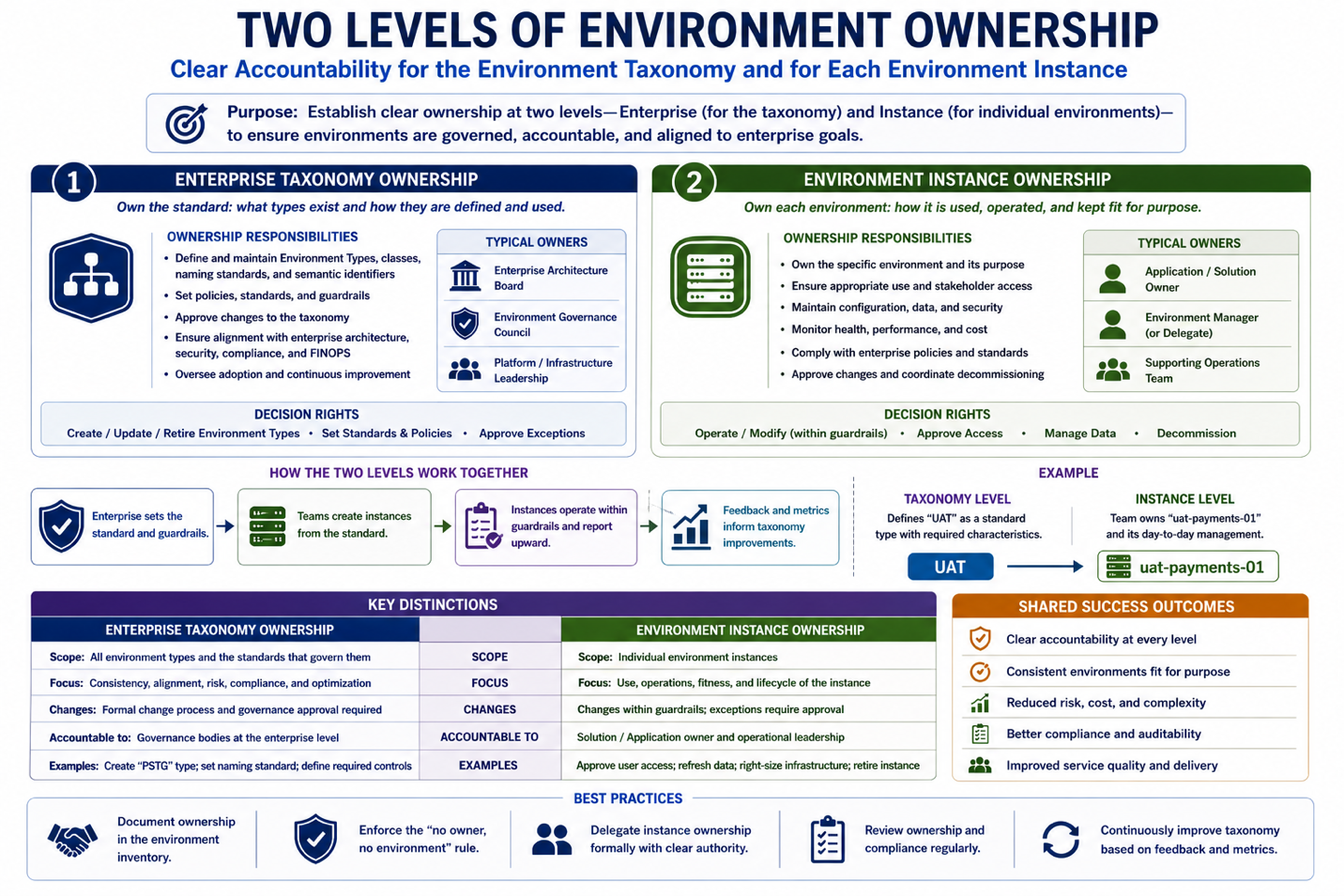
Environment ownership is frequently undefined or poorly defined in organizations where environment management is informal. When no one is explicitly accountable for an environment, the environment is effectively ungoverned: it may be created without process, modified without change management, left running without decommissioning, or allowed to accumulate configuration drift and stale access rights without detection. Even in organizations that recognize the need for environment ownership, the ownership model is often incomplete because it addresses only the operational level - who runs a specific environment - without addressing the strategic level - who owns the enterprise environment taxonomy itself and has the authority to define, modify, and enforce it.
Best Practice
Define environment ownership at two distinct levels, each with its own named owner, accountability scope, and governance authority. At the enterprise taxonomy level, assign ownership of the enterprise environment taxonomy, naming standards, and Environment Management policy to a designated enterprise-spanning function. Enterprise Architecture is the recommended owner because it already has the cross-organizational mandate, the architectural perspective, and the governance relationships that enterprise taxonomy ownership requires. This owner defines the standard environment types, approves additions or modifications to the taxonomy, enforces naming standards across the organization, and governs the Environment Management policy that all teams are expected to follow. At the individual instance level, assign a named owner to every Environment Instance in the enterprise. The Environment Instance owner is accountable for the environment’s configuration currency, its availability, its access controls, its cost, and its compliance with enterprise environment standards. The Environment Instance owner is distinct from the Application Owners of the applications running in the environment.
Benefit(s)
Defining environment ownership at both the taxonomy level and the instance level closes the governance gaps that single-level ownership leaves open. Taxonomy-level ownership ensures that the enterprise environment standard is maintained, enforced, and evolved by a function with the authority and the organizational scope to do so effectively. Instance-level ownership ensures that every deployed environment has a specific person accountable for its governance, preventing the environment from drifting into ungoverned territory as personnel change or organizational priorities shift. The combination produces an environment landscape that is both strategically governed at the enterprise level and operationally governed at the instance level.
How to cite this page
When referencing this page in academic work, internal standards, or external publications, include the page title, IF4IT as author and publisher (The International Foundation for Information Technology (IF4IT), LLC), the URL, and your access date.
Example (informal web citation):
The International Foundation for Information Technology (IF4IT), LLC. Define environment ownership at two levels - the enterprise taxonomy and individual Environment Instances | IT Operating Environments Best Practices. https://if4it.org/best-practices/it-operating-environments/define-environment-ownership-at-two-levels-the-enterprise-taxonomy-and-individual-environment-instances/ (accessed 2026-09-20).
See About Us for content governance and site-wide citation guidance.
Copyright for The International Foundation for Information Technology (IF4IT), LLC: 2008 - Present
Legal Disclaimers