Define environment stewardship roles and responsibilities - IT Operating Environments Best Practices
Define environment stewardship roles and responsibilities
(Chapter 15 of IT Operating Environments Best Practices)
Executive Summary: Chapter Overview
IF4ITThe Bottom Line
Core Concepts
| Chapter Focus Area | Practical Governance Intent |
|---|---|
| Define environment stewardship roles and responsibilities | Establishes the governance expectation, operating discipline, or decision criteria needed to manage this aspect of IT operating environments consistently. |
| Controls and Accountability | Clarifies the ownership, evidence, access, lifecycle, risk, cost, or compliance practices needed to make the guidance enforceable and auditable. |
Quick Q&A
Question: Why does this chapter matter to Environment Management?
Read More Below
Overview
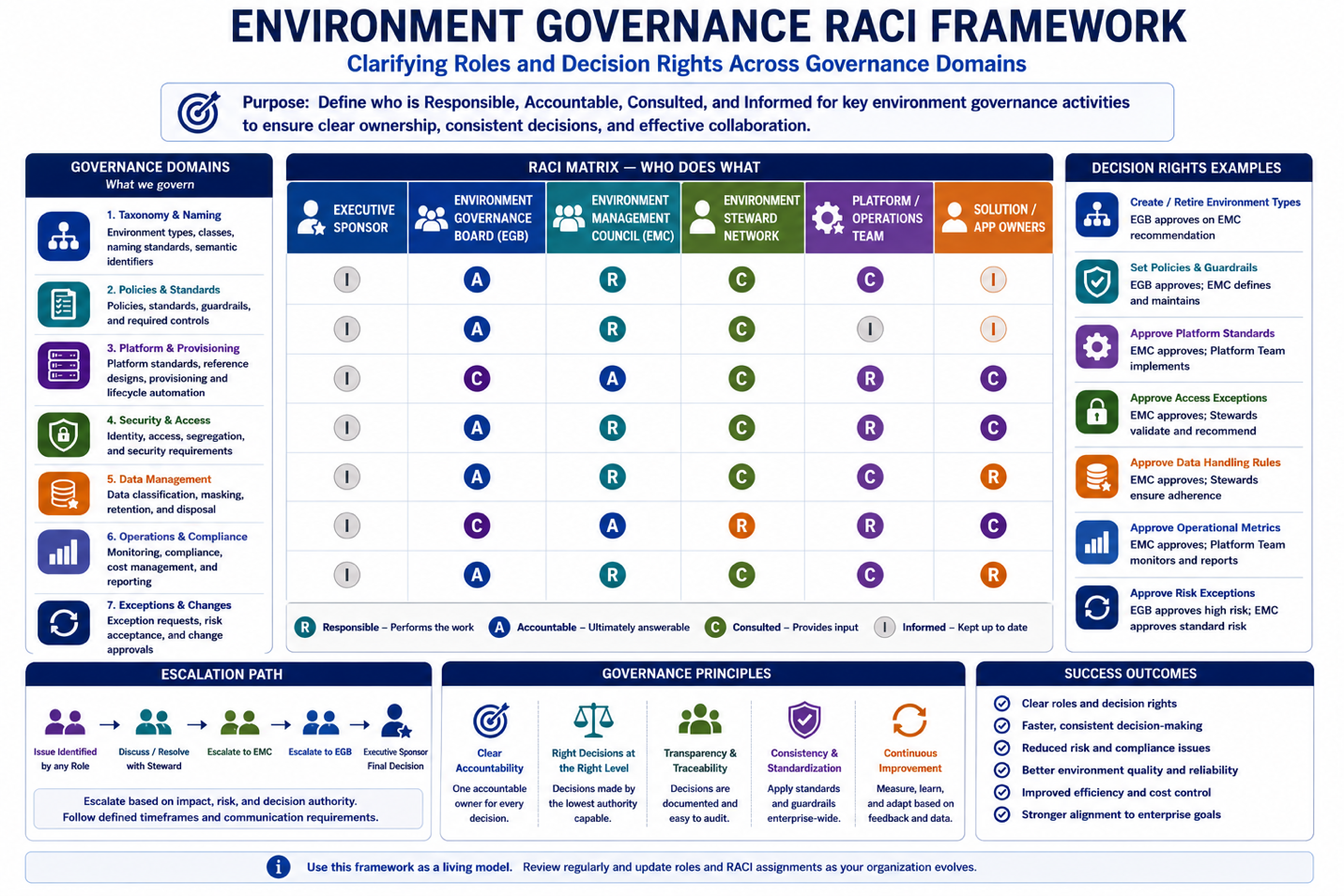
Effective environment governance requires clear role definitions that specify who does what across the full environment management landscape. Without defined roles, accountability for environment governance is diffuse: taxonomy ownership is unclear, instance owners are not formally designated, day-to-day stewardship falls to whoever is available, and governance compliance is monitored by no one in particular. The result is environment governance that exists in policy but not in practice, because the organizational roles required to execute the policy have never been explicitly assigned.
Best Practice
Define, document, and communicate a clear set of roles and responsibilities for everyone involved in environment governance. At minimum, establish the following roles and ensure each is filled by a named individual or function with documented accountability.
| Role | Description | Key Responsibilities |
|---|---|---|
| Environment Taxonomy Owner | The organizational function accountable for the enterprise environment taxonomy, naming standards, and Environment Management policy. | Define and maintain the standard environment taxonomy Approve additions and modifications to the taxonomy Enforce naming standards across the organization Own the Environment Management governance policy Report environment health to IT leadership |
| Environment Instance Owner | The individual accountable for a specific Environment Instance’s governance, configuration, availability, access controls, and cost. | Maintain environment configuration currency Manage access controls and recertification Ensure compliance with enterprise standards Oversee environment cost and right-sizing Manage environment lifecycle transitions |
| Environment Steward | The technical practitioner responsible for day-to-day operation, maintenance, and monitoring of one or more Environment Instances. | Maintain environment infrastructure and configuration Monitor environment health and availability Execute provisioning and decommissioning Support promotion and deployment automation Escalate governance issues to Instance Owner |
| Environment Consumer | Any team or individual that uses an Environment Instance without owning it - including developers, testers, trainers, and business analysts. | Follow environment usage policies Report environment issues to the Instance Owner or Steward Comply with data handling and access control requirements Request environment changes through the governance process |
| Governance Body (ARB/TRB) | The cross-organizational governance body that reviews and approves significant environment decisions above defined materiality or risk thresholds. | Review and approve new environment types and configurations Resolve cross-organizational environment conflicts Receive regular environment health reporting Ensure environment decisions align with architectural direction and security standards |
Benefit(s)
Clearly defined environment stewardship roles eliminate ambiguity about who is responsible for what across the environment governance landscape. Taxonomy Owners know they are accountable for the enterprise standard. Instance Owners know they are accountable for their specific environments. Stewards know their day-to-day operational responsibilities. Consumers know the rules they are expected to follow. The result is a coordinated, accountable environment governance capability that functions in practice rather than only on paper - and that earns organizational trust through consistent, role-appropriate execution.
How to cite this page
When referencing this page in academic work, internal standards, or external publications, include the page title, IF4IT as author and publisher (The International Foundation for Information Technology (IF4IT), LLC), the URL, and your access date.
Example (informal web citation):
The International Foundation for Information Technology (IF4IT), LLC. Define environment stewardship roles and responsibilities | IT Operating Environments Best Practices. https://if4it.org/best-practices/it-operating-environments/define-environment-stewardship-roles-and-responsibilities/ (accessed 2026-09-20).
See About Us for content governance and site-wide citation guidance.
Copyright for The International Foundation for Information Technology (IF4IT), LLC: 2008 - Present
Legal Disclaimers