Define what IT operating environments are and why they matter as a governance discipline - IT Operating Environments Best Practices
Define what IT operating environments are and why they matter as a governance discipline
(Chapter 3 of IT Operating Environments Best Practices)
Executive Summary: Chapter Overview
IF4ITThe Bottom Line
Core Concepts
| Chapter Focus Area | Practical Governance Intent |
|---|---|
| Define what IT operating environments are and why they matter as… | Establishes the governance expectation, operating discipline, or decision criteria needed to manage this aspect of IT operating environments consistently. |
| Controls and Accountability | Clarifies the ownership, evidence, access, lifecycle, risk, cost, or compliance practices needed to make the guidance enforceable and auditable. |
Quick Q&A
Question: Why does this chapter matter to Environment Management?
Read More Below
Overview
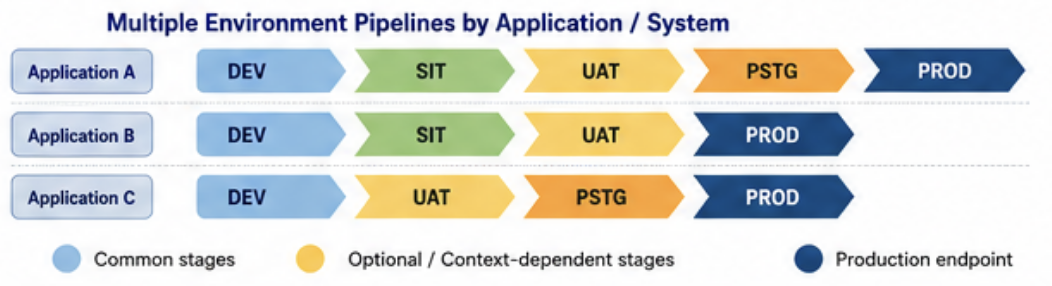
The phrase “operating environment” is used casually in most technology organizations without a shared or precise definition. Teams call environments by different names, use different criteria to decide which environments a solution needs, and apply different standards of governance to nominally equivalent environment types. The result is an environment landscape that is inconsistent, unpredictable, and difficult to govern - and that consistently produces the quality, security, and cost problems that disciplined environment governance is designed to prevent.
Best Practice
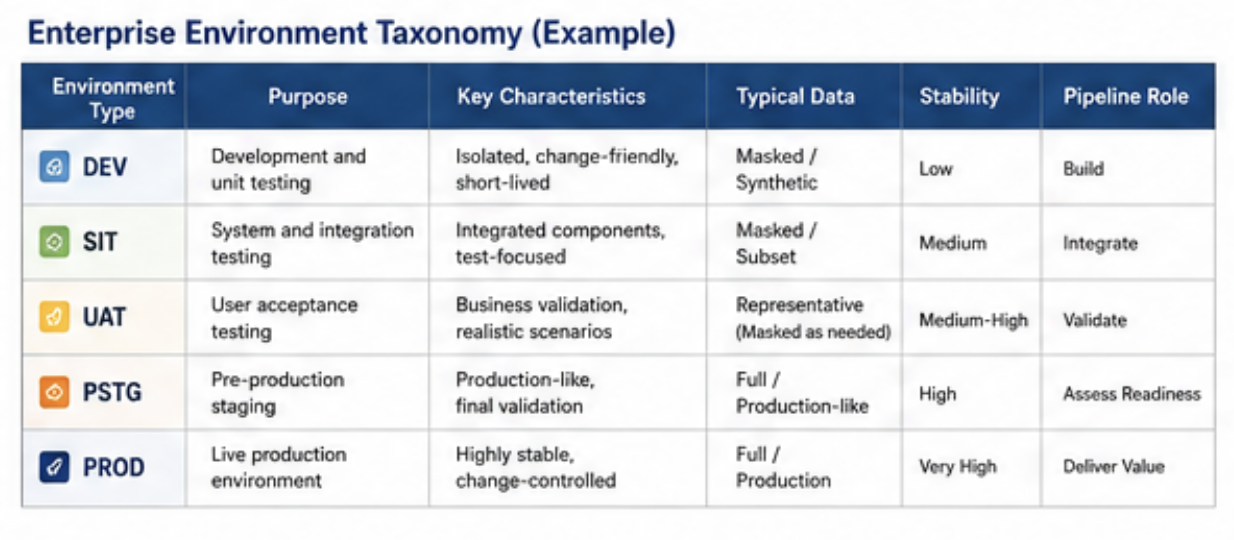
Establish and communicate a clear, organization-wide definition of what an IT operating environment is and why governing it as an organizational discipline - not merely as a technical infrastructure concern - matters. An IT operating environment is a governed technology space, defined by its purpose, its population, its data handling obligations, its access controls, and its position in the delivery pipeline. It is not simply a server, a cloud account, or a namespace. As an Environment Instance, it is a named, owned, purposeful governance domain with explicit rules about what Environment Assets belong in it, who can access it, what data it may contain, and how solutions enter and exit it.
Environments matter as a governance discipline because the choices made about them - which Environment Instances exist, how they are configured, what Environment Assets and data they contain, who can access them, and how solutions move between them - directly determine the quality, security, and cost profile of every solution the organization delivers. An organization that governs its environments well delivers solutions that are more reliable, more secure, and less expensive to operate. An organization that allows environments to accumulate and operate without governance pays for that choice through incidents, compliance failures, delivery inconsistencies, and costs that it cannot account for because it does not know what it is running or what it costs.
Benefit(s)
A shared organizational definition of IT operating environments as a governance discipline creates the foundation for consistent, trustworthy environment management. Teams understand what environments are and why they are governed. Leaders understand what they are investing in and what outcomes they should expect. The organization stops treating environment management as a technical overhead and starts treating it as a strategic quality and security discipline that determines the reliability and security of every solution it delivers.
How to cite this page
When referencing this page in academic work, internal standards, or external publications, include the page title, IF4IT as author and publisher (The International Foundation for Information Technology (IF4IT), LLC), the URL, and your access date.
Example (informal web citation):
The International Foundation for Information Technology (IF4IT), LLC. Define what IT operating environments are and why they matter as a governance discipline | IT Operating Environments Best Practices. https://if4it.org/best-practices/it-operating-environments/define-what-it-operating-environments-are-and-why-they-matter-as-a-governance-discipline/ (accessed 2026-09-20).
See About Us for content governance and site-wide citation guidance.
Copyright for The International Foundation for Information Technology (IF4IT), LLC: 2008 - Present
Legal Disclaimers