Establish a standard enterprise environment taxonomy with consistent names, abbreviations, and semantic identifiers - IT Operating Environments Best Practices
Establish a standard enterprise environment taxonomy with consistent names, abbreviations, and semantic identifiers
(Chapter 9 of IT Operating Environments Best Practices)
Executive Summary: Chapter Overview
IF4ITThe Bottom Line
Core Concepts
| Chapter Focus Area | Practical Governance Intent |
|---|---|
| Establish a standard enterprise environment taxonomy with consist… | Establishes the governance expectation, operating discipline, or decision criteria needed to manage this aspect of IT operating environments consistently. |
| Controls and Accountability | Clarifies the ownership, evidence, access, lifecycle, risk, cost, or compliance practices needed to make the guidance enforceable and auditable. |
Quick Q&A
Question: Why does this chapter matter to Environment Management?
Read More Below
Overview
A consistent environment taxonomy is essential for managing Environment Types and Environment Instances at enterprise scale. Environment Instances must be identifiable, comparable, and governable across applications, teams, and platforms. Without a standard taxonomy, environments are named and used inconsistently, making it difficult to understand their purpose, enforce governance, or analyze the portfolio as a whole.
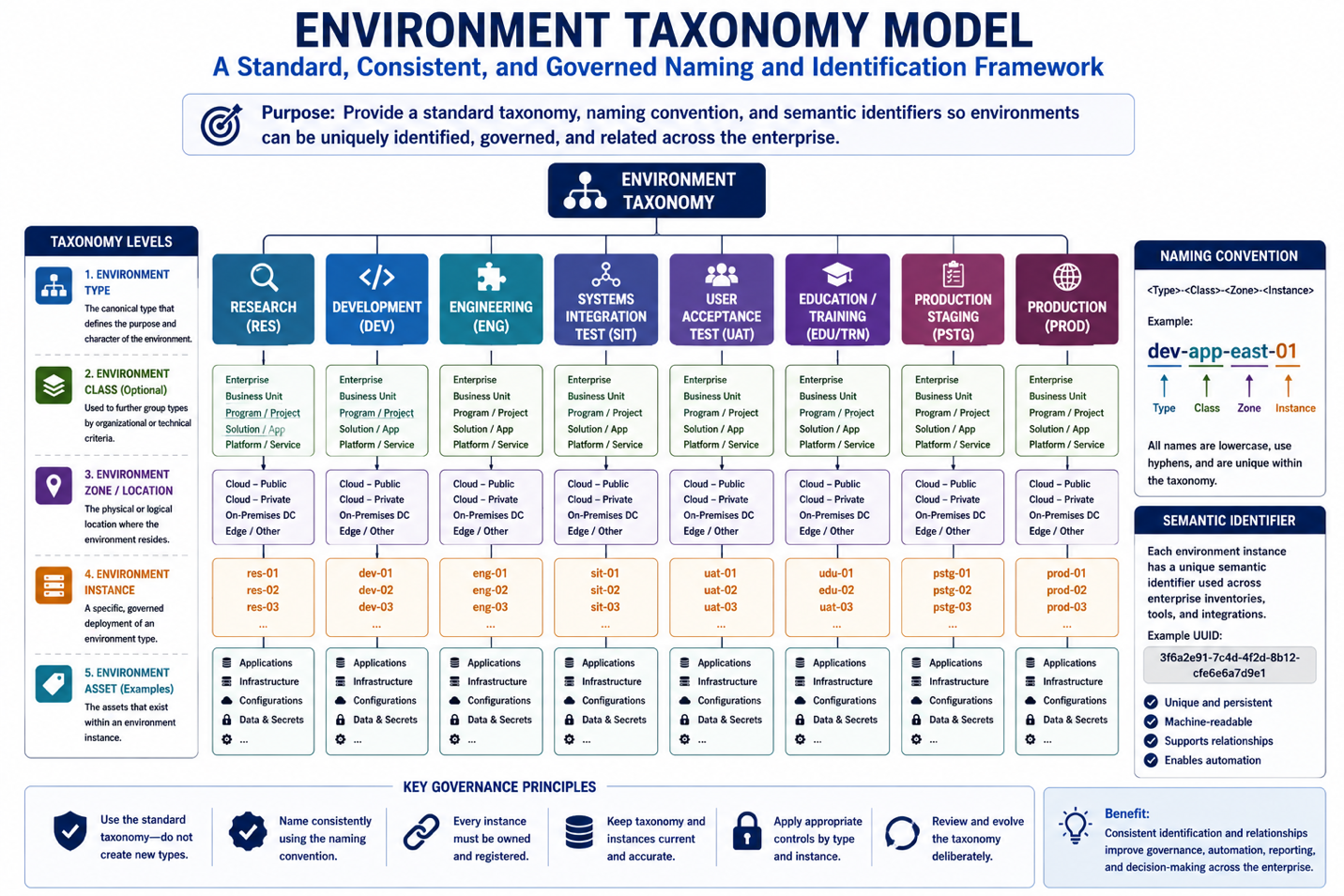
Inconsistent naming introduces ambiguity. Teams may use the same label to represent different stages of readiness, or different labels to represent the same function. As a result, communication breaks down, automation becomes brittle, and reporting loses reliability.
A well-defined taxonomy establishes a shared language for Environment Types and the Environment Instances that map to them. It defines what each Environment Type represents, how it should be used, and how it fits within the broader delivery pipeline.
Best Practice
Define and enforce a standard enterprise environment taxonomy that clearly identifies each Environment Type and its role within the delivery lifecycle.
At a minimum, the taxonomy should:
Define standard Environment Types (e.g., RES, DEV, ENG, SIT, UAT, EDU/TRN, PSTG, PROD, and any approved organization-specific variants)
Provide clear, unambiguous definitions for each Environment Type
Establish consistent naming conventions that can be applied across all applications and platforms
Align each Environment Type to its role within the environment pipeline, including its expected level of quality, stability, and readiness
Environment identifiers should be structured and consistent, enabling both human readability and machine interpretation. Where appropriate, they should align with broader enterprise naming and semantic identifier conventions to support integration with other inventories and analytical systems.
The taxonomy must be governed as an enterprise standard. Deviations should be explicitly reviewed and approved rather than allowed to emerge informally.
Benefit(s)
A standardized environment taxonomy enables clear communication, reliable automation, and consistent governance across the enterprise. Teams share a common understanding of environment purpose and expectations, reducing misalignment and operational confusion.
Automation becomes more robust because environment roles and transitions are predictable. Reporting and analysis improve because environments can be compared and aggregated consistently across applications and organizational units.
By aligning taxonomy with pipeline roles and enterprise naming conventions, organizations create an environment model that is both scalable and integrable. Environments become first-class, well-defined elements of the enterprise landscape rather than loosely defined technical artifacts.
How to cite this page
When referencing this page in academic work, internal standards, or external publications, include the page title, IF4IT as author and publisher (The International Foundation for Information Technology (IF4IT), LLC), the URL, and your access date.
Example (informal web citation):
The International Foundation for Information Technology (IF4IT), LLC. Establish a standard enterprise environment taxonomy with consistent names, abbreviations, and semantic identifiers | IT Operating Environments Best Practices. https://if4it.org/best-practices/it-operating-environments/establish-a-standard-enterprise-environment-taxonomy-with-consistent-names-abbreviations-and-semantic-identifiers/ (accessed 2026-09-20).
See About Us for content governance and site-wide citation guidance.
Copyright for The International Foundation for Information Technology (IF4IT), LLC: 2008 - Present
Legal Disclaimers