Make the isolated-vs-shared decision deliberately - document it and govern its implications - IT Operating Environments Best Practices
Make the isolated-vs-shared decision deliberately - document it and govern its implications
(Chapter 20 of IT Operating Environments Best Practices)
Executive Summary: Chapter Overview
IF4ITThe Bottom Line
Core Concepts
| Chapter Focus Area | Practical Governance Intent |
|---|---|
| Make the isolated-vs-shared decision deliberately - document it a… | Establishes the governance expectation, operating discipline, or decision criteria needed to manage this aspect of IT operating environments consistently. |
| Controls and Accountability | Clarifies the ownership, evidence, access, lifecycle, risk, cost, or compliance practices needed to make the guidance enforceable and auditable. |
Quick Q&A
Question: Why does this chapter matter to Environment Management?
Read More Below
Overview
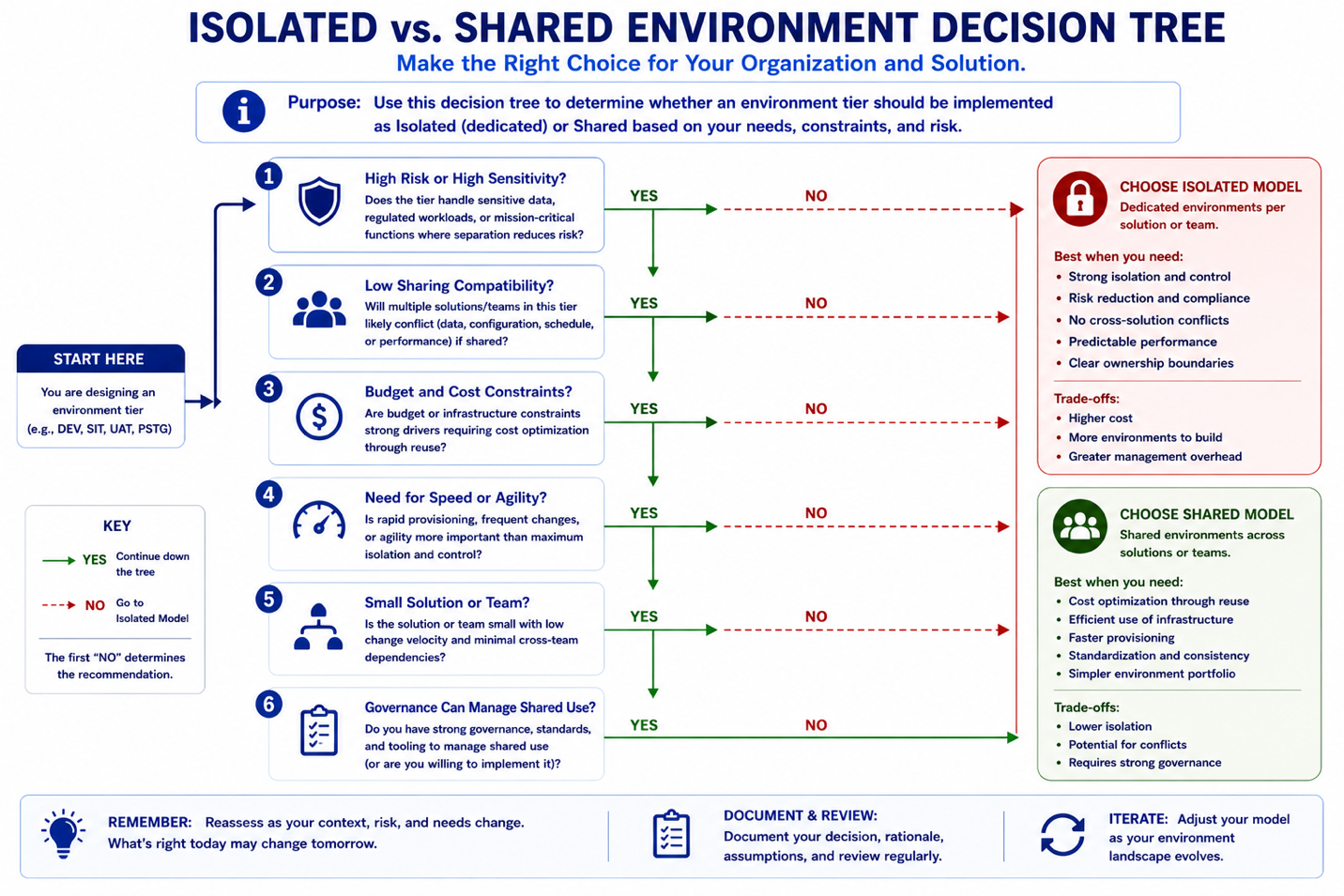
The isolated-vs-shared decision is one of the most consequential environment architecture decisions a team makes, and one of the most frequently made without deliberate consideration. Teams default to shared environments because they inherit shared infrastructure from the organization’s existing environment landscape. Teams default to isolated environments because they have the organizational resources to provision dedicated infrastructure and prefer to avoid coordination overhead. In neither case is the decision typically framed as a governance decision with documented implications. The result is an environment landscape whose isolated-vs-shared profile is not understood in aggregate, whose coordination obligations are not managed consistently, and whose cost and risk profile cannot be analyzed because the fundamental architectural model of each environment is not recorded.
Best Practice
Require that the isolated-vs-shared decision be made explicitly, documented in the environment’s inventory record, and reviewed by the environment governance process as part of environment creation approval. For teams requesting a new Environment Instance, the governance process should surface the isolated-vs-shared question explicitly and require the requesting team to declare their intended model and confirm that they understand the governance implications. For isolated environments, confirm that the team has a plan for the environment’s full lifecycle including eventual decommissioning. For shared environments, confirm that a coordination model exists, that all teams sharing the environment are aware of the shared model and have agreed to the coordination requirements, and that data governance obligations for the multi-application data landscape of the shared environment have been identified and assigned.
Benefit(s)
Making the isolated-vs-shared decision a required, documented part of the environment creation process ensures that the governance implications of each model are addressed before the environment is deployed rather than discovered after problems have materialized. Shared environment coordination failures - deployment conflicts, data contamination, configuration collisions - are prevented or mitigated by coordination mechanisms established at environment creation time. The organization’s environment landscape becomes visible and analyzable in aggregate because the fundamental architectural model of every environment is a known, recorded attribute rather than an implicit assumption.
How to cite this page
When referencing this page in academic work, internal standards, or external publications, include the page title, IF4IT as author and publisher (The International Foundation for Information Technology (IF4IT), LLC), the URL, and your access date.
Example (informal web citation):
The International Foundation for Information Technology (IF4IT), LLC. Make the isolated-vs-shared decision deliberately - document it and govern its implications | IT Operating Environments Best Practices. https://if4it.org/best-practices/it-operating-environments/make-the-isolated-vs-shared-decision-deliberately-document-it-and-govern-its-implications/ (accessed 2026-09-20).
See About Us for content governance and site-wide citation guidance.
Copyright for The International Foundation for Information Technology (IF4IT), LLC: 2008 - Present
Legal Disclaimers