Overview - IT Operating Environments Best Practices
Overview
(Chapter 1 of IT Operating Environments Best Practices)
Executive Summary: Chapter Overview
IF4ITThe Bottom Line
Core Concepts
| Chapter Focus Area | Practical Governance Intent |
|---|---|
| Overview | Establishes the governance expectation, operating discipline, or decision criteria needed to manage this aspect of IT operating environments consistently. |
| Controls and Accountability | Clarifies the ownership, evidence, access, lifecycle, risk, cost, or compliance practices needed to make the guidance enforceable and auditable. |
Quick Q&A
Question: Why does this chapter matter to Environment Management?
Read More Below
What Are IT Operating Environments?
IT Operating Environments are structured, governed technology spaces in which applications and supporting systems are developed, tested, validated, and operated. They are not simply technical deployments or infrastructure segments - they are control points in the lifecycle of application delivery, each with a defined purpose, level of stability, and governance expectation.

Each systems team will design and build its own required Environment Instance that will need to be governed both at the system level and at the enterprise level because of factors like allocated headcount, assets, and related expenses.
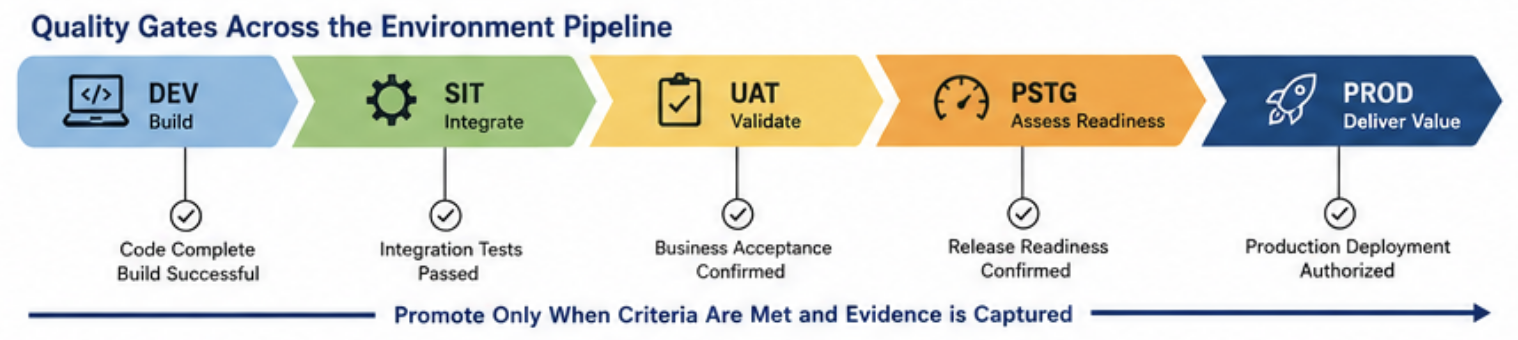

An effective environment model establishes a progression of controlled stages through which applications move as they mature. Each Environment Type represents a distinct level of readiness, with increasing expectations for quality, completeness, and operational integrity. This progression enables organizations to manage change deliberately rather than introducing it directly into production without sufficient validation.
Without a clearly defined and governed environment structure, organizations encounter predictable failure modes. Environments are created inconsistently, used interchangeably, or bypassed entirely. Teams rely on informal practices rather than standardized processes. Testing becomes unreliable, promotion decisions lack evidence, and production stability is compromised.
A well-defined environment model prevents these outcomes by establishing clear boundaries, responsibilities, and expectations at each stage of the delivery lifecycle. Environment Types and the Environment Instances that implement them function as quality gates, not convenience layers. They ensure that applications are evaluated systematically before progressing, and that changes are introduced into production only after meeting defined standards.
The Environment Pipeline
Enterprise IT operating environments form a pipeline - a defined, governed progression through which solutions, components, infrastructure changes, configurations, and data-related changes move from early exploration to live operational use. The pipeline is not a rigid conveyor belt that every solution must traverse in its entirety. Different solutions require different environment journeys based on their complexity, risk profile, regulatory exposure, technical architecture, user population, and organizational requirements.
A simple configuration change may require only a limited path through Development, Production Staging, and Production. A complex new application, integration, infrastructure platform, or enterprise capability may require a fuller progression across multiple Environment Types. The discipline is not in mandating the same path for every solution. The discipline is in defining the available Environment Types clearly, mapping Environment Instances to those types consistently, governing the criteria for moving between them, and ensuring that every promotion decision is made deliberately rather than by default.
The standard enterprise Environment Types, in general progression order from early-stage exploration to live business operation, are: Research (RES), Software Development (DEV), Engineering (ENG), Systems Integration Testing (SIT), User Acceptance Testing (UAT), Education and Training (EDU/TRN), Production Staging (PSTG), and Production (PROD). The practices that follow explain how these Environment Types should be defined, named, governed, instantiated, used, and improved.
These Environment Types should be understood as enterprise-level super-categories, not as a mandatory list of Environment Instances that every system must physically implement. A given system may require all of them, only some of them, or multiple Environment Instances that map to the same Environment Type. For example, one complex system may have multiple Production instances, multiple Development instances, or specialized Engineering instances, while a lower-risk system may have a smaller approved environment footprint. What matters is that each Environment Instance is known, owned, governed, and mapped to an approved Environment Type.
Environment Types below Production Staging are generally referred to as lower environments or non-Production environments. These include Research, Software Development, Engineering, Systems Integration Testing, User Acceptance Testing, and Education and Training. Production Staging and Production are generally referred to as upper Environment Types because they are closest to live operational use and therefore require stricter governance, access control, configuration control, data control, change control, and evidence requirements for the Environment Instances mapped to them.
Penetration Testing and Smoke Testing should not normally be treated as standard Environment Types. They are validation activities that may be performed against approved target Environment Instances under appropriate governance. Penetration Testing, in particular, must be formally authorized, scoped, monitored, evidenced, and controlled, regardless of whether it targets Production, Production Staging, a temporary isolated test environment, or another approved Environment Instance. Smoke Testing should similarly be treated as a validation activity performed after deployment or promotion, not as a separate environment category.
How to Use This Document
This document is organized as a set of best-practice guidance areas that can be read sequentially or used as a reference. Each best practice follows a consistent structure: an Overview that sets context, one or more Best Practice recommendations, and the Benefit(s) of following each recommendation. The document begins with foundational concepts and then moves through the governance, operational, technical, financial, lifecycle, and improvement disciplines needed to manage IT operating environments effectively.
How to cite this page
When referencing this page in academic work, internal standards, or external publications, include the page title, IF4IT as author and publisher (The International Foundation for Information Technology (IF4IT), LLC), the URL, and your access date.
Example (informal web citation):
The International Foundation for Information Technology (IF4IT), LLC. IT Operating Environments Best Practices. https://if4it.org/best-practices/it-operating-environments/overview/ (accessed 2026-09-20).
See About Us for content governance and site-wide citation guidance.
Copyright for The International Foundation for Information Technology (IF4IT), LLC: 2008 - Present
Legal Disclaimers