Production Staging (PSTG) - final validation in a near-Production configuration - IT Operating Environments Best Practices
Production Staging (PSTG) - final validation in a near-Production configuration
(Chapter 29 of IT Operating Environments Best Practices)
Executive Summary: Chapter Overview
IF4ITThe Bottom Line
Core Concepts
| Chapter Focus Area | Practical Governance Intent |
|---|---|
| Production Staging (PSTG) - final validation in a near-Production… | Establishes the governance expectation, operating discipline, or decision criteria needed to manage this aspect of IT operating environments consistently. |
| Controls and Accountability | Clarifies the ownership, evidence, access, lifecycle, risk, cost, or compliance practices needed to make the guidance enforceable and auditable. |
Quick Q&A
Question: Why does this chapter matter to Environment Management?
Read More Below
Overview
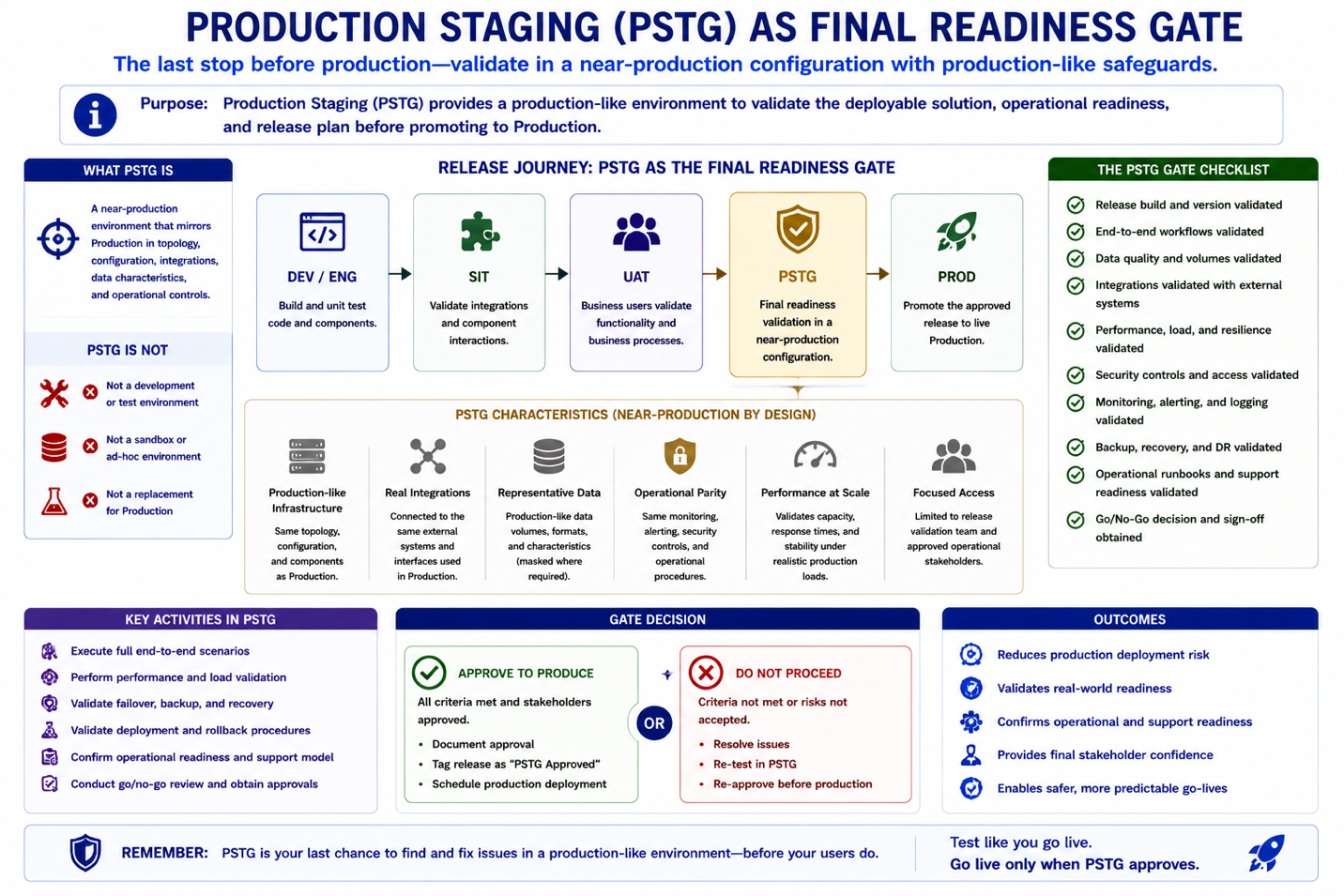
Production Staging is the last environment before Production and the first environment in the upper environment tier. PSTG serves a specific and critical purpose: to validate that the solution operates correctly in a configuration that is as close to Production as operationally achievable, including Production-equivalent infrastructure sizing, Production-equivalent network topology, Production-equivalent integration connections, and Production-equivalent operational tooling including monitoring, logging, and alerting. A solution that behaves correctly in lower environments but incorrectly in PSTG has an environment-specific problem that would have materialized as a Production incident if PSTG had not caught it. PSTG is the last line of defense before Production exposure.
Best Practice
Govern PSTG as the highest-fidelity Pre-Production environment in the enterprise pipeline, configured to match Production infrastructure, network, integration, and operational tooling to the greatest degree that is technically and financially feasible. The value of PSTG is directly proportional to its fidelity to Production: the more closely it mirrors Production, the more reliably it identifies environment-specific failures that lower environments cannot detect because they operate at a lower level of infrastructure fidelity.
PSTG is an upper environment and must be governed accordingly. Access controls in PSTG should be significantly more restrictive than in lower environments and should approximate the access model used in Production. Data governance in PSTG deserves particular care: while Production data should never be present in PSTG, the data used there should be representative of Production in structure, volume, and complexity, because many environment-specific failures manifest only under realistic data conditions. The gate artifact for promotion from PSTG to PROD should be the most comprehensive in the pipeline, incorporating the results of all final validation activities including operational readiness review, rollback plan confirmation, and explicit go/no-go authorization from the relevant governance authority.
Benefit(s)
A well-governed PSTG environment dramatically reduces the risk of Production deployment by providing a final validation opportunity in conditions that closely approximate the operational reality the solution will face in Production. Environment-specific failures - configuration incompatibilities, infrastructure scaling issues, integration behavior differences under Production-equivalent load - are caught in PSTG where they can be resolved without Production impact. The organization enters Production deployments with higher confidence because the solution has already demonstrated correct behavior in the environment that most closely resembles the one it is about to enter.
How to cite this page
When referencing this page in academic work, internal standards, or external publications, include the page title, IF4IT as author and publisher (The International Foundation for Information Technology (IF4IT), LLC), the URL, and your access date.
Example (informal web citation):
The International Foundation for Information Technology (IF4IT), LLC. Production Staging (PSTG) - final validation in a near-Production configuration | IT Operating Environments Best Practices. https://if4it.org/best-practices/it-operating-environments/production-staging-pstg-final-validation-in-a-near-production-configuration/ (accessed 2026-09-20).
See About Us for content governance and site-wide citation guidance.
Copyright for The International Foundation for Information Technology (IF4IT), LLC: 2008 - Present
Legal Disclaimers