Understand how Environment Management connects to Enterprise Inventory Management, Application Portfolio Management, Enterprise Architecture, and broader governance disciplines - IT Operating Environments Best Practices
Understand how Environment Management connects to Enterprise Inventory Management, Application Portfolio Management, Enterprise Architecture, and broader governance disciplines
(Chapter 5 of IT Operating Environments Best Practices)
Executive Summary: Chapter Overview
IF4ITThe Bottom Line
Core Concepts
| Chapter Focus Area | Practical Governance Intent |
|---|---|
| Understand how Environment Management connects to Enterprise Inve… | Establishes the governance expectation, operating discipline, or decision criteria needed to manage this aspect of IT operating environments consistently. |
| Controls and Accountability | Clarifies the ownership, evidence, access, lifecycle, risk, cost, or compliance practices needed to make the guidance enforceable and auditable. |
Quick Q&A
Question: Why does this chapter matter to Environment Management?
Read More Below
Overview
Environment Management does not operate as an isolated operational function. It is a core component of the enterprise’s broader inventory and architecture landscape. Every environment exists to support applications, and every application exists within a network of dependencies that include infrastructure, data, integrations, vendors, and people.
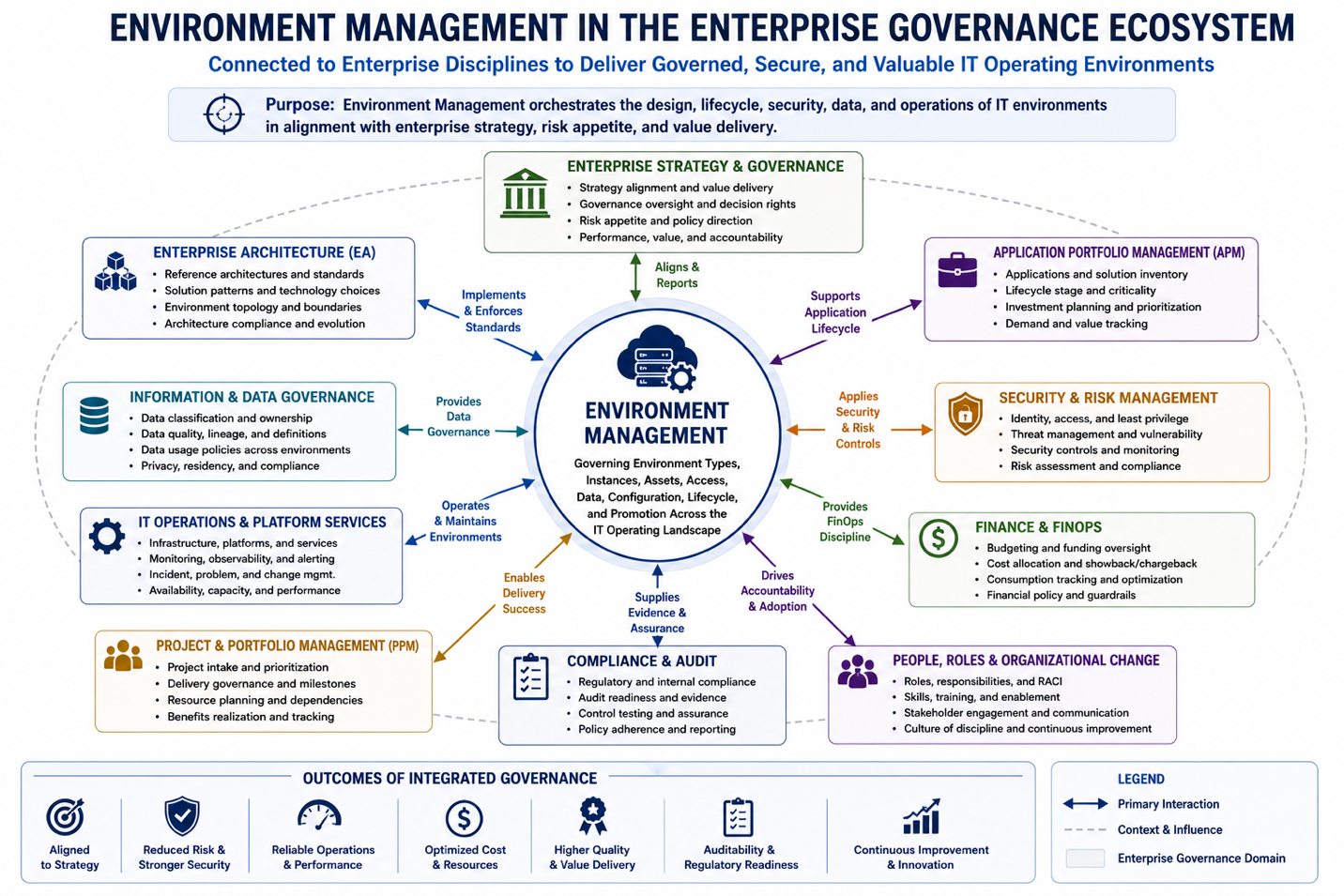
When environments are managed independently of these related domains, their value is limited. They are treated as technical constructs rather than as governed assets within the enterprise. This separation prevents organizations from understanding how environments relate to application behavior, data movement, operational risk, and cost.
When Environment Management is integrated with Enterprise Inventory Management, Application Portfolio Management (APM), and Enterprise Architecture (EA), environments become part of a connected enterprise model. In this model, environments are not standalone entities-they are nodes linked to the applications they host, the infrastructure they depend on, the data they expose, and the processes they support.
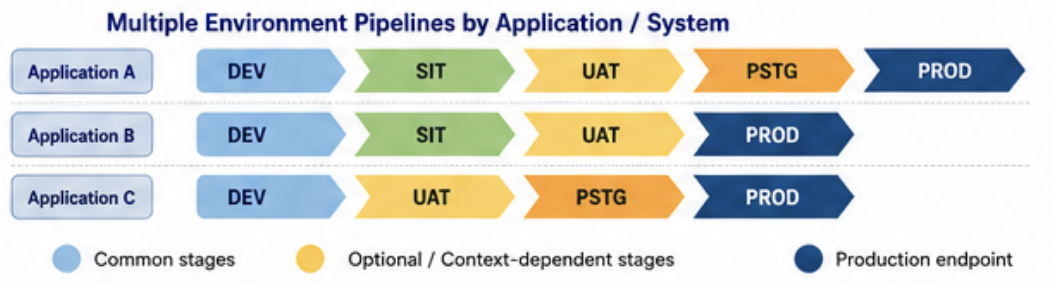
Within this integrated model, environment pipelines (e.g., DEV->UAT->PROD) for a specific solution or asset represent the dynamic pathways through which applications and their components move across environments. These pipelines define not only where an application resides at a point in time, but how it progresses through stages of build, validation, and release. As such, they form an essential part of the enterprise’s operational model, linking environment structure to application lifecycle, quality control, and delivery governance.
Best Practice
Position Environment Management as an integrated component of the Enterprise Model by treating environments as first-class inventory objects and explicitly defining their relationships to other enterprise inventories.
At a minimum, each Environment Instance should be connected to:
The applications deployed within it
The infrastructure and platforms that host it
The data assets it stores, processes, or exposes
The integrations and interfaces it participates in
The organizational units and roles responsible for its operation
These reified relationships are data assets and should be maintained as part of the enterprise’s inventory framework, not as isolated or informal references. Environment data should align with the same governance standards applied to applications, infrastructure, and data assets, including naming conventions, ownership definitions, lifecycle tracking, and access controls.
Environment Management should also align with APM by ensuring that each application’s lifecycle state is reflected in the environments it occupies, and with EA by ensuring that environment design supports enterprise standards for architecture, security, and operational resilience.
Benefit(s)
Integrating Environment Management into the Enterprise Model transforms environments from technical artifacts into sources of enterprise intelligence. Organizations gain visibility into how applications behave across environments, how data moves between them, and how dependencies introduce risk or cost.
This integrated view enables more accurate impact analysis. Changes to an application, infrastructure component, or data asset can be evaluated in terms of their effects across environments before they are implemented. Operational issues can be traced more quickly because the relationships between environments and other assets are explicitly defined.
Alignment with APM and EA ensures that environment decisions support broader enterprise objectives rather than local optimization. The result is a more coherent, governable, and scalable operating model in which environments contribute directly to informed decision-making, risk management, and strategic planning.
How to cite this page
When referencing this page in academic work, internal standards, or external publications, include the page title, IF4IT as author and publisher (The International Foundation for Information Technology (IF4IT), LLC), the URL, and your access date.
Example (informal web citation):
The International Foundation for Information Technology (IF4IT), LLC. Understand how Environment Management connects to Enterprise Inventory Management, Application Portfolio Management, Enterprise Architecture, and broader governance disciplines | IT Operating Environments Best Practices. https://if4it.org/best-practices/it-operating-environments/understand-how-environment-management-connects-to-enterprise-inventory-management-application-portfolio-management-enterprise-architecture-and-broader-governance-disciplines/ (accessed 2026-09-20).
See About Us for content governance and site-wide citation guidance.
Copyright for The International Foundation for Information Technology (IF4IT), LLC: 2008 - Present
Legal Disclaimers