Understand the lower environments and upper environments distinction - IT Operating Environments Best Practices
Understand the lower environments and upper environments distinction
(Chapter 16 of IT Operating Environments Best Practices)
Executive Summary: Chapter Overview
IF4ITThe Bottom Line
Core Concepts
| Chapter Focus Area | Practical Governance Intent |
|---|---|
| Understand the lower environments and upper environments distinction | Establishes the governance expectation, operating discipline, or decision criteria needed to manage this aspect of IT operating environments consistently. |
| Controls and Accountability | Clarifies the ownership, evidence, access, lifecycle, risk, cost, or compliance practices needed to make the guidance enforceable and auditable. |
Quick Q&A
Question: Why does this chapter matter to Environment Management?
Read More Below
Overview
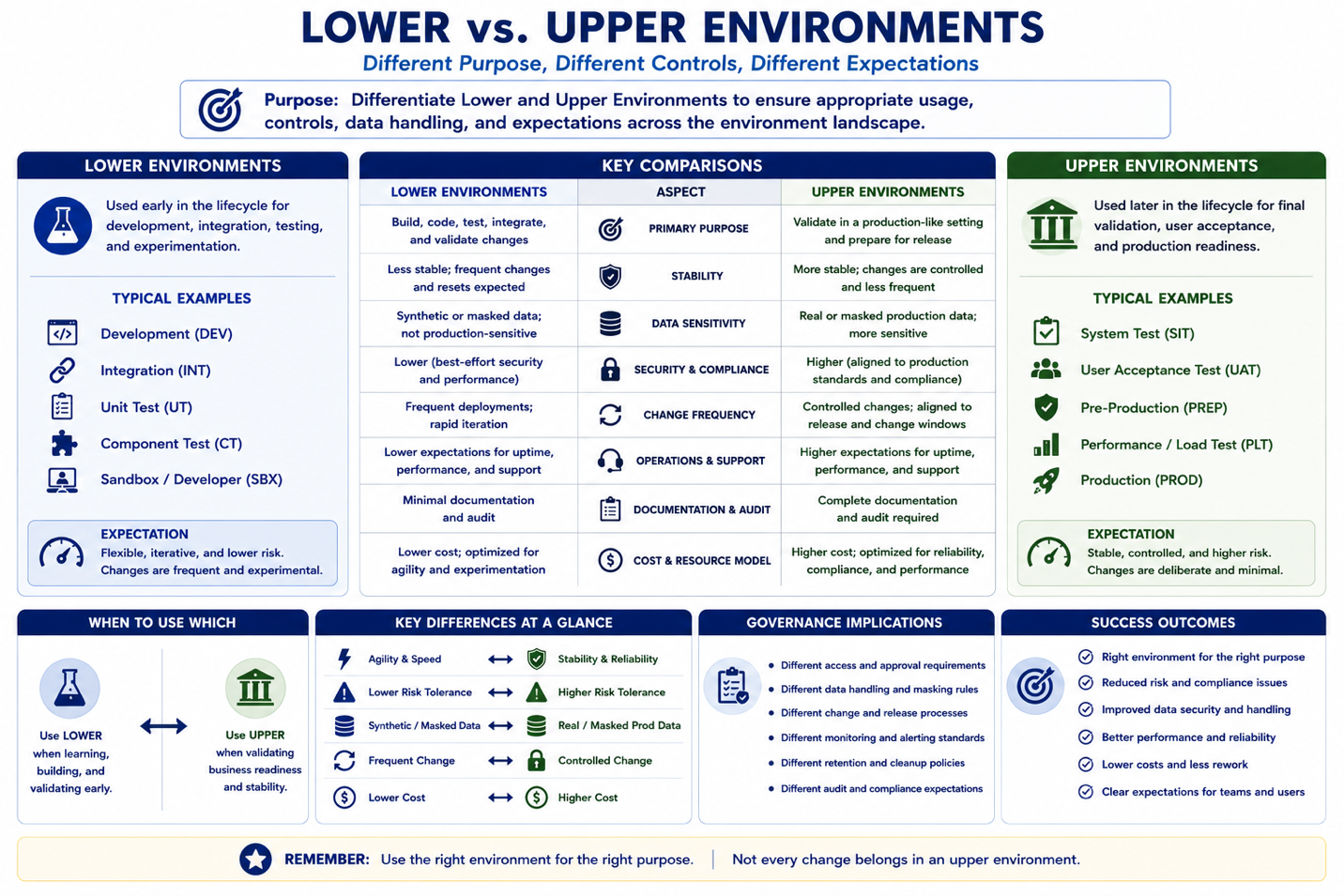
The terms lower environments and upper environments are widely used in software delivery organizations but rarely defined with the precision that governance requires. When the distinction is informal and undefined, teams apply it inconsistently, data governance obligations are unclear, and the risk profile of individual Environment Instances is not understood in the context of their position in the delivery pipeline. A formal distinction between lower and upper environments is not merely semantic - it defines fundamentally different governance obligations, access standards, data handling rules, and SLA commitments.
Best Practice
Define the lower environments and upper environments distinction formally and document it in the enterprise environment governance policy. Lower environments - also referred to as non-Production environments - include Research (RES), Software Development (DEV), Engineering (ENG), Systems Integration Testing (SIT), User Acceptance Testing (UAT), and Education and Training (EDU/TRN). Environment Instances mapped to these Environment Types are used for exploration, engineering, development, integration, testing, training, and other pre-Production activities. They are characterized by higher access permissiveness relative to Production, lower availability and performance commitments, and strict prohibitions on the presence of sensitive Production data unless a documented and approved exception exists. Upper environments encompass Production Staging (PSTG) and Production (PROD). These environments are closest to live operational use and therefore require the highest access restrictions, the most stringent availability and performance commitments, and the strongest data governance obligations.
Use the lower/upper distinction as a governance shorthand in policies, procedures, and communications, but ensure that every significant governance obligation is specified at the individual Environment Type or Environment Instance level rather than relying on the shorthand alone. The lower/upper distinction is a useful categorization, not a complete governance specification.
Benefit(s)
A formally defined lower/upper distinction gives teams a clear governance reference for data handling, access controls, and SLA obligations at every position in the delivery pipeline. Data governance communications become unambiguous - a policy that prohibits sensitive Production data in lower environments is immediately understood by every team. Access control designs are informed by a clear understanding of where in the pipeline an Environment Instance sits. The governance framework becomes more consistent and more enforceable because the fundamental categorization it depends on is explicit rather than assumed.
How to cite this page
When referencing this page in academic work, internal standards, or external publications, include the page title, IF4IT as author and publisher (The International Foundation for Information Technology (IF4IT), LLC), the URL, and your access date.
Example (informal web citation):
The International Foundation for Information Technology (IF4IT), LLC. Understand the lower environments and upper environments distinction | IT Operating Environments Best Practices. https://if4it.org/best-practices/it-operating-environments/understand-the-lower-environments-and-upper-environments-distinction/ (accessed 2026-09-20).
See About Us for content governance and site-wide citation guidance.
Copyright for The International Foundation for Information Technology (IF4IT), LLC: 2008 - Present
Legal Disclaimers