Use environment data to infer and enrich enterprise knowledge of operating locations, facilities, and geographic presence - IT Operating Environments Best Practices
Use environment data to infer and enrich enterprise knowledge of operating locations, facilities, and geographic presence
(Chapter 33 of IT Operating Environments Best Practices)
Executive Summary: Chapter Overview
IF4ITThe Bottom Line
Core Concepts
| Chapter Focus Area | Practical Governance Intent |
|---|---|
| Use environment data to infer and enrich enterprise knowledge of… | Establishes the governance expectation, operating discipline, or decision criteria needed to manage this aspect of IT operating environments consistently. |
| Controls and Accountability | Clarifies the ownership, evidence, access, lifecycle, risk, cost, or compliance practices needed to make the guidance enforceable and auditable. |
Quick Q&A
Question: Why does this chapter matter to Environment Management?
Read More Below
Overview
The Operating Environments Inventory does more than describe the technical characteristics of environments. When environment records are maintained with sufficient detail and connected to the broader Enterprise Model, they become a rich source of inferred organizational knowledge that extends well beyond IT governance. Every environment is deployed somewhere — in a specific data center, at a specific physical facility, in a specific city, region, and country. Every application and technology asset running in that environment inherits a set of physical location attributes through that association. An application running in a production environment deployed in a Frankfurt data center is, by inference, an application processing data in Germany — a fact with regulatory, tax, contractual, and operational implications that the application record itself may never explicitly state.
This inferential power is one of the most strategically valuable and most underappreciated capabilities of a well-governed Environments Inventory connected to the Enterprise Model. The Enterprise Model is not a collection of flat tables. It is a directed knowledge graph in which every inventory record is a node and every relationship between records is a typed edge with explicit governance meaning. The intelligence the Enterprise Model produces is not only what any single inventory knows about its own records — it is what the graph reveals when records are traversed from node to node through chains of explicitly typed relationships. Direct knowledge is what an inventory record states about itself. Inferred knowledge is what the record reveals through its connections. An environment record does not need to store a country attribute directly. It reveals the country through its relationship chain to an infrastructure record, which connects to a facility record, which connects to a location record.
Best Practice
Extend every Environment Instance record in the Operating Environments Inventory to include the physical location attributes of the environment’s deployment: the data center or facility in which the environment is hosted, the city or municipality, the state or province where applicable, the country, and the geographic region. For cloud-hosted environments, capture the cloud provider’s named region and availability zone. For colocation environments, capture the facility name and address. For on-premises environments, capture the facility name and address from the organization’s physical real estate or facilities inventory.
Connect the Operating Environments Inventory to the organization’s Data Center and Physical Facilities Inventory — or to the equivalent records in the Enterprise Model — through the same semantic identifier conventions used to connect all other Enterprise Model inventories. This connection makes the relationship between environments and physical facilities explicit, traversable, and governed rather than implicit and assumed.
The intelligence this connection chain produces operates through what the Enterprise Model calls Nth-degree relationship traversal — the ability to answer questions about any node in the Enterprise Model by following chains of explicitly typed relationships from one inventory record to the next. The relationship types that connect the nodes are as important as the nodes themselves. They are governed artifacts of the Enterprise Ontology rather than informal data associations, and they carry governance meaning that defines what traversals are valid and what inferences are trustworthy. Consider two concrete examples.
Example 1 - In a cloud-hosted context: Application A is Deployed To and Runs In Environment B, which is Deployed To and Runs In AWS Subnet C, which is Part Of VPC D, which is Located In AWS Region E. Each step is one degree of separation. The question “in which AWS region does Application A run?” requires traversal through four degrees and cannot be answered by looking at any single inventory record in isolation.
Example 2 - In an on-premises context: Application N is Deployed To and Runs In Environment O, which is Deployed To and Runs In Computing Server P, which is Installed In Rack Q, which is Located In Data Center R, which is Located In Location S — a specific city, region, and country. The question “in which country does Application N process data?” requires traversal through five degrees.
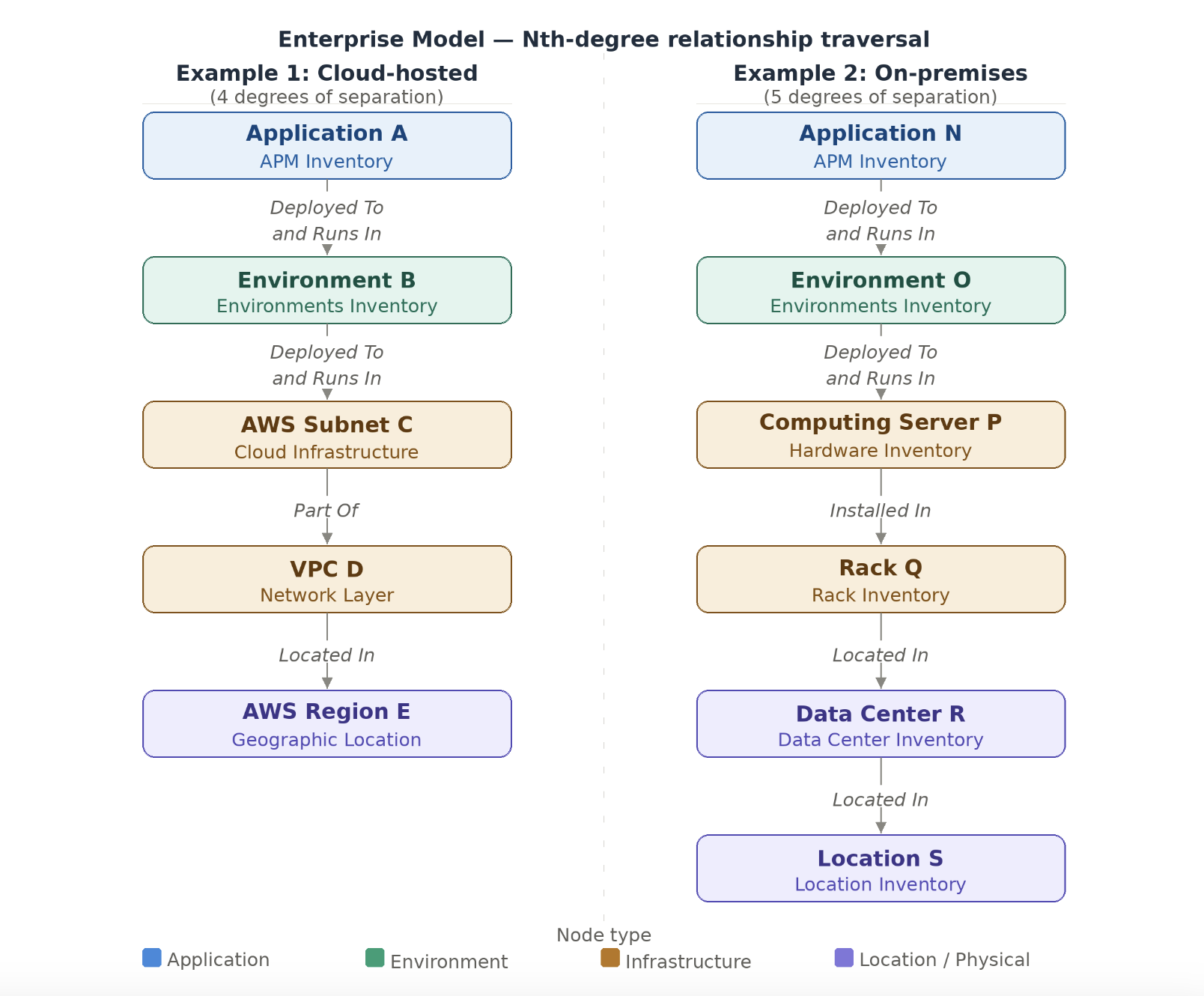
Neither question can be answered by looking at any single inventory record in isolation. Both are answered instantly when the relationship chain is governed and traversable in the Enterprise Model. The enterprise-definable relationship types — Deployed To and Runs In, Part Of, Installed In, Located In — are not incidental labels. They are the ontological vocabulary through which the Enterprise Model transforms a collection of governed inventories into an enterprise intelligence graph. Their full definition and governance are addressed in the IF4IT Enterprise Model and Modeling Best Practices document.
Use the environment-to-location connection to build and maintain an inventory of the organization’s IT operating locations — the countries, regions, cities, and specific facilities in which IT infrastructure is deployed and operational. This inventory is a natural byproduct of well-governed environment records and requires no separate data collection effort when environment records are current. It informs a broad set of downstream governance disciplines: data residency and sovereignty compliance, which requires knowing which countries data is processed in; business continuity and disaster recovery planning, which requires knowing which facilities host which environments and what the geographic relationships between primary and recovery sites are; real estate and facilities planning, which benefits from understanding which IT environments are co-located in which facilities and what the IT infrastructure demand on each facility is; and corporate regulatory and tax reporting, which in many jurisdictions requires disclosure of the countries in which the organization operates and processes data.
The Environments Inventory is most powerful when it is governed not as a standalone IT Operations artifact but as an integral part of the broader Enterprise Inventory Management effort — one node type in the Enterprise Model that connects to and enriches every other governed inventory the organization maintains. Its most consequential connections are to Application Portfolio Management (APM) and Technology Portfolio Management (TPM). In APM, every application record connects to the environments in which it is deployed, giving application governance its physical and operational context — where the application runs, what geographic footprint it creates, and what infrastructure dependencies it carries. In TPM, every technology in the Technologies Inventory is deployed and running in specific environments, giving technology governance its deployment concentration view — not only how many applications use a technology but in which environments, facilities, and geographic locations that technology is physically present. The IF4IT Application Portfolio Management (APM) Best Practices and Technology Portfolio Management (TPM) Best Practices documents address these connections from their respective perspectives. The Environments Inventory is the connective tissue that makes both disciplines physically real.
Benefit(s)
Connecting environment records to physical location and facility data — and governing the typed relationship chains that make traversal possible — transforms the Operating Environments Inventory from a purely technical governance artifact into a source of enterprise-level organizational intelligence. The organization gains an accurate, current picture of its IT operating footprint: where its infrastructure is deployed, what data is processed where, which physical facilities are operationally critical, and how logical IT assets connect to the physical and geographic world the organization operates in.
The inferential chains that Nth-degree relationship traversal enables produce knowledge that no single inventory could generate alone. A CIO asking “in which countries does our organization currently process customer data?” does not need a separate discovery project. The answer is traversable from the Environments Inventory through its facility and location connections, in the same governed data graph that IT governance already maintains for its own operational purposes. Questions that previously required manual investigation across multiple organizational functions — IT, legal, real estate, compliance — are answered through governed inference, automatically and continuously, as the underlying inventory records are kept current.
The connections to APM and TPM compound this value further. When the Environments Inventory is connected to the Applications Inventory and the Technologies Inventory within the Enterprise Model, the organization can answer questions that span all three disciplines simultaneously: which applications processing regulated data are running on deprecated technology platforms in facilities that fall outside the organization’s approved data residency footprint. That question traverses applications, environments, technologies, facilities, and locations in a single governed inference chain. It is the Enterprise Model’s most fundamental promise: that the discipline of governing individual inventories consistently, with typed relationships, produces organizational intelligence that compounds in value as the connection graph grows — and that no amount of siloed, disconnected inventory management can replicate.
How to cite this page
When referencing this page in academic work, internal standards, or external publications, include the page title, IF4IT as author and publisher (The International Foundation for Information Technology (IF4IT), LLC), the URL, and your access date.
Example (informal web citation):
The International Foundation for Information Technology (IF4IT), LLC. Use environment data to infer and enrich enterprise knowledge of operating locations, facilities, and geographic presence | IT Operating Environments Best Practices. https://if4it.org/best-practices/it-operating-environments/use-environment-data-to-infer-and-enrich-enterprise-knowledge-of-operating-locations-facilities-and-geographic-presence/ (accessed 2026-10-22).
See About Us for content governance and site-wide citation guidance.
Copyright for The International Foundation for Information Technology (IF4IT), LLC: 2008 - Present
Legal Disclaimers