User Acceptance Testing (UAT) - validating functional expectations with IT and business end users - IT Operating Environments Best Practices
User Acceptance Testing (UAT) - validating functional expectations with IT and business end users
(Chapter 26 of IT Operating Environments Best Practices)
Executive Summary: Chapter Overview
IF4ITThe Bottom Line
Core Concepts
| Chapter Focus Area | Practical Governance Intent |
|---|---|
| User Acceptance Testing (UAT) - validating functional expectation… | Establishes the governance expectation, operating discipline, or decision criteria needed to manage this aspect of IT operating environments consistently. |
| Controls and Accountability | Clarifies the ownership, evidence, access, lifecycle, risk, cost, or compliance practices needed to make the guidance enforceable and auditable. |
Quick Q&A
Question: Why does this chapter matter to Environment Management?
Read More Below
Overview
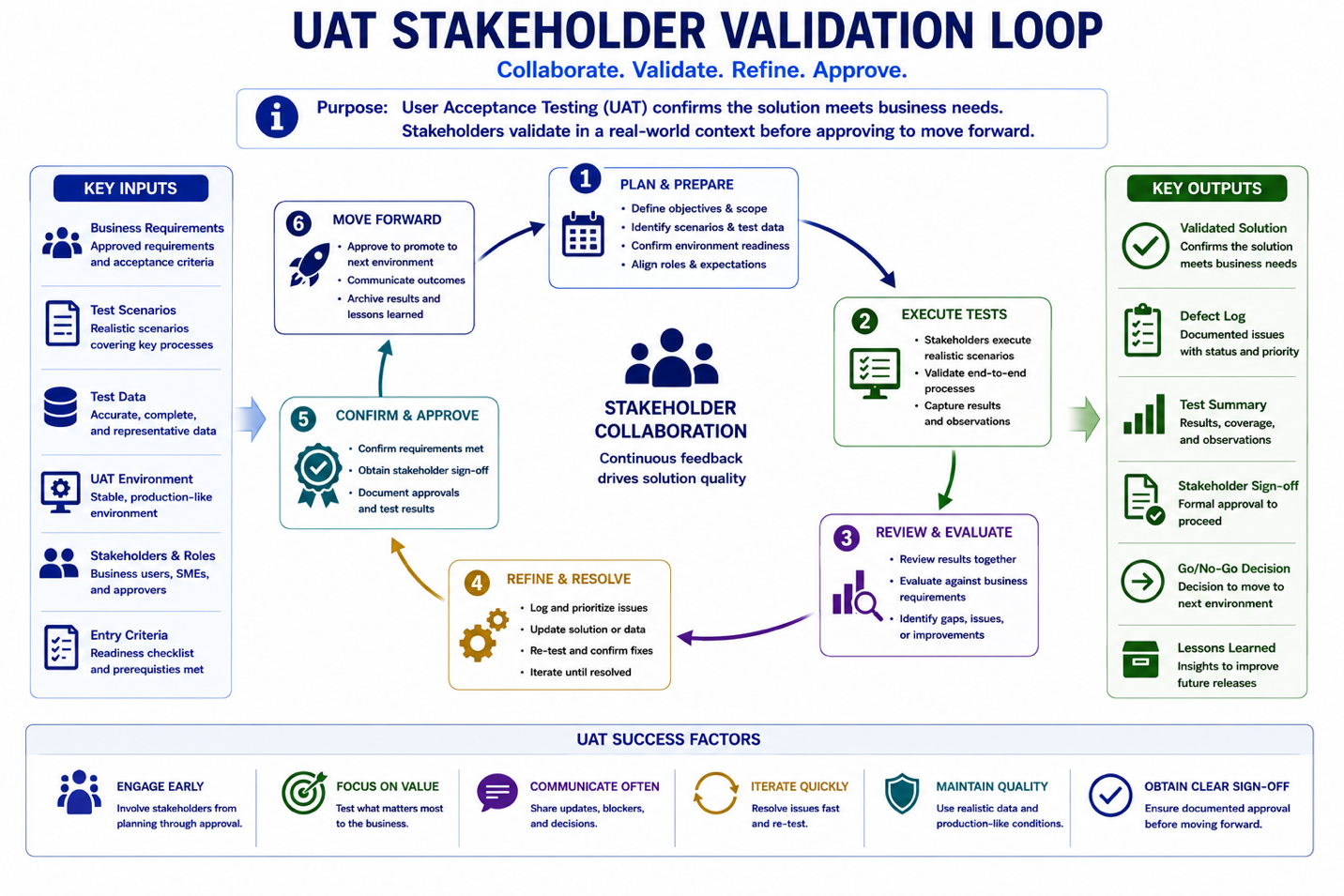
The User Acceptance Testing environment is where the intended users of the solution - both IT users and business users, depending on the solution’s scope - validate that the solution meets their functional expectations before it is promoted toward Production. UAT is the first environment in the pipeline where business stakeholders are active participants. Their involvement is not peripheral: UAT is specifically designed to answer the question that only end users can answer - does this solution do what we need it to do, in the way we need to do it? A solution that passes DEV and SIT testing but fails UAT has been built correctly but built wrong, and the earlier UAT finds this, the cheaper it is to correct.
Best Practice
Govern the UAT environment as the formal functional validation gate where end users confirm that the solution satisfies the acceptance criteria that define the conditions under which they will endorse its promotion to Production. UAT acceptance criteria should be defined before UAT testing begins - ideally before DEV begins - and should be specific, measurable, and agreed to by the business stakeholders who will be validating against them. The UAT environment should be configured to closely approximate the Production user experience: representative user interfaces, representative data volumes, representative integration behavior, and representative access controls for the user roles performing the testing.
Data governance in UAT deserves heightened attention. Because UAT tests functional behavior with realistic scenarios, the temptation to use Production data to create realistic test conditions is significant and should be firmly resisted. Production data - including PII, PCI, PHI, PFI, and any other sensitive data classification - must never be present in UAT without approved and governed exceptions. If UAT testing requires data that is representative of Production data in its structure and volume, use data masking, anonymization, or synthetic data generation to create that data. The UAT gate artifact for promotion should include documented evidence of acceptance test completion and explicit sign-off from the designated business and IT user representatives confirming acceptance.
Benefit(s)
A well-governed UAT environment catches the functional misalignments between what was built and what was needed that only end users can identify, before those misalignments are discovered in Production where correction is most disruptive and most expensive. Business stakeholders who participate meaningfully in UAT develop ownership of the solution before it reaches Production, improving adoption and reducing post-deployment support burden. The formal acceptance sign-off from UAT creates a clear organizational record of the business decision to promote the solution toward Production, establishing accountability for the promotion decision and protecting the technical team from disputes about functional requirements after Production deployment.
How to cite this page
When referencing this page in academic work, internal standards, or external publications, include the page title, IF4IT as author and publisher (The International Foundation for Information Technology (IF4IT), LLC), the URL, and your access date.
Example (informal web citation):
The International Foundation for Information Technology (IF4IT), LLC. User Acceptance Testing (UAT) - validating functional expectations with IT and business end users | IT Operating Environments Best Practices. https://if4it.org/best-practices/it-operating-environments/user-acceptance-testing-uat-validating-functional-expectations-with-it-and-business-end-users/ (accessed 2026-09-20).
See About Us for content governance and site-wide citation guidance.
Copyright for The International Foundation for Information Technology (IF4IT), LLC: 2008 - Present
Legal Disclaimers