Align Non-Functional Requirements (NFRs) with External Standards and Frameworks - Non-Functional Requirements (NFRs) Framework for Software Systems
Align Non-Functional Requirements (NFRs) with External Standards and Frameworks
(Chapter 46 of Non-Functional Requirements (NFRs) Framework for Software Systems)
Executive Summary: Chapter Overview
IF4ITThe Bottom Line
Core Concepts
| Concept | Definition & Strategic Role |
|---|---|
| Requirement Clarity | Makes the relevant NFR expectations explicit so they can influence architecture, backlog, testing, operations, and governance. |
| Validation and Evidence | Ensures the requirement can be proven through defined validation methods and credible evidence sources. |
| Governed Tailoring | Allows teams to adapt the framework to system context while preserving ownership, traceability, review, and approval discipline. |
Quick Q&A
Question: How should readers use this chapter?
Read More Below
Overview
External standards and frameworks help teams make NFRs more complete, defensible, and auditable. A team does not need to use every standard, but it should identify which quality models, architecture frameworks, security standards, privacy frameworks, accessibility standards, regulatory obligations, control frameworks, cloud frameworks, and internal enterprise standards apply to the system.
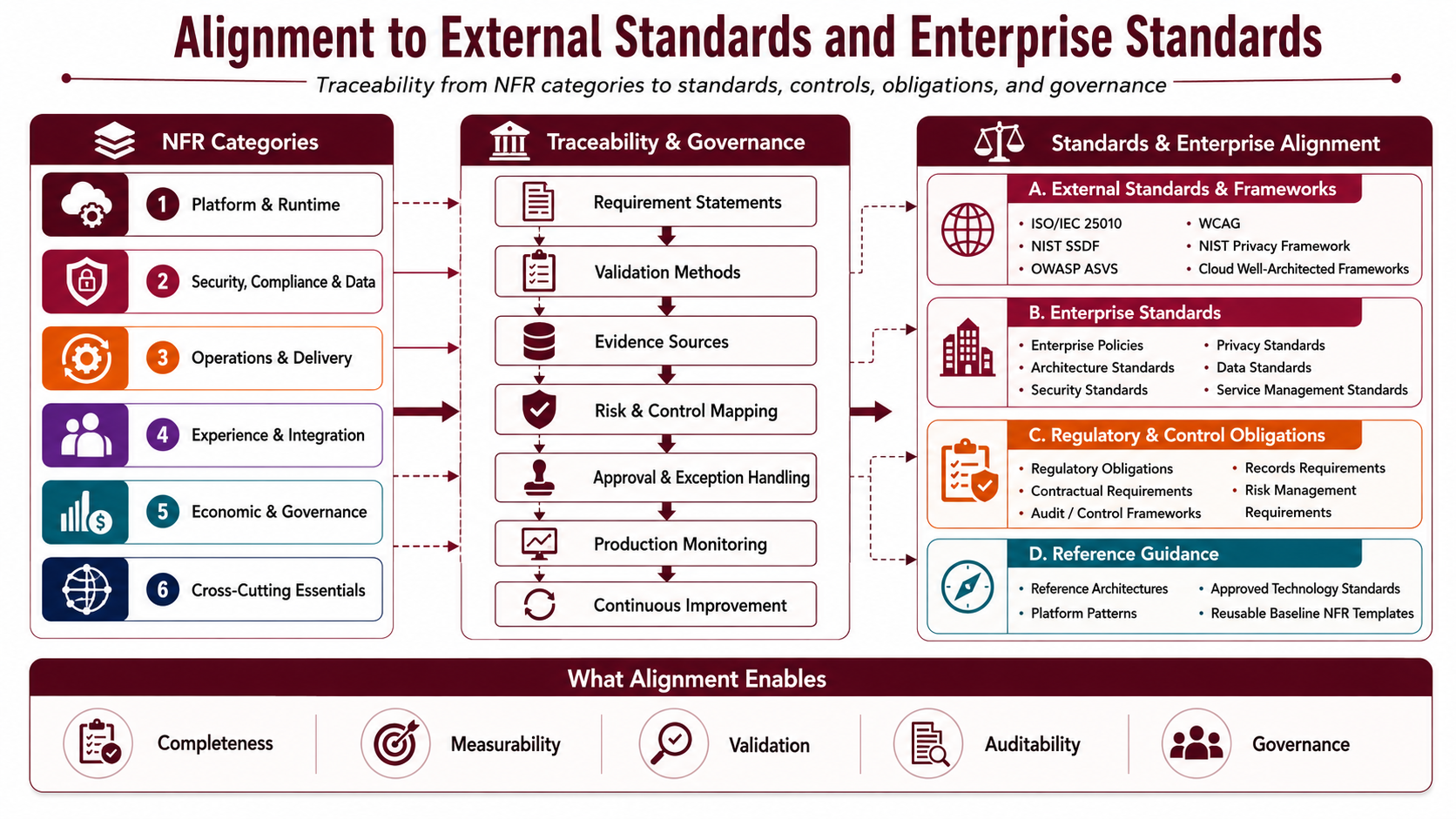
External quality models for non-functional requirements
Quality models help teams organize NFR thinking. They can be used to check whether important categories such as reliability, security, maintainability, usability, compatibility, portability, safety, and performance have been considered. Quality models should inform the NFR structure without replacing stakeholder judgment.
Cloud and architecture frameworks for non-functional requirements
Cloud and architecture frameworks can help teams identify NFRs related to operational excellence, security, reliability, performance efficiency, cost optimization, sustainability, workload design, and platform governance. These frameworks are especially useful when systems run on public cloud, hybrid, multi-cloud, or managed platforms.
Security, privacy, and software supply chain standards for non-functional requirements
Security, privacy, and software supply chain standards help teams define controls, validation methods, and evidence expectations. Examples include secure coding standards, application security verification standards, privacy frameworks, software supply chain frameworks, Software Bill of Materials (SBOM) expectations, and vulnerability management practices.
Responsible AI standards and governance frameworks for non-functional requirements
Responsible AI frameworks help teams identify NFRs for AI validity, reliability, safety, transparency, explainability, privacy, fairness, human oversight, model governance, drift monitoring, prompt governance, and retrieval-source governance. These frameworks are important when software systems include generative AI, machine learning, AI agents, or automated decision support.
Accessibility standards for non-functional requirements
Accessibility standards help teams define measurable user interface and content requirements. Accessibility alignment should identify the applicable standard, conformance level, validation approach, assistive technology coverage, exception process, remediation expectations, and evidence required for release readiness.
Regulatory, audit, and control frameworks for non-functional requirements
Regulatory, audit, and control frameworks can drive NFRs related to retention, privacy, security, reporting, traceability, audit logs, data integrity, business continuity, and evidence retention. Teams should map obligations to NFRs and avoid treating compliance as a generic statement without implementation and validation expectations.
Internal enterprise policies, standards, guidelines, and reference architectures for non-functional requirements
Internal standards and reference architectures translate enterprise expectations into reusable NFR patterns. They can define approved technologies, security controls, logging standards, cloud patterns, data classification rules, support expectations, release controls, and exception processes. NFRs should align with these internal sources unless an approved exception exists.
Traceability from non-functional requirements to external standards, controls, obligations, and evidence
Traceability shows why an NFR exists and what proof is needed. A standards-aligned NFR should reference the applicable standard, control, obligation, policy, or architecture pattern; define the requirement; identify validation; and point to evidence. This supports audits, architecture reviews, risk reviews, and future maintenance.
Standards alignment validation and evidence
Standards alignment should be validated through mapping reviews, control tests, architecture approvals, audit records, scan reports, conformance reports, exception records, and stakeholder signoff. AI can help identify candidate standards, but stakeholders must confirm what is actually required.
How to cite this page
When referencing this page in academic work, internal standards, or external publications, include the page title, IF4IT as author and publisher (The International Foundation for Information Technology (IF4IT), LLC), the URL, and your access date.
Example (informal web citation):
The International Foundation for Information Technology (IF4IT), LLC. Align Non-Functional Requirements (NFRs) with External Standards and Frameworks | Non-Functional Requirements (NFRs) Framework for Software Systems. https://if4it.org/best-practices/non-functional-requirements-nfrs-framework-for-software-systems/align-non-functional-requirements-nfrs-with-external-standards-and-frameworks/ (accessed 2026-10-05).
See About Us for content governance and site-wide citation guidance.
Copyright for The International Foundation for Information Technology (IF4IT), LLC: 2008 - Present
Legal Disclaimers