Non-Functional Requirements (NFRs) Framework for Software Systems - Best Practice: Consider Auditability and Traceability Non-Functional Requirements (NFRs)
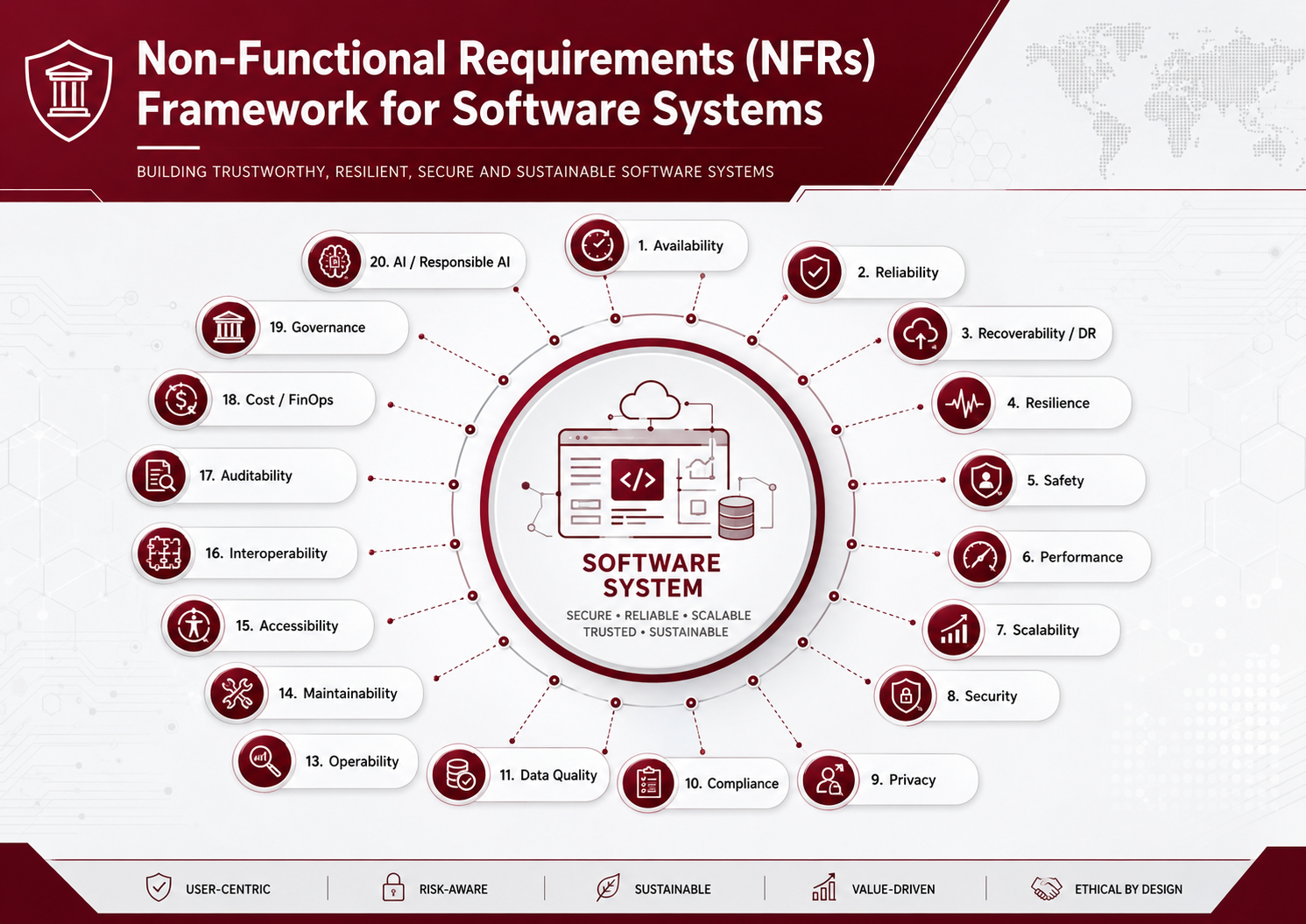
Non-Functional Requirements (NFRs) Framework for Software Systems
Chapter 35. Best Practice: Consider Auditability and Traceability Non-Functional Requirements (NFRs)
Executive Summary: Chapter Overview
IF4ITThe Bottom Line
Core Concepts
| Concept | Definition & Strategic Role |
|---|---|
| Auditability and Traceability Scope | Defines the specific quality, operating, control, and constraint expectations that must be considered for auditability and traceability in the software-system context. |
| Validation and Evidence | Connects each meaningful NFR to tests, reviews, scans, monitoring, operational exercises, approvals, or other evidence sources that prove whether the requirement is satisfied. |
| Stakeholder and Lifecycle Alignment | Clarifies when the requirement should be addressed and which product, architecture, engineering, security, operations, compliance, or governance stakeholders must participate. |
Quick Q&A
Question: How should teams apply Auditability and Traceability NFRs without turning the framework into a one-size-fits-all checklist?
Read More Below
Overview
Auditability and Traceability Non-Functional Requirements (NFRs) define how activities, transactions, decisions, approvals, data changes, requirements, controls, tests, validation methods, evidence, and operational events must be recorded, protected, correlated, retained, searched, and reviewed. These requirements help organizations prove what happened, who or what caused it, when it occurred, what data or system component was affected, and which requirement, control, risk, decision, or obligation it relates to.
Auditability and traceability are essential for regulated environments, high-risk workflows, security investigations, operational support, incident response, quality assurance, compliance reviews, and governance. They should be defined early because retrofitting audit trails, correlation identifiers, lineage, and evidence retention after implementation is expensive and frequently incomplete.
Best Practice: Define user activity audit non-functional requirements
Description
User activity audit NFRs define what user actions must be logged, how users are identified, what contextual information is captured, and how audit records are protected from unauthorized modification or deletion. They should distinguish ordinary usage telemetry from formal audit records that may be needed for compliance, investigation, or dispute resolution.
Benefits
Well-defined user activity audit requirements improve accountability, support incident investigation, deter misuse, and provide evidence for compliance and operational review.
Example non-functional requirements
- The system shall record all privileged administrative actions, including user identifier, role, action performed, affected object, timestamp, source location, and outcome.
Validation method: Validate through role-based test execution, audit log inspection, privileged access review, and security review of log protection controls.
Example validation evidence: Privileged action test results, sample audit log entries, access review record, log retention configuration, and security approval.
- The system shall prevent ordinary application users and administrators from modifying or deleting formal audit records outside approved retention and purge processes.
Validation method: Validate through access-control testing, configuration inspection, negative-path testing, and review of audit store permissions.
Example validation evidence: Access-control test results, permission review, negative test evidence, audit repository configuration, and approval record.
Related stakeholders
Typical stakeholders include security teams, audit teams, compliance stakeholders, application owners, product owners, operations teams, database administrators, and support teams.
Related lifecycle phases
User activity audit NFRs are defined during requirements and security design; implemented during application, identity, and logging development; validated during SIT, security testing, UAT, and production readiness; and reviewed during audits, investigations, and periodic access reviews.
Best Practice: Define transaction traceability non-functional requirements
Description
Transaction traceability NFRs define how business and technical transactions are correlated across screens, services, APIs, events, batch jobs, databases, and external systems. They often require correlation identifiers, trace identifiers, transaction statuses, source systems, destination systems, and reconciliation points.
Benefits
Transaction traceability improves troubleshooting, recovery, reconciliation, customer service, operational reporting, and root cause analysis across distributed systems.
Example non-functional requirements
- Each externally initiated business transaction shall include a unique correlation identifier that is propagated across all internal services, messages, logs, and downstream integrations.
Validation method: Validate through end-to-end integration testing, trace inspection, log review, and message payload review across representative workflows.
Example validation evidence: Integration test report, trace samples, correlated log extracts, message samples, and operations review signoff.
- The system shall provide a transaction status history for critical payment, order, eligibility, authorization, or fulfillment workflows.
Validation method: Validate through workflow testing, database inspection, UI/API verification, and reconciliation of event history against expected state transitions.
Example validation evidence: Workflow test evidence, status history samples, database query results, reconciliation report, and defect closure evidence.
Related stakeholders
Typical stakeholders include business process owners, integration architects, application teams, data teams, operations teams, service desk teams, QA teams, and audit stakeholders.
Related lifecycle phases
Transaction traceability NFRs are defined during workflow, data, and integration design; implemented during application and integration development; validated during SIT, UAT, reconciliation testing, and production readiness; and monitored during operations and incident response.
Best Practice: Define decision and approval traceability non-functional requirements
Description
Decision and approval traceability NFRs define how human and automated decisions, approvals, overrides, exceptions, and rejections are recorded and linked to the responsible actor, policy, rule, model, control, or workflow context. They are especially important for regulated decisions, financial approvals, access approvals, AI-assisted decisions, and exception handling.
Benefits
Decision traceability supports accountability, regulatory review, audit defense, quality review, dispute handling, and continuous improvement of decision logic.
Example non-functional requirements
- All workflow approvals shall retain approver identity, approval timestamp, decision outcome, approval context, and any required justification or comment.
Validation method: Validate through workflow execution testing, approval record inspection, role-permission review, and audit report review.
Example validation evidence: Approval workflow test results, sample approval records, role review evidence, audit report sample, and business owner signoff.
- Automated decisions that affect eligibility, access, payment, or customer outcome shall retain the rule version, model version, input reference, output, confidence or score where applicable, and human override record where applicable.
Validation method: Validate through decision engine testing, model/rule configuration review, audit trail inspection, and representative transaction replay.
Example validation evidence: Decision test report, rule/model version record, audit trail sample, replay evidence, and compliance review signoff.
Related stakeholders
Typical stakeholders include product owners, business process owners, compliance teams, legal teams, audit teams, data science teams, application teams, and operations teams.
Related lifecycle phases
Decision traceability NFRs are defined during process, rule, workflow, and AI governance design; implemented during workflow and decision-engine development; validated during SIT, UAT, audit testing, and compliance review; and monitored during production review and exception management.
Best Practice: Define requirement-to-design-to-test traceability non-functional requirements
Description
Requirement-to-design-to-test traceability NFRs define how NFRs are linked to architecture decisions, design artifacts, controls, implementation items, test cases, validation methods, evidence, defects, approvals, and operational monitoring. They help prove that NFRs were not only documented but actually implemented and validated.
Benefits
Traceability reduces missed requirements, improves audit readiness, supports impact analysis, and makes it easier to determine whether changes affect existing NFR commitments.
Example non-functional requirements
- Each approved NFR shall be linked to at least one design artifact, implementation work item, validation method, and evidence artifact before production release.
Validation method: Validate through traceability matrix review, requirements management inspection, backlog review, and release readiness checklist.
Example validation evidence: Traceability matrix, design references, backlog links, validation evidence links, release checklist, and approval record.
- NFR-related defects shall identify the affected NFR category, requirement identifier, validation failure, severity, owner, remediation decision, and retest evidence.
Validation method: Validate through defect workflow review, sample defect inspection, retest evidence review, and QA governance review.
Example validation evidence: Defect report samples, retest results, QA review notes, closure evidence, and release approval record.
Related stakeholders
Typical stakeholders include business analysts, product owners, architects, QA teams, test managers, release managers, compliance teams, audit stakeholders, and governance bodies.
Related lifecycle phases
Traceability NFRs are defined during planning and requirements management; maintained through design, development, testing, and release; validated during quality gates and audit review; and updated during change, remediation, and continuous improvement.
Best Practice: Define audit log retention and protection non-functional requirements
Description
Audit log retention and protection NFRs define how audit records are retained, archived, protected, searched, exported, purged, and made available for investigation, compliance, legal hold, or operational review. They should align with data retention, privacy, security, compliance, and records management expectations.
Benefits
Protected and retained audit logs help organizations reconstruct events, support investigations, satisfy regulatory obligations, and prove control effectiveness without exposing or over-retaining sensitive data.
Example non-functional requirements
- Formal audit records for regulated transactions shall be retained for the approved retention period and protected from unauthorized modification, deletion, or unapproved purge.
Validation method: Validate through retention configuration review, access-control testing, purge workflow testing, and records management review.
Example validation evidence: Retention policy mapping, configuration evidence, access test results, purge test evidence, and records management approval.
- Audit logs containing personal or sensitive data shall be protected using approved access controls, encryption, masking, and retention rules.
Validation method: Validate through log content inspection, security configuration review, privacy review, and access testing.
Example validation evidence: Log sample review, encryption configuration, access test results, privacy review notes, and approved retention mapping.
Related stakeholders
Typical stakeholders include security teams, privacy teams, compliance teams, records managers, audit teams, operations teams, platform teams, and application owners.
Related lifecycle phases
Audit log retention and protection NFRs are defined during security, privacy, and records design; implemented during logging and platform configuration; validated during security, compliance, and privacy testing; and reviewed during audits, investigations, and retention reviews.
Best Practice: Define auditability and traceability validation and evidence non-functional requirements
Description
Auditability and traceability validation NFRs define how audit trails, trace identifiers, decision records, evidence links, retention settings, and reporting capabilities are tested and proven. Validation should cover normal paths, exception paths, privileged actions, failures, and cross-system transactions.
Benefits
Explicit validation expectations make auditability repeatable and prevent teams from discovering missing audit evidence after incidents or compliance reviews.
Example non-functional requirements
- Each release shall validate at least one representative transaction path from user action through downstream integration, audit trail, trace record, and monitoring evidence.
Validation method: Validate through end-to-end test execution, trace correlation review, audit log inspection, and evidence package review.
Example validation evidence: End-to-end trace report, audit log samples, monitoring screenshot, validation checklist, and release signoff.
- Auditability validation evidence shall be retained with release evidence and linked to the related NFRs, controls, and test cases.
Validation method: Validate through release evidence repository review, traceability inspection, and governance checkpoint review.
Example validation evidence: Evidence repository export, NFR traceability links, test case references, governance review record, and approval signoff.
Related stakeholders
Typical stakeholders include QA teams, audit teams, compliance teams, security teams, release managers, product owners, operations teams, and architecture governance groups.
Related lifecycle phases
Auditability validation NFRs are defined during test planning and governance; validated during SIT, UAT, security testing, production readiness, and release review; and retained for audit, incident investigation, and future regression testing.
How to cite this page
When referencing this page in academic work, internal standards, or external publications, include the page title, IF4IT as author and publisher (The International Foundation for Information Technology (IF4IT), LLC), the URL, and your access date.
Example (informal web citation):
The International Foundation for Information Technology (IF4IT), LLC. Best Practice: Consider Auditability and Traceability Non-Functional Requirements (NFRs) | Non-Functional Requirements (NFRs) Framework for Software Systems. https://if4it.org/best-practices/non-functional-requirements-nfrs-framework-for-software-systems/best-practice-consider-auditability-and-traceability-non-functional-requirements-nfrs/ (accessed 2026-08-06).
See About Us for content governance and site-wide citation guidance.
Copyright for The International Foundation for Information Technology (IF4IT), LLC: 2008 - Present
Legal Disclaimers