Non-Functional Requirements (NFRs) Framework for Software Systems - Best Practice: Consider Safety Non-Functional Requirements (NFRs)
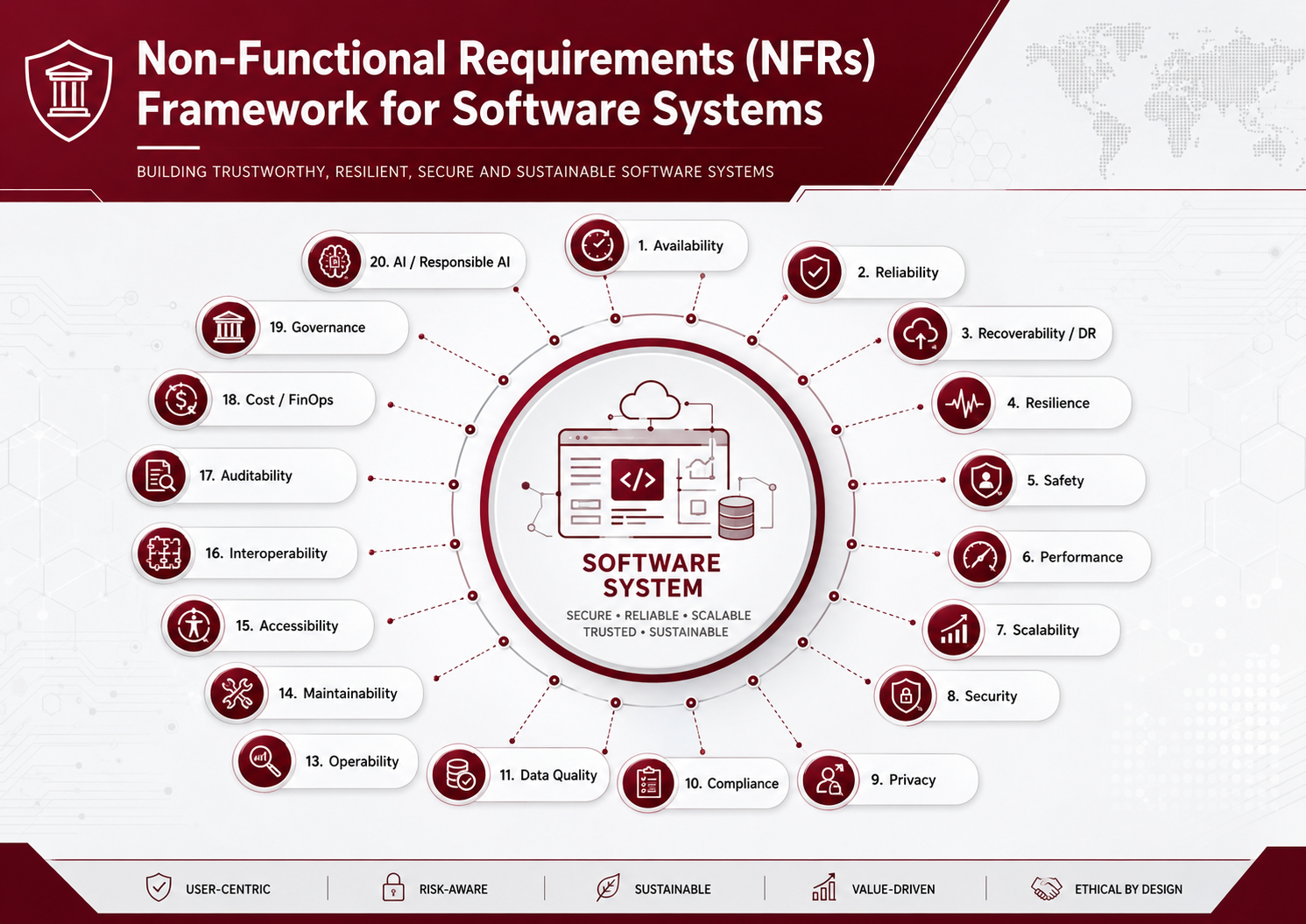
Non-Functional Requirements (NFRs) Framework for Software Systems
Chapter 15. Best Practice: Consider Safety Non-Functional Requirements (NFRs)
Executive Summary: Chapter Overview
IF4ITThe Bottom Line
Core Concepts
| Concept | Definition & Strategic Role |
|---|---|
| Safety Scope | Defines the specific quality, operating, control, and constraint expectations that must be considered for safety in the software-system context. |
| Validation and Evidence | Connects each meaningful NFR to tests, reviews, scans, monitoring, operational exercises, approvals, or other evidence sources that prove whether the requirement is satisfied. |
| Stakeholder and Lifecycle Alignment | Clarifies when the requirement should be addressed and which product, architecture, engineering, security, operations, compliance, or governance stakeholders must participate. |
Quick Q&A
Question: How should teams apply Safety NFRs without turning the framework into a one-size-fits-all checklist?
Read More Below
Overview
Safety Non-Functional Requirements (NFRs) define how a software system must avoid, prevent, detect, reduce, warn about, or recover from conditions that could create unacceptable harm. Safety concerns may involve people, property, regulated processes, physical environments, mission-critical services, financial outcomes, operational workflows, external systems, or business continuity.
Safety is related to security, reliability, resilience, and compliance, but it is not the same thing. A system may be secure and reliable yet still unsafe if it creates hazardous decisions, unsafe operating states, inadequate warnings, unsafe integrations, or uncontrolled actions. Safety NFRs should therefore be explicit, validated, evidenced, and approved by appropriate stakeholders.
Best Practice: Define safety risk and hazard identification non-functional requirements
Description
Safety risk and hazard identification NFRs define how teams identify, document, classify, evaluate, and review conditions that could create unacceptable harm. These requirements should clarify the hazardous scenarios that must be analyzed, the affected users or operations, the severity level, the likelihood, the mitigations, and the required approvals.
Benefits
Safety risk and hazard identification helps teams find harm-related risks before design, implementation, or release decisions make them harder to correct. It also creates traceability from hazards to controls, tests, approvals, operating procedures, and evidence.
Example non-functional requirements
- The software system shall maintain a documented safety hazard register for workflows where incorrect system behavior could create harm to users, operations, regulated processes, or mission-critical services.
Validation method: Validate through safety review by comparing critical workflows against the hazard register, mitigation records, and approval decisions.
Example validation evidence: Hazard register, workflow analysis, mitigation plan, safety review notes, risk acceptance records, and stakeholder approval.
- Each safety-critical workflow shall identify at least one owner responsible for reviewing hazards, approving mitigations, and accepting residual safety risk before production release.
Validation method: Validate through release readiness review and confirm that safety-critical workflows have named owners, documented approvals, and unresolved risk decisions.
Example validation evidence: Workflow inventory, owner assignment record, safety approval record, residual risk review, and release readiness checklist.
Related stakeholders
Typical stakeholders include product owners, business owners, safety officers, risk managers, compliance stakeholders, architects, engineers, QA teams, operations teams, legal stakeholders, and domain experts for the affected operating context.
Related lifecycle phases
Safety risk NFRs are defined during discovery, requirements, architecture, and risk analysis; validated during design review, test planning, specialized testing, release readiness, post-release monitoring, and periodic safety review.
Best Practice: Define operational constraint non-functional requirements
Description
Operational constraint NFRs define limits on when, where, how, by whom, or under what conditions a system capability may be used. These constraints may limit automation, require supervisory approval, restrict actions by location or state, enforce business rules, prevent unsafe sequencing, or block actions when required context is missing.
Benefits
Operational constraints prevent software from performing actions that may be technically possible but unsafe, inappropriate, unauthorized, or unacceptable in a specific business or operating context.
Example non-functional requirements
- The software system shall prevent automated approval of transactions above the approved safety threshold unless a qualified human reviewer explicitly approves the transaction.
Validation method: Validate through workflow testing using transactions below, at, and above the threshold and verify that the required human approval is enforced.
Example validation evidence: Workflow test report, threshold configuration, approval logs, rejected automation attempt records, and business owner approval.
- The system shall disable field-action recommendations when required operational context, location data, or safety status data is missing or stale beyond the approved threshold.
Validation method: Validate by simulating missing and stale context data and verifying that recommendations are blocked, warnings are displayed, and operators are alerted.
Example validation evidence: Simulation results, context data logs, warning screenshots, alert records, and safety review approval.
Related stakeholders
Typical stakeholders include business process owners, operations leaders, compliance teams, risk managers, safety stakeholders, architects, developers, QA teams, and user experience designers.
Related lifecycle phases
Operational constraint NFRs are defined during process design, requirements, architecture, and UX design; validated during workflow testing, user acceptance testing, exception testing, safety review, and production monitoring.
Best Practice: Define fail-safe behavior non-functional requirements
Description
Fail-safe behavior NFRs define the safer state or action a system must choose when an error, exception, missing dependency, abnormal signal, suspicious input, or uncertain condition occurs. These requirements should clarify what is stopped, what continues, what is isolated, what is rolled back, what is queued, what is escalated, and how users and operators are informed.
Benefits
Fail-safe behavior prevents uncertain or abnormal system states from escalating into harm. It also gives teams a safer default pattern for unexpected conditions and improves confidence during failure, recovery, and audit review.
Example non-functional requirements
- If the system cannot verify that a required safety rule has been applied, it shall block the affected transaction and route it to manual review rather than completing the transaction automatically.
Validation method: Validate through rule-engine failure testing and verify blocked transaction behavior, manual review routing, notification, and audit logging.
Example validation evidence: Rule failure test report, blocked transaction record, manual review queue evidence, notification evidence, and audit log sample.
- If sensor or operational status input is outside the approved range or cannot be trusted, the software system shall enter a safe state and prevent automated downstream action until status is verified.
Validation method: Validate through abnormal input simulation, stale input simulation, and safe-state verification in a controlled test environment.
Example validation evidence: Simulation test results, safe-state transition logs, downstream action prevention evidence, operator alert records, and safety signoff.
Related stakeholders
Typical stakeholders include safety stakeholders, operations teams, architects, engineers, QA teams, business process owners, risk stakeholders, compliance teams, and support teams.
Related lifecycle phases
Fail-safe NFRs are defined during requirements, architecture, data-flow design, and exception design; validated during failure testing, simulation testing, integration testing, user acceptance testing, release readiness, and operational drills.
Best Practice: Define hazard warning and user notification non-functional requirements
Description
Hazard warning and user notification NFRs define how the system informs users, operators, administrators, or dependent systems when a hazardous condition, unsafe state, blocked action, degraded condition, or required intervention occurs. These requirements should clarify message timing, channel, severity, content, recipient, accessibility, logging, and escalation behavior.
Benefits
Warnings and notifications reduce the risk that hazardous conditions remain hidden or misunderstood. They also help users and operators take timely corrective action and create evidence that safety-related events were detected and communicated.
Example non-functional requirements
- The system shall display a clear, accessible warning to the user when a requested action cannot be completed because required safety conditions are not satisfied.
Validation method: Validate through workflow tests for blocked safety conditions and review warning clarity, timing, accessibility, and logging.
Example validation evidence: Workflow test results, warning screenshots, accessibility test evidence, event logs, and product owner approval.
- Safety-critical alerts shall be routed to the responsible operations team within one minute of detection and shall remain visible until acknowledged or escalated according to the approved escalation rule.
Validation method: Validate through alert simulation and verify delivery time, recipient routing, acknowledgement behavior, escalation behavior, and event history.
Example validation evidence: Alert simulation report, notification delivery logs, acknowledgement records, escalation records, and operations review approval.
Related stakeholders
Typical stakeholders include user experience teams, operations teams, support teams, safety stakeholders, product owners, accessibility reviewers, developers, QA teams, and communications stakeholders.
Related lifecycle phases
Warning and notification NFRs are defined during requirements, UX design, operations design, and support planning; validated during workflow testing, accessibility testing, alert testing, user acceptance testing, and operational readiness review.
Best Practice: Define safe integration non-functional requirements
Description
Safe integration NFRs define how a system interacts with other systems, devices, data sources, workflows, APIs, AI tools, physical processes, or operational platforms without creating unacceptable safety risk. These requirements should address contract validation, data validation, sequencing, stale data, command authorization, dependency trust, and fallback behavior.
Benefits
Safe integration requirements reduce the risk that one system introduces unsafe data, commands, decisions, or timing into another system. They also help teams validate safety risks across system boundaries rather than only within a single application.
Example non-functional requirements
- The software system shall validate safety-critical inbound messages against the approved schema, source, timestamp, and authorization rules before allowing downstream processing.
Validation method: Validate through integration tests using valid, invalid, unauthorized, stale, and malformed messages and verify rejection, logging, alerting, and safe handling.
Example validation evidence: Integration test report, schema validation logs, authorization records, rejected message samples, alert evidence, and architecture approval.
- The system shall not send automated control instructions to an external operational platform unless the target state, command authorization, and current operating context have been validated.
Validation method: Validate through command-flow simulation and verify that invalid context, unauthorized commands, and unsafe target states are blocked.
Example validation evidence: Command simulation results, blocked command logs, authorization review, operating context evidence, and safety review signoff.
Related stakeholders
Typical stakeholders include integration architects, solution architects, operations teams, safety stakeholders, data owners, platform owners, API owners, developers, QA teams, and external system owners.
Related lifecycle phases
Safe integration NFRs are defined during architecture, integration design, data design, and vendor/platform design; validated during contract testing, integration testing, simulation testing, release readiness, and production monitoring.
Best Practice: Define safety validation and evidence non-functional requirements
Description
Safety validation and evidence NFRs define how safety-related requirements are proven, reviewed, approved, retained, and monitored. Safety validation may include hazard analysis, simulation, manual review, exception testing, integration testing, audit review, operational drills, production monitoring, and formal approval.
Benefits
Safety validation makes safety claims defensible. It also prevents teams from relying only on intent, design assumptions, or untested controls when safety-related decisions require evidence.
Example non-functional requirements
- Each safety-critical NFR shall include a documented validation method, validation environment, validation owner, evidence source, and approval stakeholder before production release.
Validation method: Validate through requirements and release readiness review, confirming that required validation attributes and evidence are complete for every safety-critical NFR.
Example validation evidence: Safety NFR traceability matrix, validation plan, evidence repository, release readiness checklist, and approval record.
- Safety validation evidence shall be retained for each production release that changes a safety-critical workflow, integration, rule, AI model, automation, or operating constraint.
Validation method: Validate by sampling release records and confirming that safety validation evidence maps to changed safety-critical items.
Example validation evidence: Release record, change impact analysis, safety test evidence, approval record, evidence retention record, and audit sampling results.
Related stakeholders
Typical stakeholders include safety stakeholders, risk managers, compliance stakeholders, product owners, architects, QA teams, operations teams, legal stakeholders, and audit stakeholders.
Related lifecycle phases
Safety validation NFRs are defined during requirements and test planning; validated during specialized testing, user acceptance testing, operational readiness, release approval, production monitoring, incident review, and audit review.
How to cite this page
When referencing this page in academic work, internal standards, or external publications, include the page title, IF4IT as author and publisher (The International Foundation for Information Technology (IF4IT), LLC), the URL, and your access date.
Example (informal web citation):
The International Foundation for Information Technology (IF4IT), LLC. Best Practice: Consider Safety Non-Functional Requirements (NFRs) | Non-Functional Requirements (NFRs) Framework for Software Systems. https://if4it.org/best-practices/non-functional-requirements-nfrs-framework-for-software-systems/best-practice-consider-safety-non-functional-requirements-nfrs/ (accessed 2026-08-12).
See About Us for content governance and site-wide citation guidance.
Copyright for The International Foundation for Information Technology (IF4IT), LLC: 2008 - Present
Legal Disclaimers