Non-Functional Requirements (NFRs) Across Software Development Lifecycle (SDLC) Phases - Non-Functional Requirements (NFRs) Framework for Software Systems
Non-Functional Requirements (NFRs) Across Software Development Lifecycle (SDLC) Phases
(Chapter 40 of Non-Functional Requirements (NFRs) Framework for Software Systems)
Executive Summary: Chapter Overview
IF4ITThe Bottom Line
Core Concepts
| Concept | Definition & Strategic Role |
|---|---|
| Requirement Clarity | Makes the relevant NFR expectations explicit so they can influence architecture, backlog, testing, operations, and governance. |
| Validation and Evidence | Ensures the requirement can be proven through defined validation methods and credible evidence sources. |
| Governed Tailoring | Allows teams to adapt the framework to system context while preserving ownership, traceability, review, and approval discipline. |
Quick Q&A
Question: How should readers use this chapter?
Read More Below
Overview
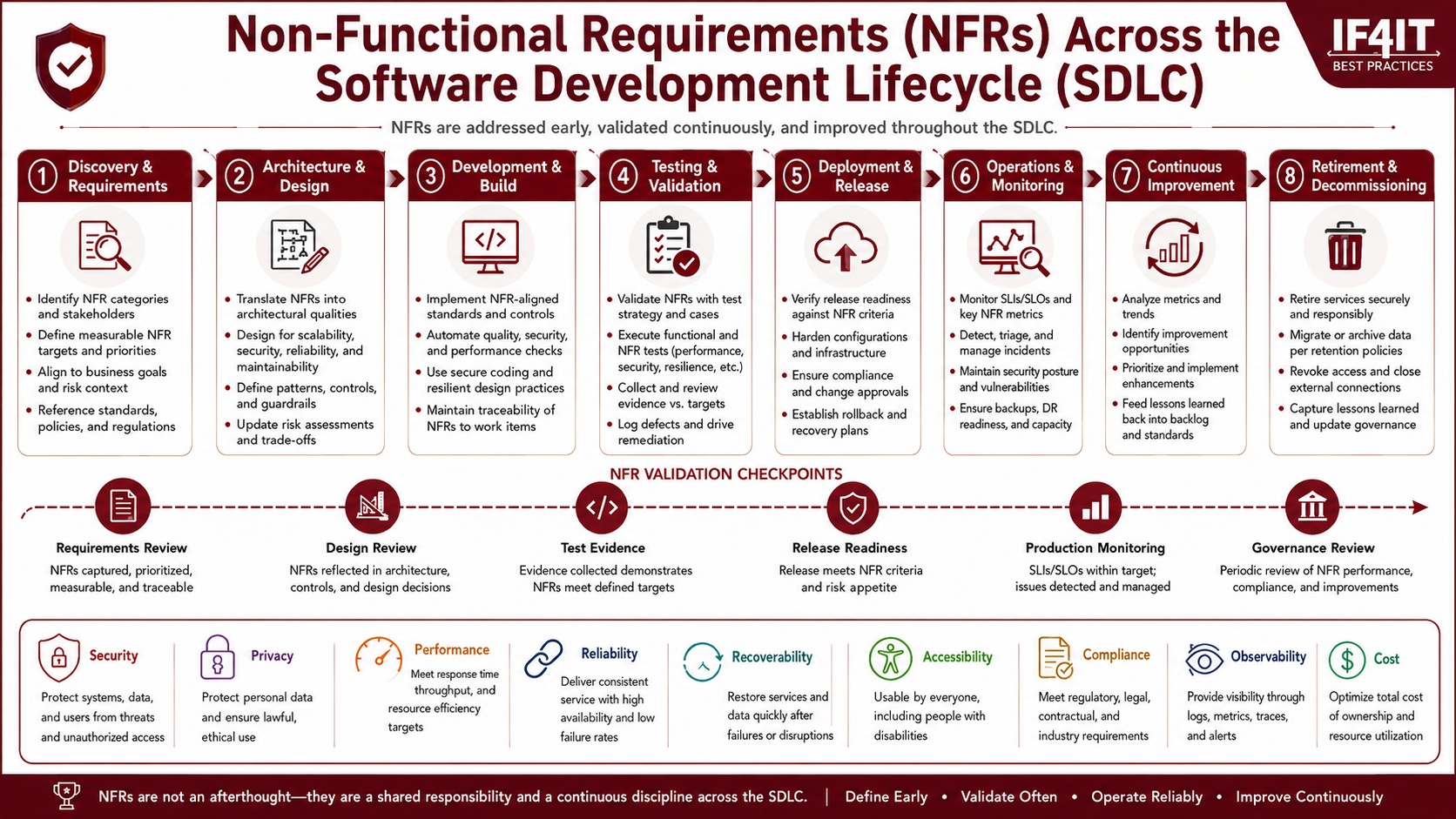
Non-Functional Requirements (NFRs) should be addressed across the full Software Development Lifecycle (SDLC), not only during requirements definition or late-stage testing. Each SDLC phase gives teams a different opportunity to identify, refine, design, implement, validate, operate, and improve NFRs. Early phases establish intent and measurable targets; middle phases turn those targets into architecture, code, configuration, controls, and test plans; later phases prove, monitor, govern, and improve the results.
The practical goal is traceability. A strong NFR can be traced from business need or risk, to requirement statement, design decision, implementation artifact, validation method, evidence source, approval, production signal, and improvement action. This traceability allows teams to prove that NFRs were not merely written but were actually considered, implemented, validated, and governed.
Discovery and requirements definition
During discovery and requirements definition, stakeholders should identify the NFR categories that apply to the system, the business outcomes that depend on them, and the risks created if they are missed. This phase should produce candidate NFRs, measurable targets, assumptions, open questions, responsible owners, validation expectations, and initial evidence expectations.
Example activities: review the solution context, identify critical users and business processes, capture availability, recovery, security, privacy, performance, accessibility, compliance, data, cost, and operational expectations, and flag unresolved stakeholder questions.
Validation focus: confirm that each material NFR has an owner, rationale, measurable target where practical, acceptance criteria, validation method, expected evidence, and lifecycle phase for validation.
Example evidence: stakeholder workshop notes, approved requirement records, traceability matrix, risk register entries, open question log, and early NFR checklist.
Architecture and design
During architecture and design, NFRs should be translated into architecture decisions, design constraints, technology choices, integration patterns, deployment models, data-handling rules, control designs, and operational patterns. Design reviews should explicitly test whether the architecture can satisfy the NFRs and whether any NFRs require exceptions or tradeoff decisions.
Example activities: map NFRs to architecture views, deployment diagrams, data flows, integration contracts, threat models, privacy reviews, recovery patterns, observability designs, and platform constraints.
Validation focus: confirm that the design includes the mechanisms needed to satisfy each NFR, such as redundancy, encryption, logging, backup, throttling, validation rules, monitoring, access controls, accessibility patterns, and release controls.
Example evidence: architecture review record, Architecture Decision Records (ADRs), threat model, data-flow diagram, recovery design, monitoring design, standards mapping, and approved exceptions.
Development and build
During development and build, NFRs are implemented through code, configuration, infrastructure definitions, pipelines, controls, telemetry, tests, and documentation. NFRs should be treated as development work, not as after-the-fact quality checks. Teams should implement the features and supporting mechanisms needed to satisfy the NFRs before the system reaches production readiness review.
Example activities: implement logging, metrics, validation rules, retries, timeouts, access controls, secrets management, feature flags, error handling, configuration controls, accessibility markup, and automated checks in Continuous Integration / Continuous Delivery (CI/CD) pipelines.
Validation focus: confirm through code review, static analysis, unit tests, configuration review, pipeline checks, and build evidence that the required NFR mechanisms exist and are working as intended.
Example evidence: pull request approvals, static analysis results, unit test results, CI/CD logs, infrastructure-as-code scan results, dependency scan reports, and implementation traceability links.
Unit and module testing
Unit and module testing should validate NFR-related behavior at the smallest practical level. This includes error handling, boundary conditions, validation logic, data transformation integrity, logging behavior, timeout handling, configuration behavior, accessibility helper components, security helper functions, and other local mechanisms that contribute to NFR satisfaction.
Validation focus: prove that local components behave predictably under normal, boundary, error, and exception conditions.
Example evidence: automated unit test results, code coverage summary, test case links, failure-condition tests, logging tests, and peer review records.
Systems Integration Testing (SIT)
Systems Integration Testing (SIT) should validate NFRs that depend on interactions between systems, services, data stores, queues, APIs, networks, identity providers, platforms, and third-party services. Many NFR failures are not visible inside a single component; they appear when multiple components must work together under realistic integration conditions.
Validation focus: validate integration reliability, data integrity, retry and timeout behavior, service contracts, API performance, security handoffs, audit trails, observability correlation, and error propagation across systems.
Example evidence: SIT test results, integration trace logs, API contract test results, data reconciliation reports, interface error reports, end-to-end monitoring traces, and defect remediation records.
User Acceptance Testing (UAT)
User Acceptance Testing (UAT) should validate user-facing and business-facing NFRs in representative business workflows. UAT should not be limited to functional correctness. Users and business stakeholders should be asked to validate usability, accessibility, workflow efficiency, error clarity, data quality, timing expectations, operational fit, and evidence needed for business acceptance.
Validation focus: confirm that the system is acceptable to business users under realistic workflows, roles, data scenarios, and acceptance conditions.
Example evidence: UAT signoff, business acceptance records, user feedback, accessibility findings, usability findings, workflow timing results, and approved residual issues.
Performance testing
Performance testing should validate response time, latency, throughput, concurrency, batch duration, resource consumption, scaling behavior, and performance under expected, peak, stress, and endurance conditions. Performance NFRs should be tied to defined workload profiles, measurement windows, test data, environments, Service Level Indicators (SLIs), Service Level Objectives (SLOs), and acceptance thresholds.
Validation focus: prove that performance targets are satisfied under approved workload assumptions and that performance risks are understood when assumptions change.
Example evidence: performance test plan, load model, test results, percentile latency dashboard, resource utilization report, bottleneck analysis, tuning records, and approval of residual risks.
Security and penetration testing
Security and penetration testing should validate security NFRs through automated scans, manual review, threat-informed testing, abuse-case testing, penetration testing, configuration review, identity and access testing, secrets review, vulnerability remediation, and exception governance. Security validation should also include AI-enabled attack surfaces and software supply chain controls when they apply.
Validation focus: confirm that security controls are implemented, exploitable weaknesses are remediated or accepted, and residual risks are visible to accountable stakeholders.
Example evidence: penetration test report, vulnerability scan report, static and dynamic application security testing results, secrets scan, access review, remediation evidence, and risk acceptance records.
Accessibility testing
Accessibility testing should validate that user interfaces, documents, portals, dashboards, forms, workflows, and generated content meet the approved accessibility standard and conformance target. Automated scans are useful but are not sufficient by themselves; manual testing and assistive technology coverage are often required to prove accessibility NFRs.
Validation focus: confirm that the system is perceivable, operable, understandable, and robust for users with disabilities and for assistive technologies.
Example evidence: Web Content Accessibility Guidelines (WCAG) checklist, automated scan results, keyboard-only test results, screen reader test notes, color contrast report, issue remediation record, and accessibility approval.
Software supply chain validation
Software supply chain validation should prove that source code, dependencies, build pipelines, artifacts, containers, Infrastructure as Code (IaC), deployment packages, vendor software, and release processes are controlled and traceable. These activities should be integrated into development, build, release, and governance workflows rather than treated as optional security checks.
Validation focus: validate dependency risk, open-source component status, Software Bill of Materials (SBOM) completeness, artifact provenance, artifact signing, build integrity, vulnerability remediation, and release approval.
Example evidence: SBOM, software composition analysis report, signed artifact record, provenance attestation, container image scan, IaC scan, dependency exception record, and release approval evidence.
Staging, production deployment, and smoke testing
Staging and production deployment phases should validate that the system is deployable, configurable, observable, secure, recoverable, and ready to operate in its target runtime environment. Smoke testing should confirm that critical functions, integrations, access paths, monitoring signals, and rollback expectations work after deployment.
Validation focus: confirm that production-like configuration, deployment automation, secrets, connectivity, health checks, monitoring, alerts, and smoke tests operate correctly before release acceptance.
Example evidence: deployment log, release checklist, smoke test results, health-check dashboard, rollback test evidence, monitoring screenshot, and release approval record.
Operations, support, and continuous improvement
During operations and support, NFRs should be monitored, measured, reviewed, and improved using operational data. Incidents, service requests, defects, alerts, user feedback, cost reports, audit findings, vulnerability findings, and performance trends should be used to improve both the system and the NFRs that govern it.
Validation focus: confirm that operational processes, support models, runbooks, escalation paths, dashboards, and incident response practices are working and producing useful evidence.
Example evidence: runbook review, support ticket trends, incident reports, post-incident reviews, monitoring dashboards, operational readiness reviews, and improvement backlog items.
Production monitoring and continuous validation
Production monitoring provides the continuous validation needed to determine whether NFRs remain satisfied after release. Some NFRs can only be fully validated in production or production-like operation because actual users, data volumes, integrations, traffic patterns, costs, and failure modes may differ from test assumptions.
Validation focus: use logs, metrics, traces, alerts, audit events, business indicators, service-level reports, cost dashboards, and control evidence to confirm that NFRs remain satisfied over time.
Example evidence: Service Level Indicator (SLI) dashboard, Service Level Objective (SLO) report, error-budget report, alert history, production incident trend, cost trend, audit evidence, and corrective-action record.
Disaster Recovery (DR) testing
Disaster Recovery (DR) testing should validate that the system can satisfy defined Recovery Time Objective (RTO), Recovery Point Objective (RPO), backup, restore, failover, failback, dependency recovery, data reconciliation, communication, and evidence expectations. DR testing should include both technical recovery and business validation of recovered services and data.
Validation focus: prove that recovery procedures work, dependencies are available, recovered data is usable, and stakeholders approve recovery outcomes.
Example evidence: DR test plan, failover log, restore evidence, RTO/RPO measurement, reconciliation report, recovered service validation, defect log, lessons learned, and DR signoff.
Retirement and decommissioning
Retirement and decommissioning phases should validate that NFR obligations are satisfied when systems, data, integrations, infrastructure, credentials, logs, licenses, and vendor services are retired. Decommissioning should not create unresolved privacy, security, compliance, retention, audit, cost, or operational risk.
Validation focus: confirm that data is retained, archived, migrated, anonymized, or purged according to approved rules; access is removed; integrations are closed; infrastructure is deprovisioned; monitoring is retired; and evidence is retained.
Example evidence: decommissioning checklist, data disposition record, access removal report, integration shutdown confirmation, infrastructure destruction evidence, retention approval, and final governance signoff.
How to cite this page
When referencing this page in academic work, internal standards, or external publications, include the page title, IF4IT as author and publisher (The International Foundation for Information Technology (IF4IT), LLC), the URL, and your access date.
Example (informal web citation):
The International Foundation for Information Technology (IF4IT), LLC. Non-Functional Requirements (NFRs) Across Software Development Lifecycle (SDLC) Phases | Non-Functional Requirements (NFRs) Framework for Software Systems. https://if4it.org/best-practices/non-functional-requirements-nfrs-framework-for-software-systems/non-functional-requirements-nfrs-across-software-development-lifecycle-sdlc-phases/ (accessed 2026-10-06).
See About Us for content governance and site-wide citation guidance.
Copyright for The International Foundation for Information Technology (IF4IT), LLC: 2008 - Present
Legal Disclaimers