Non-Functional Requirements (NFRs) Framework for Software Systems - Six Core Questions that Non-Functional Requirements (NFRs) Help Answer
Non-Functional Requirements (NFRs) Framework for Software Systems
Chapter 6. Six Core Questions that Non-Functional Requirements (NFRs) Help Answer
Overview
This framework helps teams answer six core questions for every new software system, every meaningful update to an existing software system, and every software-enabled business or technical capability. These questions help teams identify which NFRs apply, when they should be considered, where they apply, who is responsible, how they will be proven, and how Artificial Intelligence (AI) can help improve completeness, quality, validation, and evidence.
The six questions are intentionally simple, but they are powerful when used consistently. They turn NFR discovery from an informal conversation into a structured analysis that supports architecture, delivery, testing, operations, governance, and continuous improvement.
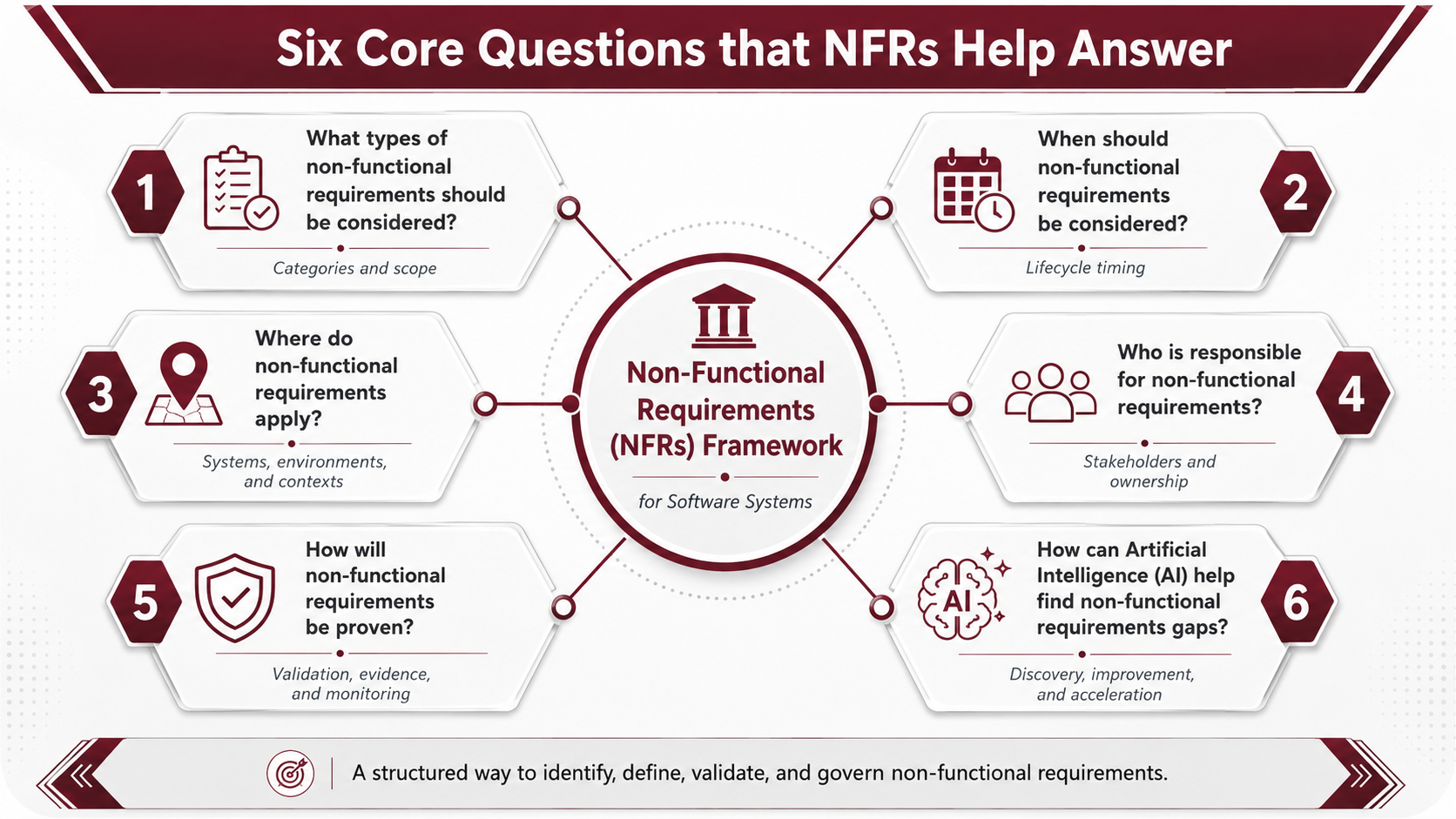
Figure: The Six Core Questions that Non-Functional Requirements (NFRs) Help Answer.
What types of non-functional requirements should be considered?
Teams should consider NFRs across a broad set of categories, including deployment platform, availability, reliability, recoverability, Disaster Recovery (DR), resilience, safety, performance, scalability, security, software supply chain security, responsible AI, privacy, compliance, data quality, retention, observability, operability, maintainability, deployability, testability, usability, accessibility, interoperability, portability, compatibility, configurability, auditability, cost, sustainability, localization, and governance.
The purpose of this question is to prevent narrow discovery. A team should not stop after identifying the most obvious NFRs. Instead, it should scan the full framework and decide which categories are applicable, which are not applicable, which require stakeholder input, and which require further analysis before a final requirement can be written.
When should non-functional requirements be considered?
NFRs should be considered early and continuously across the Software Development Lifecycle (SDLC). They should influence discovery, planning, architecture, design, development, testing, validation, deployment, production operation, modernization, enhancement, and retirement. They should also be revisited when business criticality changes, user volume changes, data sensitivity changes, integrations change, regulations change, platforms change, or incidents reveal new risks.
The timing matters because many NFRs affect foundational decisions. If an NFR is discovered only after design or implementation, the team may need to redesign, re-platform, rebuild, retest, renegotiate vendor responsibilities, change operational procedures, or accept risk. Early consideration reduces rework and supports better tradeoff decisions.
Where do non-functional requirements apply?
NFRs apply to software systems, user interfaces, services, microservices, APIs, integrations, data stores, data pipelines, event streams, batch jobs, AI agents, workflow platforms, infrastructure automation, cloud workloads, vendor-hosted solutions, and operational processes. They also apply across environments such as development, test, Systems Integration Testing (SIT), User Acceptance Testing (UAT), staging, production, Disaster Recovery (DR), and shared or coexisting platforms.
This question helps teams avoid applying NFRs only to the visible application. For example, a performance requirement may apply to the user interface, API, database query, message queue, integration partner, reporting layer, and monitoring dashboard. A privacy requirement may apply to input forms, logs, backups, analytics exports, AI prompts, AI outputs, and support workflows. A validation requirement may apply to pre-production tests, production monitoring, and audit evidence.
Who is responsible for non-functional requirements?
Responsibility for NFRs is shared, but accountability should be explicit. Product owners, architects, engineers, testers, security teams, privacy teams, compliance teams, operations teams, data owners, support teams, vendors, governance bodies, and executives may all have responsibilities depending on the NFR category and system context.
Each important NFR should have an owner or accountable stakeholder. Ownership does not mean one person does all the work. It means someone is responsible for ensuring that the requirement is clear, measurable where appropriate, feasible, reviewed, implemented, validated, evidenced, and governed. Ownership should also include who can approve exceptions, accept residual risk, or require remediation.
How will non-functional requirements be proven?
NFRs should be proven through defined validation methods and evidence sources. Validation may include testing, review, analysis, inspection, simulation, monitoring, scanning, audit, stakeholder approval, production telemetry, or operational exercises. Evidence may include test reports, dashboards, logs, configuration reviews, scan results, architecture decisions, audit records, service-level reports, exception records, and approval artifacts.
For NFRs that use measurable targets, teams should define the indicator, target, measurement window, tolerance, and evidence source. For example, an availability NFR may use an uptime Service Level Indicator (SLI), a monthly Service Level Objective (SLO), a monitoring system as the evidence source, and an error-budget policy for governance. A performance NFR may use latency percentiles, a load profile, a performance test report, and production monitoring trends.
How can Artificial Intelligence (AI) help find non-functional requirements gaps?
Artificial Intelligence (AI) can help teams scan the framework, generate candidate NFRs, identify missing categories, compare NFRs against solution context, make vague requirements more measurable, suggest validation methods, identify evidence expectations, propose standards alignment, and generate formal requirements templates or Agile backlog entries. AI can also review existing requirements content and highlight NFRs that are missing, weak, unmeasurable, untestable, unvalidated, or unsupported by evidence.
AI should not be treated as the final authority for NFRs. AI-generated requirements, validation methods, backlog entries, tests, templates, standards mappings, and code must be reviewed by qualified stakeholders. The best use of AI is to accelerate discovery and improve completeness while preserving human accountability for decisions, approvals, risk acceptance, and governance.
How to cite this page
When referencing this page in academic work, internal standards, or external publications, include the page title, IF4IT as publisher, the URL, and your access date.
Example (informal web citation):
International Foundation for Information Technology (IF4IT). Six Core Questions that Non-Functional Requirements (NFRs) Help Answer | Non-Functional Requirements (NFRs) Framework for Software Systems. https://if4it.org/best-practices/non-functional-requirements-nfrs-framework-for-software-systems/six-core-questions-that-non-functional-requirements-nfrs-help-answer/ (accessed 2026-06-23).
See About Us for content governance and site-wide citation guidance.
Copyright for the International Foundation for Information Technology (IF4IT): 2008 - Present
Legal Disclaimers